Introduction
Tocotrienols are a lesser-known part of the vitamin E family. Most people are familiar with regular vitamin E, called tocopherols, which are commonly found in supplements. Tocotrienols are different. While they still belong to the vitamin E group, they behave very differently inside the body.
Instead of acting only as antioxidants, tocotrienols interact with important systems inside cells. These systems control how cells grow, survive, repair themselves, and respond to stress. Because of this, researchers have been studying tocotrienols for their potential role in cancer biology.
This page explains, in simple language, how tocotrienols affect cancer cells, the immune system, and the environment around tumors. The goal is to make a complex topic easy to understand without removing the important details.
This is educational information only and not medical advice.
What Makes Cancer Difficult to Control
Cancer is not just a group of abnormal cells growing out of control. It is a complex system that adapts, survives, and protects itself.
Cancer cells can:
- Grow faster than normal cells
- Avoid signals that tell them to stop
- Escape detection by the immune system
- Create their own blood supply
- Spread to other parts of the body
In addition, cancer builds a supportive environment around itself. This includes nearby cells, blood vessels, and signaling molecules that help it survive.
Because of this, targeting cancer is difficult. If only one pathway or process is blocked, cancer can often adapt and use another pathway to survive.
This is where compounds like tocotrienols become interesting. Instead of targeting just one pathway, they affect many systems at the same time.
What Are Tocotrienols
Tocotrienols are one of two main forms of vitamin E. The other form is tocopherols.
There are four types of tocotrienols:
- Alpha
- Beta
- Gamma
- Delta
The gamma and delta forms are the most studied in cancer-related research.
The key difference between tocotrienols and regular vitamin E is how they behave inside the body. Tocopherols mostly act as antioxidants, meaning they help neutralize damage from free radicals.
Tocotrienols, on the other hand, can:
- Enter cell membranes more easily
- Interact with signaling pathways
- Influence how cells respond to stress
Because of this, they are often described as more active at the cellular level.
The Tumor Microenvironment Explained Simply
To understand how tocotrienols work, it is important to understand the tumor microenvironment.
The tumor microenvironment is everything around the cancer cells. It includes:
- Blood vessels that supply nutrients
- Immune cells that may attack or ignore the tumor
- Support cells like fibroblasts
- Structural material called the extracellular matrix
Cancer cells depend on this environment. They use it to:
- Get oxygen and nutrients
- Hide from the immune system
- Move and spread
If this environment is disrupted, cancer becomes weaker and less able to survive.
Tocotrienols affect many parts of this environment.
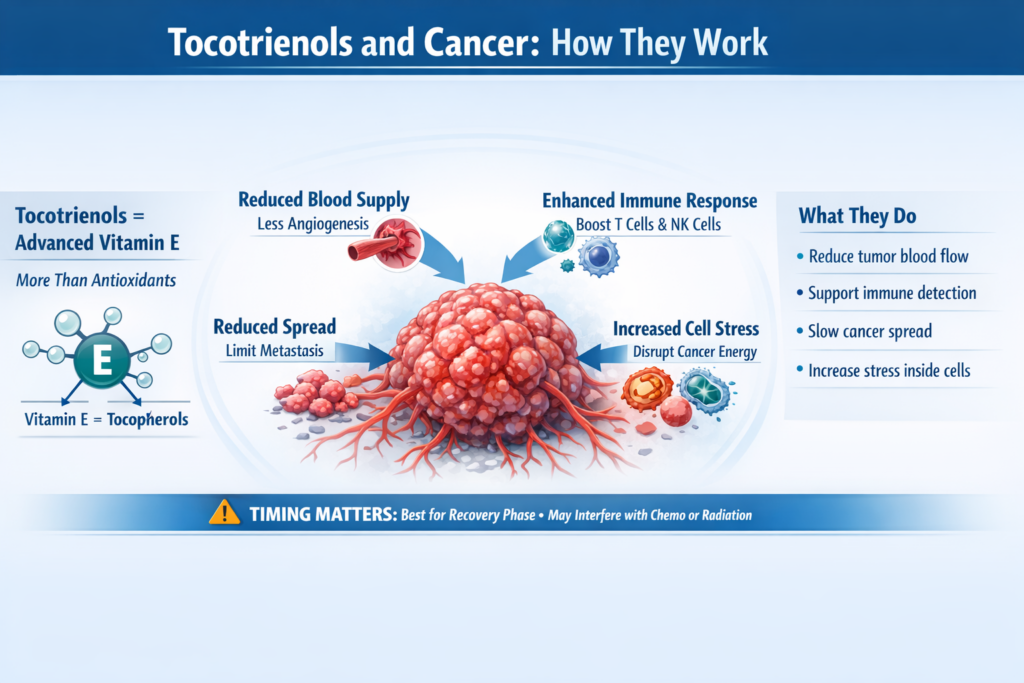
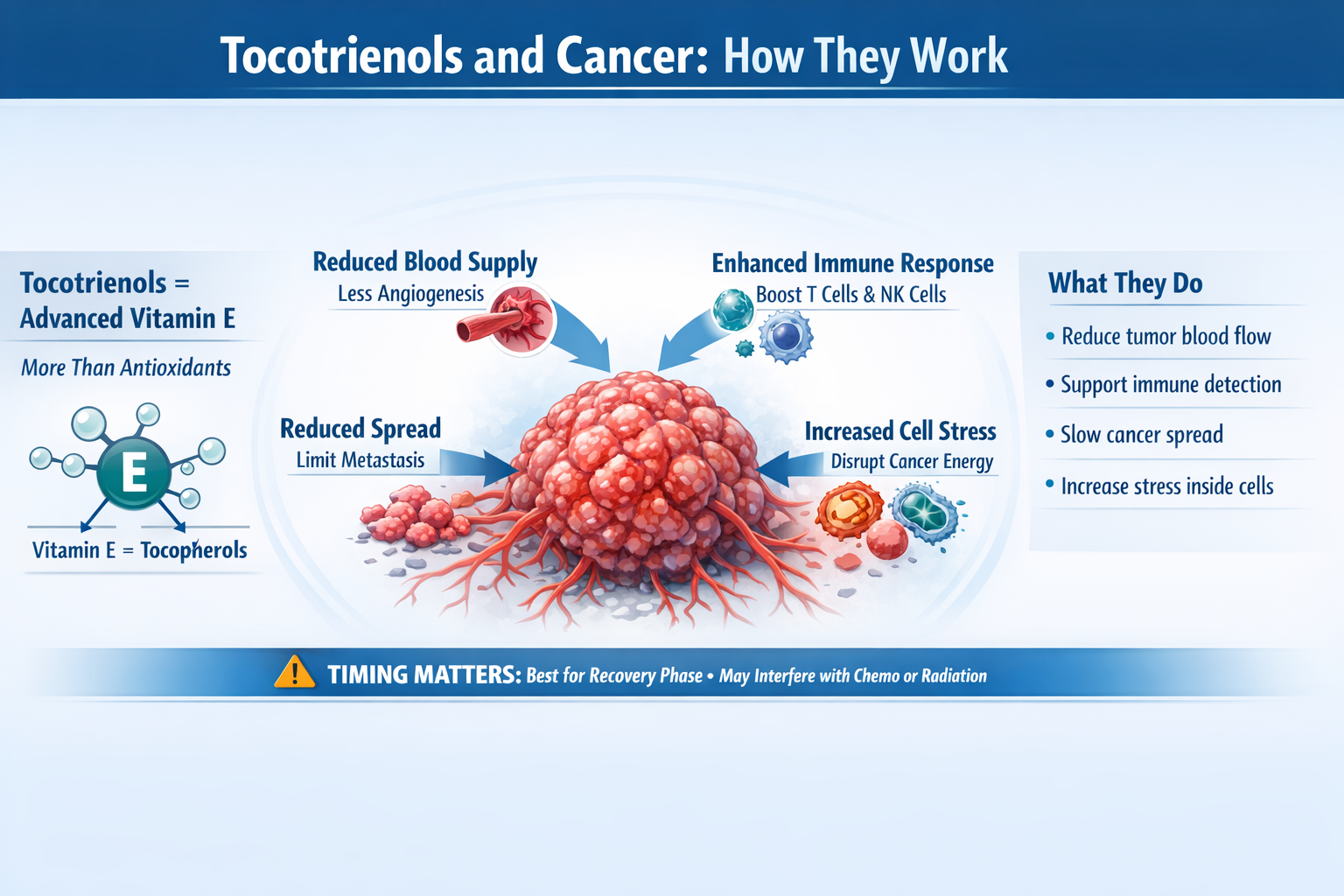
How Tocotrienols Affect Blood Supply
Tumors need a constant supply of blood to grow. They create new blood vessels through a process called angiogenesis.
This process is controlled by signals, especially one called VEGF (vascular endothelial growth factor).
Tocotrienols can reduce VEGF levels. When this happens:
- Fewer new blood vessels are formed
- Existing vessels may function less effectively
As a result:
- The tumor receives less oxygen
- The tumor receives fewer nutrients
This can slow down tumor growth and make cancer cells more vulnerable.
How Tocotrienols Affect the Immune System
The immune system is designed to find and remove abnormal cells. However, cancer can avoid detection by creating signals that suppress immune activity.
Tocotrienols may help reduce these suppressive signals.
They can:
- Lower inflammatory signals that protect tumors
- Support the activity of T cells, which attack abnormal cells
- Support natural killer (NK) cells, which destroy damaged or cancerous cells
They may also reduce signals that allow cancer cells to hide from the immune system.
This does not mean they “boost” the immune system in a general way. Instead, they may help the immune system recognize and respond to cancer more effectively.
How Tocotrienols Affect Cancer Spread
For cancer to spread, it must break through surrounding tissue and move into other areas of the body.
To do this, cancer uses enzymes that break down tissue. These enzymes are called MMPs (matrix metalloproteinases).
Tocotrienols can reduce the activity of these enzymes.
When this happens:
- Tissue remains more intact
- Cancer cells have a harder time moving
- Spread to other areas may be reduced
They may also affect how cancer cells attach to surfaces, which is another step needed for spreading.
How Tocotrienols Disrupt Cancer Support Systems
Cancer cells do not survive on their own. They depend on nearby support cells.
These support cells release signals that help cancer:
- Grow
- Avoid damage
- Repair itself
Tocotrienols can reduce these signals.
They can affect:
- Fibroblasts, which support tumor growth
- Stromal cells, which help create a protective environment
- Cytokines, which are signaling molecules
When these support systems are weakened, cancer cells lose part of their advantage.
How Tocotrienols Increase Stress Inside Cancer Cells
Cancer cells are already under stress because they grow quickly and use a lot of energy.
Tocotrienols can increase this stress in several ways.
They can:
- Increase reactive oxygen species (ROS), which are damaging molecules
- Disrupt energy production in cells
- Interfere with protein handling systems
When stress becomes too high, cancer cells cannot keep up.
This can lead to:
- Loss of function
- Damage to important cell structures
- Activation of cell death processes
How Tocotrienols Affect Cell Survival
Cells have systems that decide whether they survive or die. Cancer cells often disable the signals that would normally cause them to die.
Tocotrienols can influence these systems.
They can:
- Reduce survival signals inside the cell
- Increase signals that lead to programmed cell death
There are different types of cell death, including:
- Apoptosis, which is a controlled form of cell death
- Autophagy, which is a cleanup process that can become harmful if overactivated
By shifting the balance, tocotrienols can make it harder for cancer cells to continue surviving.
Why Targeting Multiple Pathways Matters
One of the biggest challenges in cancer is adaptation.
If a treatment blocks only one pathway, cancer can often:
- Activate a different pathway
- Change its behavior
- Become resistant
Tocotrienols affect multiple pathways at once.
These include pathways related to:
- Growth
- Survival
- Inflammation
- Energy use
By affecting several systems at the same time, it becomes more difficult for cancer to adapt.
Important Considerations
While tocotrienols show interesting effects in research, there are important limitations.
Most studies are:
- Laboratory studies using cells
- Animal studies
Human research is still limited.
Another important point is that tocotrienols can act in different ways depending on the situation.
They can:
- Increase stress in cancer cells
- Act as antioxidants in other contexts
Some cancer treatments, such as chemotherapy and radiation, rely on oxidative stress to damage cancer cells.
Because of this, timing and context may matter. Interactions with treatments are still being studied.
Final Summary
Tocotrienols are a unique form of vitamin E that behave differently from standard supplements.
In simple terms, they may:
- Reduce blood supply to tumors
- Support the immune system’s ability to respond
- Slow down cancer spread
- Disrupt the environment cancer depends on
- Increase stress inside cancer cells
- Shift cells toward death rather than survival
Instead of targeting one single process, they affect multiple systems at the same time.
This makes them a subject of ongoing research in cancer biology.
Disclaimer
This content is for educational purposes only.
It is not medical advice, diagnosis, or treatment.
Tocotrienols are not a replacement for medical care, chemotherapy, radiation, or any prescribed treatment.
Always consult a qualified healthcare professional before making any changes related to health or treatment.