What This Page Explains
This page explains:
- What a circulating tumor cell (CTC) is
- How cancer cells enter the bloodstream
- Why the bloodstream is dangerous for cancer
- Why most cancer cells die
- How a small number survive
- Why this process matters in cancer spread
What Is a Circulating Tumor Cell?
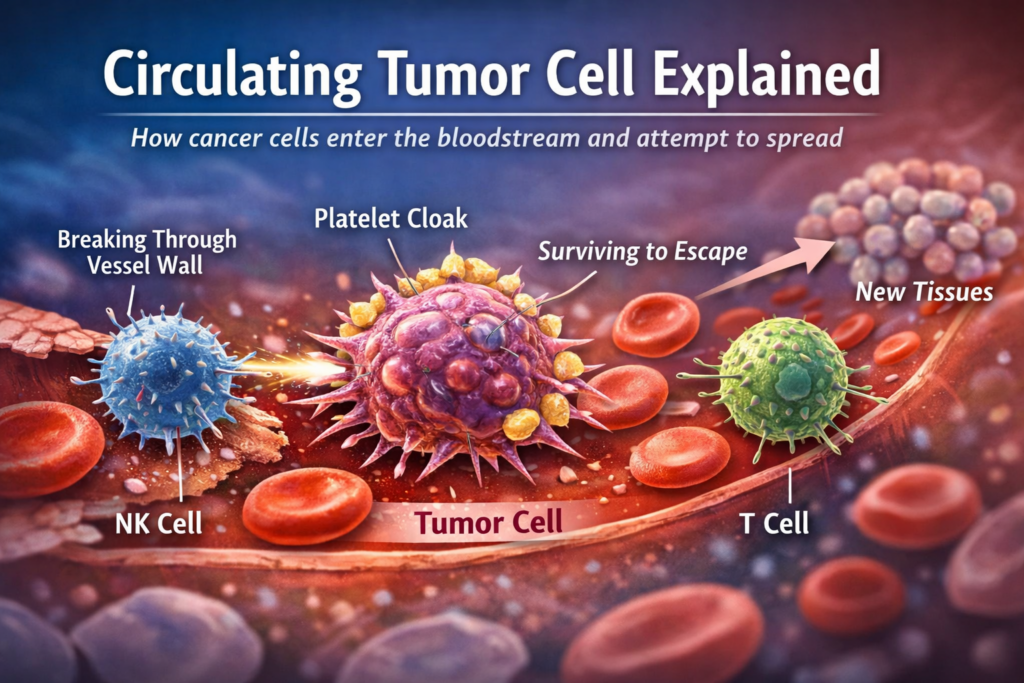
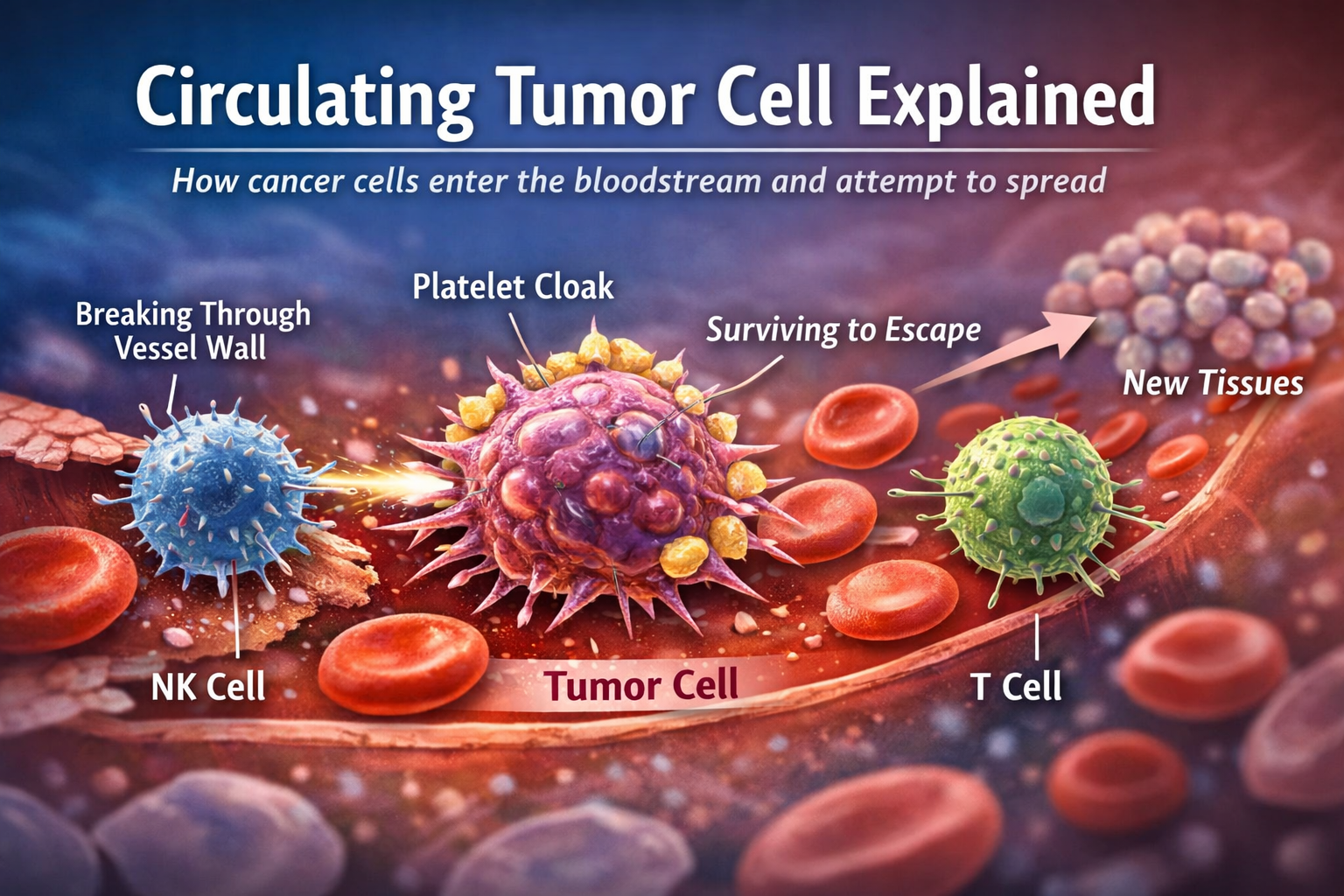
A circulating tumor cell (CTC) is a cancer cell that has broken away from a tumor and entered the bloodstream.
Instead of staying in one place, this cell is now traveling through the body.
Think of it like this:
- The tumor is the main location
- A circulating tumor cell is a cell that escapes and travels
These cells are the starting point of cancer spreading to other areas of the body.
This process is explained in more detail here:
https://helping4cancer.com/metastasis-how-cancer-spreads/
Why Circulating Tumor Cells Matter
Cancer does not become dangerous because it stays in one place.
It becomes dangerous when it spreads.
Circulating tumor cells are the first step in that process.
Without them:
- Cancer stays local
With them:
- Cancer can move
- Cancer can form new tumors
This is called metastasis.
How Cancer Cells Enter the Bloodstream
Cancer cells do not randomly fall into the blood.
They go through specific changes that allow them to escape.
Step 1: Losing Their Grip
Normal cells stick tightly together.
Cancer cells lose this ability.
This allows them to detach from the tumor.
Step 2: Becoming More Mobile
Cancer cells change their structure so they can move.
This process is often called EMT.
A simple way to understand this:
👉 The cell becomes more flexible and less attached
Learn more here:
https://helping4cancer.com/emt-cancer/
Step 3: Breaking Into Blood Vessels
Cancer cells push through the walls of nearby blood vessels.
Once inside the bloodstream, they are now:
👉 Circulating tumor cells
The Bloodstream Is a Dangerous Place
The bloodstream is not a safe place for cancer cells.
It is one of the most dangerous environments they will face.
Physical Stress
Blood moves quickly.
This creates strong forces that can damage cells.
Many cancer cells are destroyed just from this stress.
Lack of Support
In a tumor, cancer cells are supported by surrounding tissue.
In the bloodstream, they are alone.
This makes survival much harder.
Oxygen and Pressure Changes
Cells are exposed to different oxygen levels and pressure.
This creates stress and damage.
The Immune System Attacks Immediately
Your immune system constantly monitors the blood.
Two main types of cells are responsible for attacking cancer:
Natural Killer (NK) Cells
These are fast responders.
They attack anything that looks abnormal right away.
They do not need time to learn the target.
T Cells
These are more precise.
They recognize specific markers on cancer cells and attack them.
They are slower than NK cells but more targeted.
Learn more about how this works:
https://helping4cancer.com/cancer-immune-system/
Most Circulating Tumor Cells Die
This is one of the most important facts:
Most cancer cells do not survive in the bloodstream
In fact:
- The majority are destroyed within hours
- The immune system eliminates most of them
- Only a very small number survive
This means cancer spread is not easy.
It requires multiple survival advantages.
How Some Cancer Cells Survive
Even though most die, a small number survive.
These are the cells that can lead to metastasis.
1. Hiding From the Immune System
Cancer cells can reduce signals that immune cells use to detect them.
This makes them harder to find.
2. Using Platelets as Protection
Cancer cells can cover themselves with platelets.
Platelets are normal blood cells.
This creates a shield that helps cancer hide.
3. Traveling in Groups
Clusters of cancer cells survive better than single cells.
They protect each other and are harder to destroy.
4. Becoming More Flexible
Flexible cells handle blood flow stress better.
This improves survival.
The Role of Cancer Survival Mechanisms
Cancer cells that survive are not normal.
They have adapted.
These adaptations include:
- Immune evasion
- Structural flexibility
- Stress resistance
- Metabolic adaptation
Learn more about survival strategies:
https://helping4cancer.com/cancer-survival-mechanisms/
What Happens After Survival?
If a circulating tumor cell survives, it can:
- Exit the bloodstream
- Enter new tissue
- Stay hidden
- Or begin growing
This next step is called dissemination.
It is covered here:
https://helping4cancer.com/cancer-extravasation
The Transition to Dormancy
Many surviving cancer cells do not grow right away.
Instead, they enter a state called dormancy.
In dormancy:
- Cells stop dividing
- Cells conserve energy
- Cells avoid the immune system
Learn more here:
https://helping4cancer.com/cancer-dormancy-late-recurrence/
Important Reality About Cancer Spread
Here is the key idea:
Cancer spreads not because all cells survive
but because a few do
This changes how we think about cancer.
It is not just about growth.
It is about:
- Survival
- adaptation
- evasion
How This Connects to the Bigger Picture
Circulating tumor cells are just the beginning.
They connect to many other processes:
- Immune evasion → https://helping4cancer.com/cancer-immune-evasion
- Dormancy → https://helping4cancer.com/cancer-dormancy
- Autophagy → https://helping4cancer.com/autophagy-cancer-survival
- Growth control → https://helping4cancer.com/p38-erk-cancer
They are part of a larger system that determines whether cancer spreads.
Key Takeaways
- A circulating tumor cell is a cancer cell in the bloodstream
- Most circulating tumor cells die quickly
- The immune system attacks immediately
- Only a small number survive
- These surviving cells can spread cancer
External References
National Cancer Institute – Metastasis Overview
https://www.cancer.gov/about-cancer/understanding/what-is-cancer
Nature Reviews Cancer – Circulating Tumor Cells
https://www.nature.com/articles/nrc.2017.15
Frontiers in Oncology – Tumor Cell Dissemination
https://www.frontiersin.org/articles/10.3389/fonc.2019.00019/full
Continue Learning
Next page:
👉 https://helping4cancer.com/cancer-bloodstream-survival
Also explore:
- https://helping4cancer.com/nk-t-cell-cancer
- https://helping4cancer.com/cancer-immune-evasion
- https://helping4cancer.com/cancer-dormancy
- https://helping4cancer.com/autophagy-cancer-survival