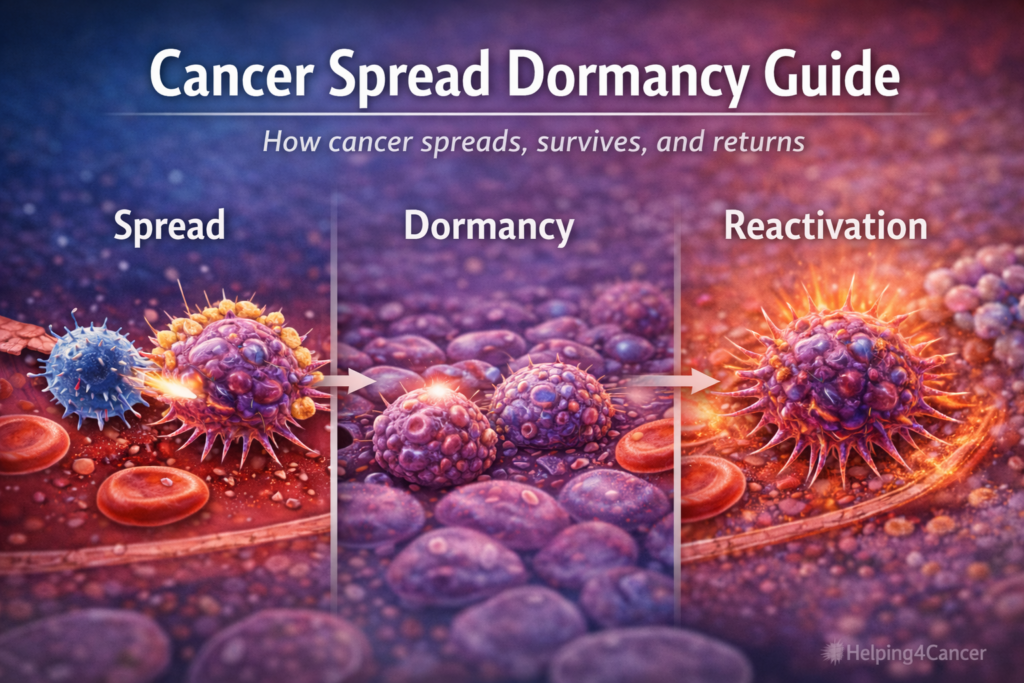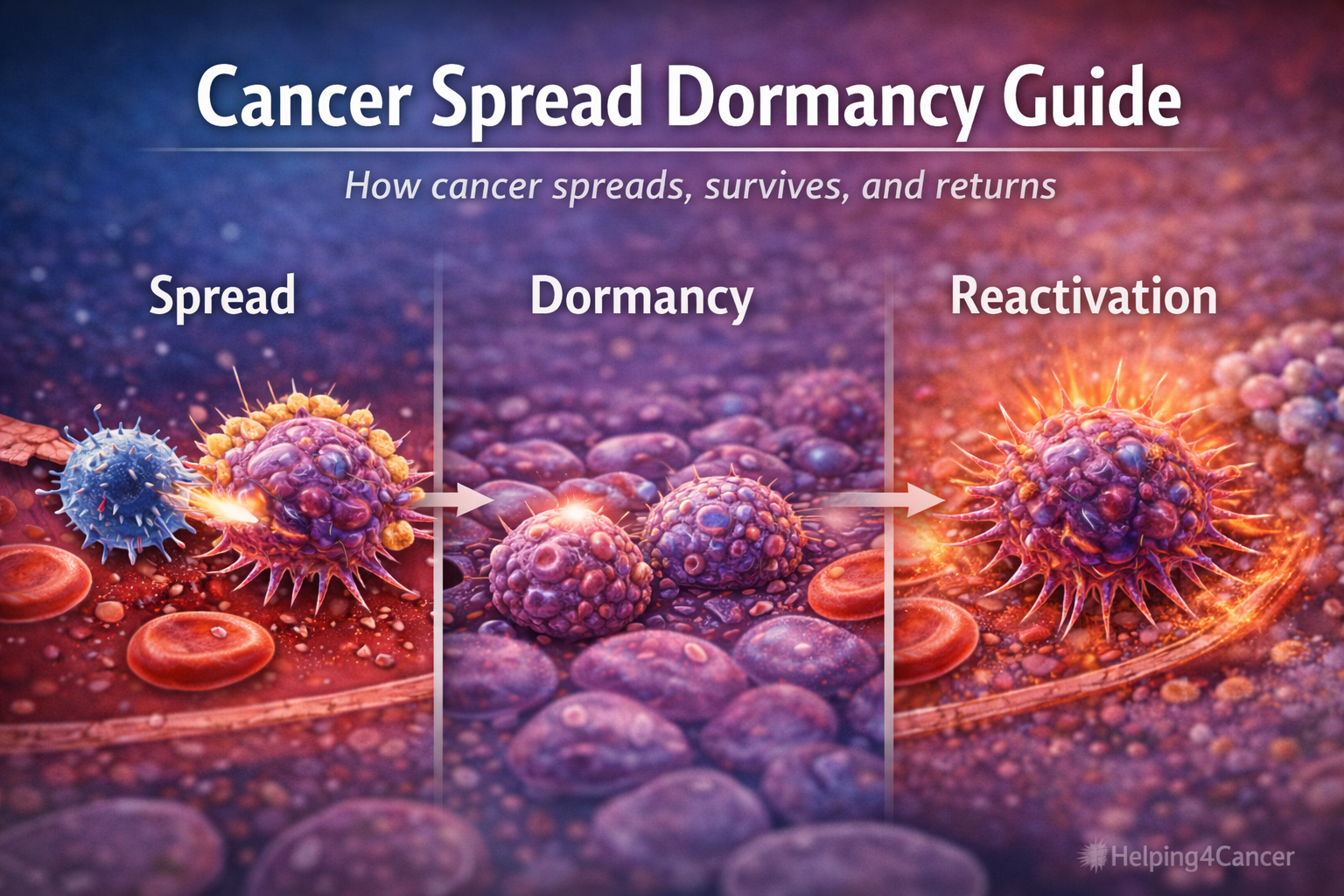
What This Page Explains
This page explains:
- How cancer spreads through the body
- Why most cancer cells die
- How some cells survive
- How cancer hides from the immune system
- What cancer dormancy is
- Why cancer can return years later
- How all these systems connect
The Most Important Truth About Cancer
Most people think cancer spreads because it grows fast.
That is not the full picture.
Cancer spreads because a small number of cells survive long enough
Not all cells.
Not most cells.
👉 Only a few.
Step 1: Cancer Cells Escape the Tumor
Cancer begins in one location.
For it to spread, cells must break away.
These cells become:
👉 Circulating tumor cells
Learn more:
https://www.helping4cancer.com/circulating-tumor-cell
What Makes This Possible?
Cancer cells change:
- They loosen from nearby cells
- They become more flexible
- They gain the ability to move
This process is linked to:
https://www.helping4cancer.com/emt-cancer
Step 2: Cancer Enters the Bloodstream
Once cancer cells enter the bloodstream, they face extreme danger.
Learn more:
https://www.helping4cancer.com/cancer-bloodstream-survival
Why This Step Is So Difficult
In the bloodstream:
- Cells are exposed to strong forces
- Immune cells attack immediately
- There is no support system
The Critical Reality
Most cancer cells die at this stage
This is one of the most important facts in cancer biology.
Step 3: The Immune System Attacks
Your immune system constantly monitors for abnormal cells.
The two most important defenders are:
- NK cells
- T cells
Learn more:
https://www.helping4cancer.com/nk-t-cell-cancer
What They Do
- NK cells attack quickly
- T cells attack precisely
Together, they form a powerful defense system.
Step 4: How Cancer Survives the Immune System
If cancer is detected, it is destroyed.
So for cancer to survive, it must hide.
Learn more:
https://www.helping4cancer.com/cancer-immune-evasion
Common Survival Strategies
Cancer cells can:
- Hide identifying markers
- Block immune signals
- Use platelets as a shield
- Suppress immune activity
Step 5: Leaving the Bloodstream
If a cancer cell survives, it can leave the bloodstream.
This is called extravasation.
Learn more:
https://www.helping4cancer.com/cancer-extravasation
What Happens Next?
The cell enters new tissue and becomes:
👉 A disseminated tumor cell
Learn more:
https://www.helping4cancer.com/disseminated-tumor-cell
Step 6: Dormancy (The Hidden Phase)
This is one of the most misunderstood parts of cancer.
Many cancer cells do not grow right away.
Instead, they enter:
👉 Dormancy
Learn more:
https://www.helping4cancer.com/cancer-dormancy
What Dormancy Means
- The cell stops dividing
- The cell survives in a low-energy state
- The immune system keeps it controlled
Why This Matters
Dormant cancer cells can remain in the body for:
- Months
- Years
- Even decades
Step 7: How Cancer Survives Dormancy
Dormant cells are not inactive.
They are actively surviving.
Key Survival Mechanism: Autophagy
Autophagy is a process where cells recycle their own components.
Learn more:
https://www.helping4cancer.com/autophagy-cancer-survival
What This Does
- Provides energy
- Removes damage
- Helps avoid immune detection
Step 8: The Growth vs Sleep Switch (p38 vs ERK)
Cancer cells are controlled by signaling pathways.
One of the most important is:
👉 p38 vs ERK
Learn more:
https://www.helping4cancer.com/p38-erk-cancer
What This Means
- p38 → keeps cells in dormancy
- ERK → triggers growth
Step 9: The Tumor Environment Controls Everything
Cancer does not act alone.
It is influenced by its environment.
Learn more:
https://www.helping4cancer.com/tumor-microenvironment/
Key Factors
- Low oxygen (hypoxia)
👉 https://www.helping4cancer.com/tumor-hypoxia-hif1a - Lactate buildup
👉 https://www.helping4cancer.com/cancer-lactate-acid - Adenosine suppression
👉 https://www.helping4cancer.com/cancer-adenosine-immune
These conditions weaken the immune system.
Step 10: Mechanical and Structural Changes
Cancer cells also change physically.
Learn more:
https://www.helping4cancer.com/cancer-mechanical-evasion
What This Does
- Makes cells softer
- Helps them avoid immune attack
- Allows movement through tissue
Step 11: Dormancy Signaling Networks
Dormancy is controlled by multiple pathways:
- TGF-beta
👉 https://www.helping4cancer.com/tgf-beta-cancer - BMP
👉 https://www.helping4cancer.com/bmp-cancer-dormancy - GAS6 / AXL
👉 https://www.helping4cancer.com/gas6-axl-cancer
These signals keep cancer cells in a controlled state.
Step 12: Why Cancer Comes Back
Cancer does not always return because it was gone.
It returns because it was hidden.
Reactivation Happens When:
- Immune control weakens
- The environment changes
- Growth signals increase
Learn more:
https://www.helping4cancer.com/cancer-reactivation-recurrence
The Full Picture (Simple Summary)
Cancer spread is not a single event.
It is a process:
- Cells escape
- Cells enter the bloodstream
- Most die
- Some survive
- Cells hide
- Cells enter dormancy
- Cells adapt
- Cells may reactivate
The Most Important Concept
Cancer is not always growing
Most of the time, it is hiding and surviving
How This All Connects
This page connects to every major system:
- Circulating tumor cells
→ https://www.helping4cancer.com/circulating-tumor-cell - Bloodstream survival
→ https://www.helping4cancer.com/cancer-bloodstream-survival - Immune system
→ https://www.helping4cancer.com/nk-t-cell-cancer - Immune evasion
→ https://www.helping4cancer.com/cancer-immune-evasion - Dormancy
→ https://www.helping4cancer.com/cancer-dormancy
Key Takeaways
- Cancer spreads through surviving cells, not all cells
- Most cancer cells die in the bloodstream
- The immune system plays a major role
- Cancer survives by hiding and adapting
- Dormancy allows cancer to remain for years
- Recurrence happens when dormant cells reactivate
External References
National Cancer Institute
https://www.cancer.gov/about-cancer/understanding/what-is-cancer
Nature Reviews Cancer
https://www.nature.com/articles/nrc.2017.15
Frontiers in Oncology
https://www.frontiersin.org/articles/10.3389/fonc.2019.00019/full
Continue Learning
Start with:
👉 https://www.helping4cancer.com/circulating-tumor-cell
Then follow the full guide step-by-step through each page.