What This Page Explains
This page explains:
- What extravasation is
- How cancer cells leave the bloodstream
- How cancer cells attach to blood vessels
- How they enter new tissue
- Why this step is critical for metastasis
- What happens after cancer enters tissue
What Is Extravasation?
Extravasation is the process where a cancer cell leaves the bloodstream and enters nearby tissue.
It is one of the most important steps in cancer spread.
Simple Explanation
- Cancer enters the blood
- Cancer travels through the body
- Cancer exits the blood
- Cancer enters a new location
👉 That exit step is extravasation
How This Connects to Previous Steps
From earlier pages:
- Circulating tumor cells
👉 https://www.helping4cancer.com/circulating-tumor-cell - Bloodstream survival
👉 https://www.helping4cancer.com/cancer-bloodstream-survival - Immune evasion
👉 https://www.helping4cancer.com/cancer-immune-evasion
Only cells that survive these steps can reach extravasation.
Why Extravasation Is Difficult
Leaving the bloodstream is not easy.
Cancer cells must:
- Stop moving in fast blood flow
- Attach to the vessel wall
- Break through the vessel lining
- Enter surrounding tissue
Step 1: Slowing Down in the Bloodstream
Blood flows quickly.
Cancer cells must slow down first.
How They Do This
- They interact with blood vessel walls
- They get trapped in small capillaries
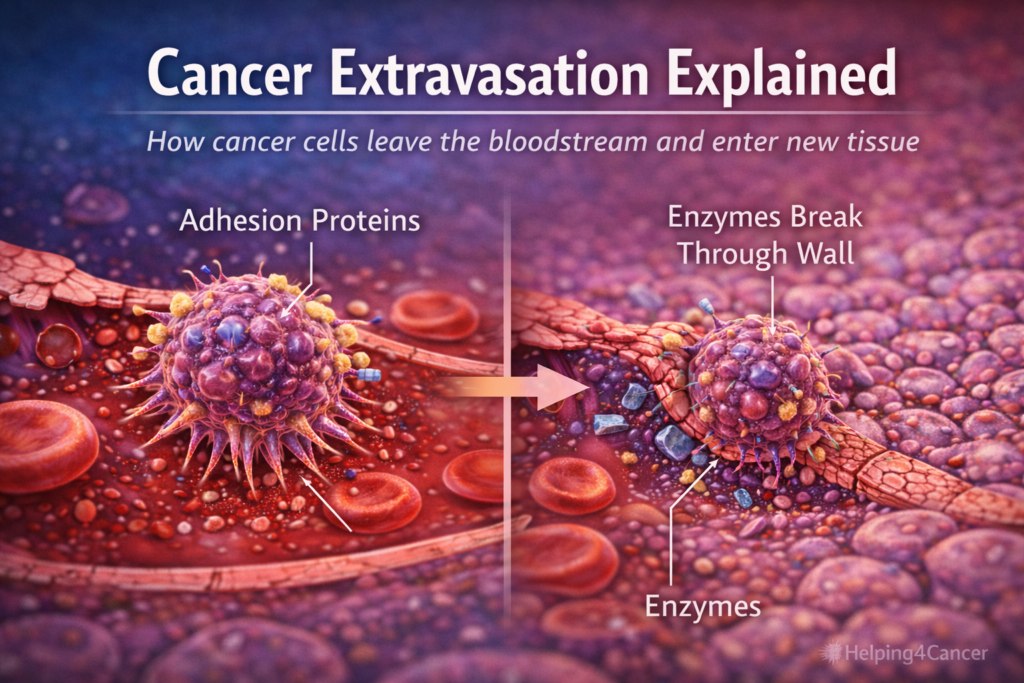
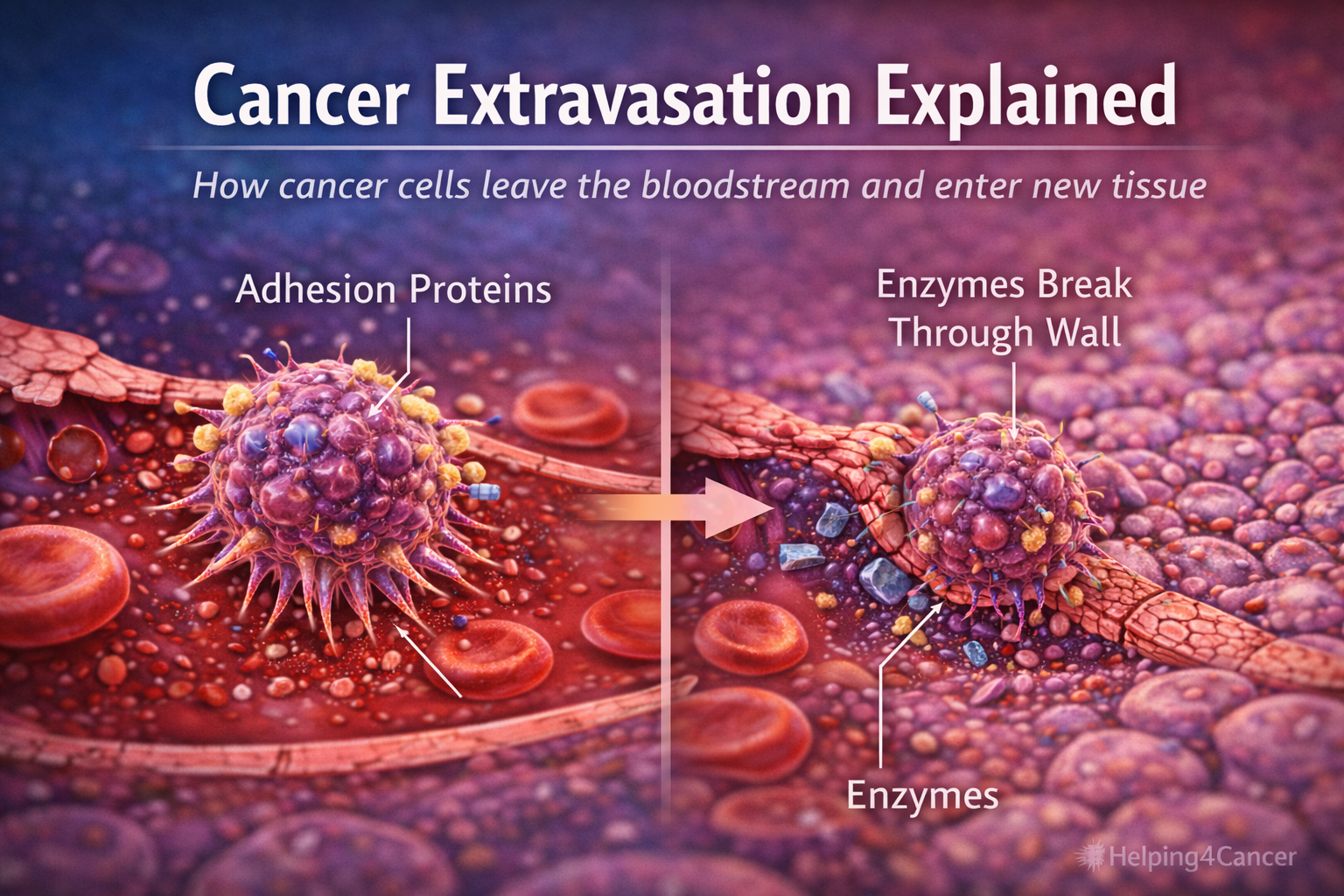
- They use adhesion molecules
Step 2: Attaching to the Blood Vessel Wall
Cancer cells must stick to the inside of blood vessels.
Key Tools
- Integrins
- Selectins
- Adhesion proteins
Why This Matters
Without attachment:
👉 The cell keeps moving and cannot exit
Step 3: Breaking Through the Vessel Wall
Blood vessels are lined with endothelial cells.
This creates a barrier.
Cancer’s Solution
Cancer cells release enzymes that break down this barrier.
These include:
- Matrix metalloproteinases (MMPs)
Result
- The vessel wall weakens
- Cancer cells push through
Step 4: Moving Into New Tissue
Once through the vessel wall:
👉 The cancer cell enters surrounding tissue
This is where it becomes:
👉 A disseminated tumor cell
Learn more:
👉 https://www.helping4cancer.com/disseminated-tumor-cell
Why Location Matters
Cancer does not spread randomly.
Certain cancers prefer certain organs.
Examples
- Breast cancer → bone, lung
- Colon cancer → liver
- Prostate cancer → bone
Why This Happens
Cancer cells follow chemical signals.
These signals guide them to specific tissues.
The Role of Chemokines
Chemokines are signaling molecules.
They act like:
👉 Directional signals
Cancer cells use these signals to:
- Find favorable environments
- Move toward specific organs
What Happens After Extravasation?
Once inside new tissue, the cancer cell faces a new problem.
The New Challenges
- Immune surveillance
- Lack of nutrients
- Unfamiliar environment
The Critical Decision
After entering tissue, cancer cells have two options:
1. Grow Immediately (Rare)
- Rapid tumor formation
- Requires strong support
2. Enter Dormancy (Common)
- Stop dividing
- Hide from the immune system
- Survive long-term
Learn more:
👉 https://www.helping4cancer.com/cancer-dormancy
Why Dormancy Is More Common
New environments are harsh.
Cancer cells often cannot grow right away.
So Instead They:
- Slow down
- Adapt
- Survive
The Importance of Disseminated Tumor Cells
After extravasation, cancer cells become:
👉 Disseminated tumor cells (DTCs)
Learn more:
👉 https://www.helping4cancer.com/disseminated-tumor-cell
The Connection to Metastasis
Extravasation is required for metastasis.
Without it:
👉 Cancer cannot form new tumors
The Full Chain (So Far)
- Cancer cells escape tumor
- Enter bloodstream
- Most die
- Some survive
- Cells leave bloodstream (extravasation)
- Cells enter new tissue
What Determines Success?
For cancer to spread successfully, it must:
- Survive immune attack
- Attach to vessels
- Break through barriers
- Adapt to new tissue
The Most Important Concept
Extravasation is the gateway to metastasis
Without it:
👉 Cancer cannot spread
How This Connects to the Bigger System
This page connects to:
- Circulating tumor cells
→ https://www.helping4cancer.com/circulating-tumor-cell - Bloodstream survival
→ https://www.helping4cancer.com/cancer-bloodstream-survival - Immune evasion
→ https://www.helping4cancer.com/cancer-immune-evasion - Dormancy
→ https://www.helping4cancer.com/cancer-dormancy
What Comes Next
After extravasation:
👉 Cancer enters a hidden survival phase
This is called:
👉 Disseminated tumor cells
Next page:
👉 https://www.helping4cancer.com/disseminated-tumor-cell
Key Takeaways
- Extravasation is how cancer leaves the bloodstream
- Cancer cells must attach to blood vessel walls
- They break through using enzymes
- They enter new tissue and become DTCs
- This step is required for metastasis
- Most cells enter dormancy after this stage
External References
National Cancer Institute
https://www.cancer.gov/about-cancer/understanding/what-is-cancer
Nature Reviews Cancer – Metastasis
https://www.nature.com/articles/nrc.2017.15
Frontiers in Oncology
https://www.frontiersin.org/articles/10.3389/fonc.2019.00019/full
Continue Learning
Next page:
👉 https://www.helping4cancer.com/disseminated-tumor-cell
Also explore:
- https://www.helping4cancer.com/cancer-dormancy
- https://www.helping4cancer.com/autophagy-cancer-survival
- https://www.helping4cancer.com/p38-erk-cancer