What This Page Explains
This page explains:
- How cancer cells control their energy
- How cancer survives low oxygen conditions
- How cancer changes its environment
- How metabolism helps cancer avoid the immune system
- How this connects to dormancy and recurrence
What Is Metabolic Evasion?
Metabolic evasion is how cancer cells change the way they use energy to survive.
Simple Explanation
- Normal cells use energy in a standard way
- Cancer cells change how they use energy
- This helps them survive stress
Why Cancer Needs Metabolic Adaptation
From previous pages:
- Cancer spreads
👉 https://www.helping4cancer.com/circulating-tumor-cell - Cancer survives immune attack
👉 https://www.helping4cancer.com/cancer-immune-evasion - Cancer enters dormancy
👉 https://www.helping4cancer.com/cancer-dormancy
At this stage:
👉 Cancer must survive in difficult conditions
The Main Problem: Lack of Resources
Cancer cells often face:
- Low oxygen
- Low nutrients
- High stress
Solution: Metabolic Adaptation
Cancer changes how it produces energy.
The Warburg Effect (Simplified)
Cancer cells often rely on:
👉 Glucose (sugar) for energy
Even when oxygen is available.
Why This Matters
This produces:
- Fast energy
- Waste products like lactate
Learn more:
👉 https://www.helping4cancer.com/cancer-metabolism-explained/
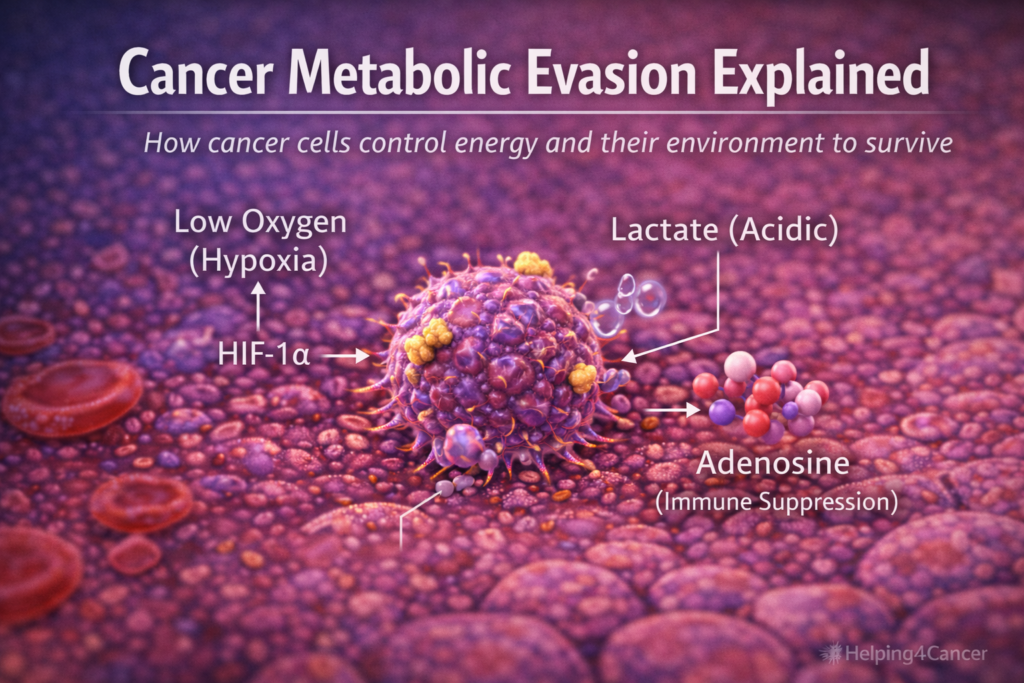
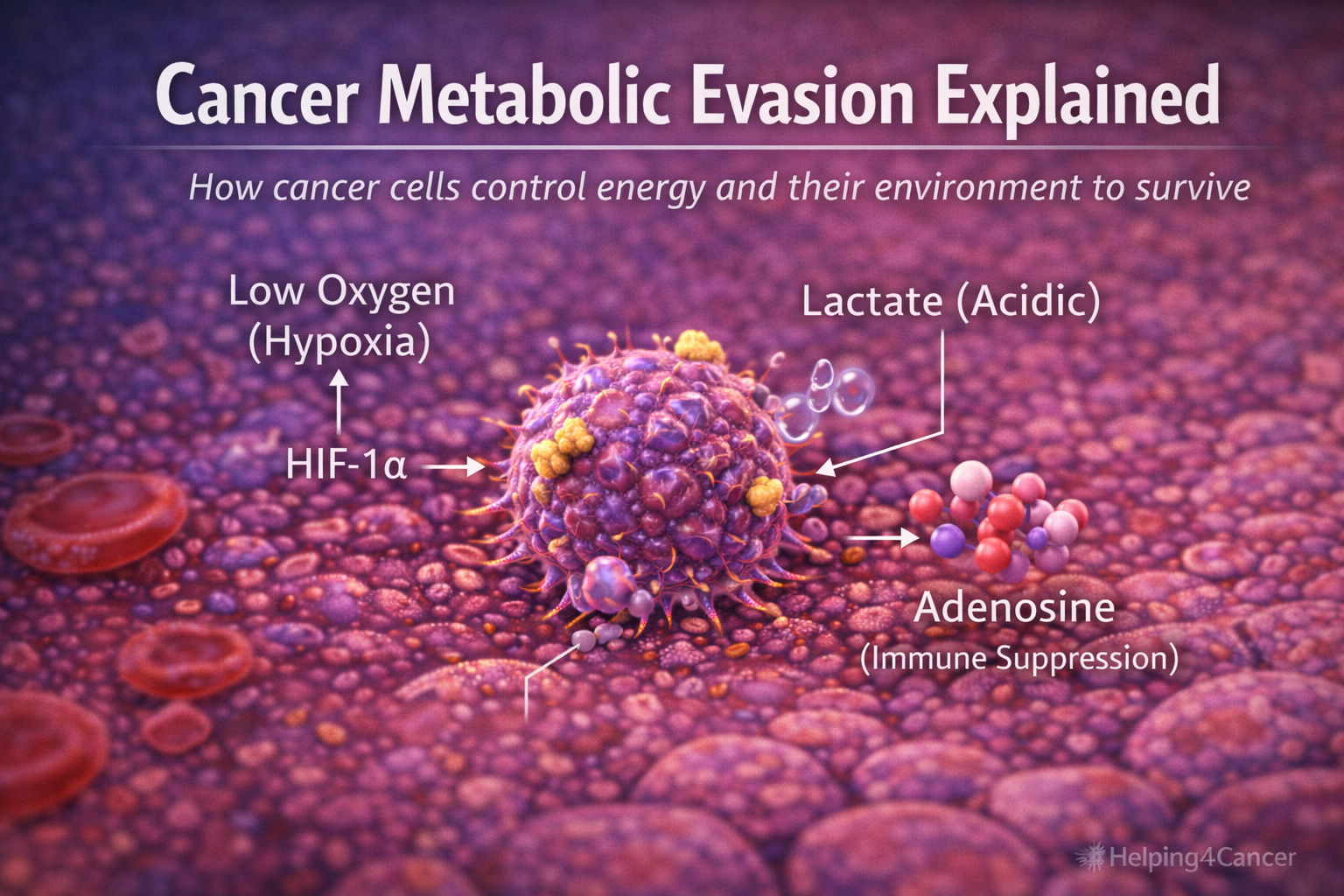
Hypoxia (Low Oxygen)
Many tumors have low oxygen.
Why?
- Poor blood supply
- Rapid growth
Cancer’s Response
Cancer adapts to hypoxia.
Learn more:
👉 https://www.helping4cancer.com/tumor-hypoxia-hif1a
What Hypoxia Does
- Activates survival pathways
- Changes metabolism
- Promotes adaptation
Lactate (Acidic Environment)
Cancer cells produce lactate.
What This Does
- Makes the environment acidic
- Weakens immune cells
- Helps cancer survive
Learn more:
👉 https://www.helping4cancer.com/cancer-lactate-acid
Adenosine (Immune Suppression)
Cancer cells increase adenosine levels.
What This Does
- Suppresses immune cells
- Reduces immune attack
- Helps cancer hide
Learn more:
👉 https://www.helping4cancer.com/cancer-adenosine-immune
The Tumor Microenvironment
Cancer controls its surroundings.
Learn more:
👉 https://www.helping4cancer.com/tumor-microenvironment/
Key Features
- Low oxygen
- Acidic conditions
- Immune suppression
Result
👉 A survival-friendly environment
Connection to Autophagy
When external energy is low:
👉 Cancer uses internal energy
Learn more:
👉 https://www.helping4cancer.com/autophagy-cancer-survival
Combined Effect
- External adaptation (metabolism)
- Internal survival (autophagy)
Connection to Dormancy
Metabolic evasion supports dormancy.
Learn more:
👉 https://www.helping4cancer.com/cancer-dormancy
What Happens
- Low energy demand
- Survival mode
- Long-term persistence
Connection to p38 vs ERK
Energy status affects growth signals.
Learn more:
👉 https://www.helping4cancer.com/p38-erk-cancer
Result
- Low energy → dormancy
- High energy → growth
Why This Is Critical for Cancer Survival
Without metabolic adaptation:
👉 Cancer cells would not survive
The Most Important Concept
Cancer changes its environment to make survival easier
Not just itself.
How This Connects to the Bigger System
This page connects to:
- Autophagy
→ https://www.helping4cancer.com/autophagy-cancer-survival - Dormancy
→ https://www.helping4cancer.com/cancer-dormancy - Immune evasion
→ https://www.helping4cancer.com/cancer-immune-evasion - Reactivation
→ https://www.helping4cancer.com/cancer-reactivation-recurrence
What Comes Next
Next page:
👉 https://www.helping4cancer.com/tumor-hypoxia-hif1a
Key Takeaways
- Cancer adapts how it uses energy
- Hypoxia forces survival changes
- Lactate weakens the immune system
- Adenosine suppresses immune attack
- The tumor environment supports survival
- Metabolic evasion helps dormancy and recurrence
External References
National Cancer Institute
https://www.cancer.gov/about-cancer/understanding/what-is-cancer
Nature Reviews Cancer
https://www.nature.com/articles/nrc.2017.15
Frontiers in Oncology
https://www.frontiersin.org/articles/10.3389/fonc.2019.00019/full
Continue Learning
Next page:
👉 https://www.helping4cancer.com/tumor-hypoxia-hif1a
Also explore:
- https://www.helping4cancer.com/cancer-lactate-acid
- https://www.helping4cancer.com/cancer-adenosine-immune