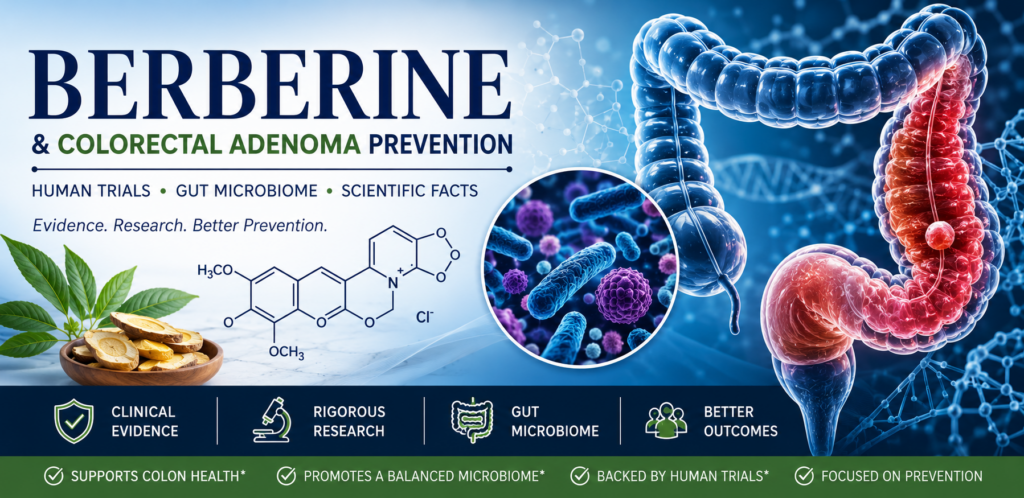
Berberine and Colon Cancer Prevention: Separating Facts From Assumptions
The internet is full of bold claims about berberine.
Some articles say it “kills cancer cells.” Others claim it “feeds good gut bacteria” or “prevents colon cancer.”
The reality is both more interesting and more scientifically sound.
After reviewing the clinical trials, microbiome research, and laboratory studies, one thing becomes clear:
Berberine has promising human evidence—but many of the proposed explanations for how it works remain hypotheses rather than established facts.
This article separates what has actually been proven from what researchers still need to investigate.
The Strongest Human Evidence
The most important study was a randomized, double-blind, placebo-controlled clinical trial involving more than 1,100 adults.
Every participant had previously undergone a colonoscopy where one or more colorectal adenomas (precancerous polyps) had been removed.
Researchers wanted to answer one simple question:
Could berberine reduce the chance that new adenomas would develop?
Participants received either:
- Berberine hydrochloride 300 mg twice daily
- Placebo
Treatment continued for approximately two years.
The Results
The findings were impressive.
Placebo
47% developed another adenoma.
Berberine
36% developed another adenoma.
This represented:
- 11% absolute risk reduction
- Approximately 23% relative risk reduction
This is currently the strongest human evidence supporting berberine for colorectal adenoma prevention.
An Important Distinction
This trial did not show that berberine prevents colorectal cancer.
Why?
Because no participants developed colorectal cancer during the original study.
Instead, researchers measured the recurrence of adenomas.
Adenomas are abnormal growths that increase the risk of future colorectal cancer.
Reducing adenomas is considered encouraging because adenomas are the major precursor lesion for most colorectal cancers.
However:
Reducing adenomas is not the same as proving cancer prevention.
Later Follow-Up
Researchers later followed many of the participants for approximately six years.
Interestingly, the former berberine group continued to have fewer recurrent adenomas.
Although encouraging, this follow-up was observational.
The participants were no longer randomized during this period.
Therefore, the follow-up strengthens the original findings but cannot prove that berberine caused the long-term benefit.
Berberine Changes the Gut Microbiome
Multiple randomized human studies show that berberine changes gut bacteria.
This part is no longer controversial.
However, another common internet claim is less accurate.
Many websites state that berberine “feeds good bacteria.”
Current evidence does not support that statement.
Berberine is not a prebiotic.
It does not nourish bacteria the way resistant starch, inulin, or other fermentable fibers do.
Instead, berberine appears to reshape the microbial ecosystem.
Some bacteria decrease.
Others increase.
The exact pattern varies depending on:
- Diet
- Disease
- Existing microbiome
- Medications
- Individual biology
Researchers now believe microbial function may be more important than simply counting specific bacterial species.
What About Akkermansia?
One bacterium receives enormous attention:
Akkermansia muciniphila
Animal studies frequently show berberine increases Akkermansia.
Researchers think berberine may increase intestinal mucus (MUC2), creating a better environment for Akkermansia.
This is fascinating.
However…
Human studies have not consistently demonstrated this effect.
More importantly:
No human study has shown:
Berberine
↓
Increased Akkermansia
↓
Reduced adenoma recurrence
That entire pathway remains hypothetical.
More on Akkermansia muciniphila https://helping4cancer.com/akkermansia-muciniphila-colon-cancer/
Cancer Pathways
Laboratory studies demonstrate that berberine influences several important cancer pathways including:
- Wnt/β-catenin
- STAT3
- NF-κB
- MAPK
- AMPK
These pathways regulate:
- Cell growth
- Inflammation
- Survival
- Cell death
The laboratory evidence is strong.
However…
The human adenoma trial never measured any of these pathways.
Therefore, researchers cannot honestly say these pathway changes explain the clinical results.
More On Cancer Pathways https://helping4cancer.com/part-4-the-10-cancer-pathways-and-how-to-block-them/
Facts vs. Assumptions
FACTS
✅ Human randomized trial reduced recurrent adenomas.
✅ Human studies show berberine changes the microbiome.
✅ Laboratory studies show berberine affects important cancer pathways.
✅ Animal studies suggest berberine can increase Akkermansia.
ASSUMPTIONS
Berberine reduced adenomas because it changed the microbiome.
Not proven.
Berberine reduced adenomas because it inhibited Wnt/β-catenin.
Not proven.
Berberine increases Akkermansia in humans.
Not consistently demonstrated.
Increasing Akkermansia reduces adenoma recurrence.
Not proven.
Healthy diet plus berberine works better than berberine alone.
Plausible.
Not tested.
Maintaining a healthy microbiome prevents recurrence.
Biologically reasonable.
Not demonstrated in clinical trials.
Why Scientists Think the Microbiome Still Matters
The microbiome influences:
- Immune function
- Inflammation
- Bile acid metabolism
- Production of short-chain fatty acids such as butyrate
- Integrity of the intestinal barrier
All of these processes may influence colorectal cancer risk.
However,
association does not prove causation.
A healthier microbiome may simply be one characteristic of healthier people rather than the direct reason they develop fewer adenomas.
Future studies will need to answer that question.
Where Research Needs to Go
The ideal future study would measure:
- Gut microbiome
- Akkermansia
- Butyrate
- Bile acids
- Colon tissue biomarkers
- Wnt signaling
- STAT3
- Repeat colonoscopy findings
Only then could researchers determine why berberine reduced adenoma recurrence.
Final Thoughts
Berberine is one of the few natural compounds supported by a randomized clinical trial showing a reduction in recurrent colorectal adenomas after polyp removal.
That finding deserves attention.
But the science should not be overstated.
The clinical effect is supported by human evidence.
The mechanism remains an active area of investigation.
Whether berberine works primarily through the gut microbiome, inflammation, cancer signaling pathways, or several mechanisms working together is still unknown.
For now, the most scientifically accurate conclusion is simple:
Berberine has demonstrated a promising preventive effect against recurrent colorectal adenomas in human trials. How it achieves that benefit remains one of the most interesting unanswered questions in colorectal cancer research.
Key Takeaways
- Berberine reduced recurrent colorectal adenomas in a randomized human trial.
- It has not been proven to prevent colorectal cancer.
- Berberine changes the gut microbiome, but it does not simply “feed good bacteria.”
- Proposed mechanisms involving Akkermansia, butyrate, and cancer signaling pathways remain hypotheses.
- More human studies are needed to determine exactly how berberine works.
More On Berberine https://helping4cancer.com/berberine-cancer-protocol/
Research Links
1. Landmark Randomized Clinical Trial (2020)
Berberine versus placebo for the prevention of recurrence of colorectal adenoma: a multicentre, double-blinded, randomised controlled study
https://www.sciencedirect.com/science/article/pii/S2468125319304091
PubMed:
https://pubmed.ncbi.nlm.nih.gov/31926918/
2. Systematic Review & Meta-analysis (2021)
Efficacy and safety of berberine in preventing recurrence of colorectal adenomas
https://www.sciencedirect.com/science/article/pii/S0378874121008461
PubMed:
https://pubmed.ncbi.nlm.nih.gov/34509605/
3. Six-Year Follow-up Study (2025)
Berberine for preventing colorectal adenoma recurrence and neoplasm occurrence: 6-Year follow-up of a randomized clinical trial
https://www.sciencedirect.com/science/article/pii/S2666379125003660
4. Earlier Long-term Report
Long-term effect of berberine in preventing recurrence of colorectal adenomas and neoplasms after endoscopic resection
https://www.sciencedirect.com/science/article/pii/S2666606524004024
These four papers represent the strongest human evidence currently available on berberine and colorectal adenoma prevention.