What This Page Explains
This page explains:
- What andrographis is
- How it affects cancer cells
- How it interacts with dormant cancer cells
- Which survival systems it targets
- Where it may help
- Where it may create risk
- How it fits into a complete strategy
What Is Andrographis?
Andrographis paniculata is a medicinal plant used in traditional medicine.
Key Active Compound
- Andrographolide
Simple Explanation
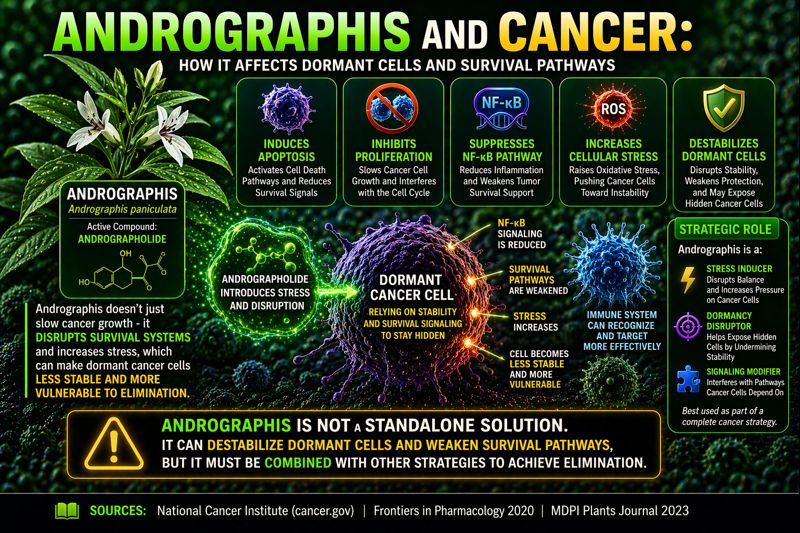
- It increases cellular stress
- It affects signaling pathways
- It can trigger cancer cell death signals
Why Andrographis Matters in Cancer
Cancer cells survive by:
- Avoiding stress
- Maintaining stability
- Using survival signaling
Andrographis does the opposite.
It introduces disruption and stress into these systems.
Where This Fits in the System
Start here:
https://helping4cancer.com/cancer-spread-learning-hub
Andrographis primarily affects:
- Survival signaling
- Inflammation pathways
- Stress response systems
- Dormancy stability
How Andrographis Affects Cancer Cells (Research-Based)
Research on andrographolide shows multiple effects:
1. Induction of Apoptosis (Cell Death Signals)
Studies suggest andrographolide can:
- Activate apoptosis pathways
- Increase pro-death signaling
- Reduce survival signaling
What This Means
Cancer cells may:
- Lose protection
- Become more vulnerable
- Enter programmed death pathways
Important
This effect is stronger in active cancer cells than dormant ones.
2. Inhibition of Proliferation
Cancer cells depend on constant growth signals.
What Andrographis Does
- Reduces proliferation signals
- Interferes with cell cycle progression
Result
- Slows tumor growth
- Limits expansion of active cancer cells
3. NF-κB Pathway Suppression
NF-κB is a major survival and inflammation pathway.
What Andrographis Does
- Inhibits NF-κB signaling
- Reduces inflammation
- Decreases survival signaling
Result
- Less protection for cancer cells
- Reduced inflammatory support for tumors
4. Oxidative Stress Modulation
Andrographis can increase cellular stress.
What It Does
- Increases reactive oxygen species (ROS) in some conditions
- Pushes cells toward stress thresholds
Result
- Cancer cells experience higher stress
- May trigger damage or instability
How Andrographis Affects Dormant Cancer Cells
Dormant cancer cells are different from active ones.
They survive by:
- Staying stable
- Avoiding stress
- Maintaining low activity
Andrographis disrupts this balance.
1. Destabilizing Dormancy
Dormancy depends on stable signaling.
What Andrographis Does
- Interferes with survival pathways
- Disrupts signaling balance
Result
Dormant cells may:
- Lose stability
- Become more active
- Become vulnerable
2. Increasing Cellular Stress
Dormant cells avoid stress to survive.
What Andrographis Does
- Introduces stress signals
- Disrupts protective balance
Result
Cells may:
- Struggle to maintain dormancy
- Become easier to target
3. Interference with Survival Signaling
Dormant cells rely on pathways like:
- NF-κB
- TGF-beta
- Survival cascades
Learn more:
https://helping4cancer.com/tgf-beta-cancer/
What Andrographis Does
- Reduces protective signaling
- Weakens survival mechanisms
Result
Cells become less protected.
Where Andrographis Can Help
Andrographis may help when:
- Destabilizing dormant cancer cells
- Increasing stress within tumor cells
- Reducing inflammation-driven survival
- Supporting combination strategies
Where Andrographis Can Harm (Critical Section)
This is extremely important.
1. Dormant Cell Reactivation Risk
When dormant cells are destabilized:
- They may not die
- They may reactivate instead
Result
- Increased growth potential
- Increased risk if not controlled
2. Stress Without Elimination
If cells are stressed but not removed:
- They may adapt
- They may become more resistant
3. Inflammation Variability
While andrographis often reduces inflammation:
- In some contexts it may increase immune activity
- This can create unpredictable responses
4. Not a Complete Solution
Andrographis does NOT:
- Fully eliminate cancer cells
- Replace immune function
- Replace metabolic targeting
Strategic Role of Andrographis
Andrographis is best understood as:
- A stress inducer
- A dormancy disruptor
- A signaling modifier
How It Fits Into a Complete Strategy
From the system:
https://helping4cancer.com/cancer-spread-learning-hub
Step 1: Destabilize Dormancy
✔ Andrographis helps
Step 2: Remove Survival Systems
✔ Andrographis helps
Step 3: Eliminate Cells
✘ Andrographis does NOT complete this
Why Andrographis Alone Is Not Enough
Andrographis can:
- Increase stress
- Weaken survival systems
But it does NOT:
- Eliminate cancer cells
- Replace immune elimination
- Replace treatment
Key Takeaways
- Andrographis increases stress in cancer cells
- It interferes with survival pathways
- It can destabilize dormant cancer cells
- It may trigger apoptosis in active cells
- It carries risk of reactivation if used alone
- It must be used within a structured strategy
External References
National Cancer Institute
https://www.cancer.gov/about-cancer/understanding/what-is-cancer
Frontiers in Pharmacology
https://www.frontiersin.org/articles/10.3389/fphar.2020.00660/full
MDPI Plants Journal
https://www.mdpi.com/2223-7747/12/10/1969
Continue Learning
Main system:
https://helping4cancer.com/cancer-spread-learning-hub
Related pages:
https://helping4cancer.com/berberine-cancer/
https://helping4cancer.com/sulforaphane-cancer/
https://helping4cancer.com/cancer-dormancy/
Disclaimer
This content is for educational purposes only and is not medical advice.