What This Page Explains
This page explains:
- What mechanical evasion is
- How cancer cells change their shape
- Why flexibility helps cancer survive
- How physical changes help avoid immune attack
- How this connects to spread and dormancy
What Is Mechanical Evasion?
Mechanical evasion is how cancer cells physically change their structure to survive.
Simple Explanation
- Cancer cells become softer
- Cancer cells become more flexible
- Cancer cells avoid being destroyed
Why Physical Properties Matter
Most people think cancer is only about biology.
But physical structure is just as important.
Cancer cells must survive:
- Blood flow
- Immune attack
- Movement through tissue
Where This Happens in the Cancer Process
From earlier pages:
- Cancer enters bloodstream
👉 https://www.helping4cancer.com/circulating-tumor-cell - Cancer survives blood flow
👉 https://www.helping4cancer.com/cancer-bloodstream-survival - Cancer exits into tissue
👉 https://www.helping4cancer.com/cancer-extravasation
At every step:
👉 Physical adaptation is required
How Cancer Cells Become More Flexible
Cancer cells change their internal structure.
Key Changes
- Cytoskeleton becomes weaker
- Cell membrane becomes softer
- Shape becomes more adaptable
Result
👉 The cell can deform and squeeze through tight spaces
Why Flexibility Helps Cancer
1. Surviving Blood Flow
Blood flow creates strong forces.
Flexible cells:
- Bend instead of breaking
- Survive longer
2. Moving Through Tissue
Cancer cells must move through dense environments.
Flexible cells:
- Squeeze between cells
- Move through barriers
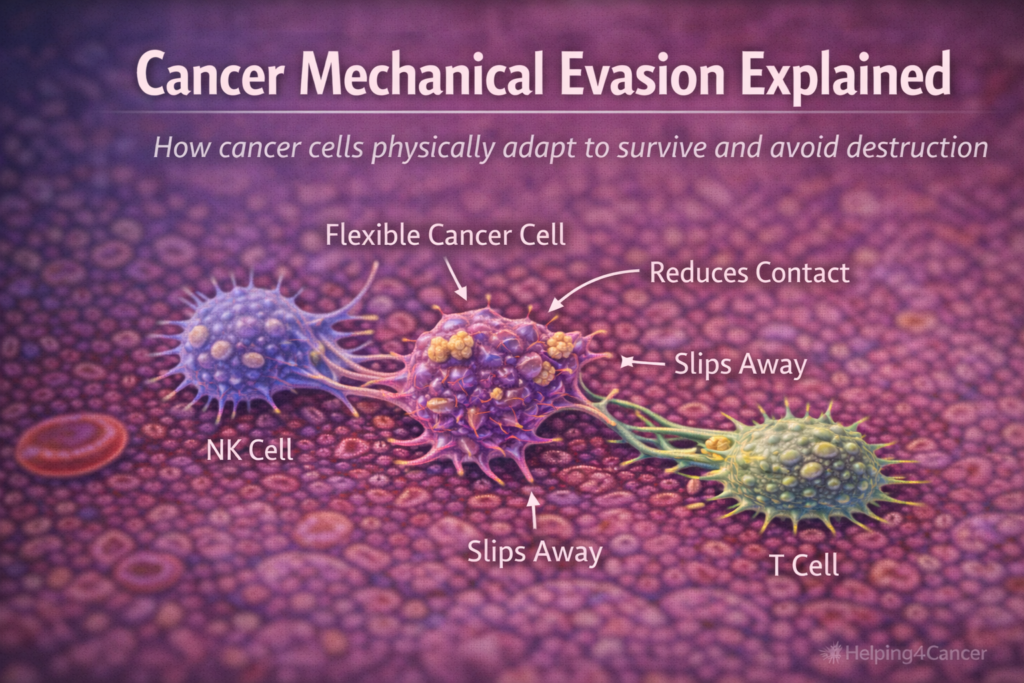
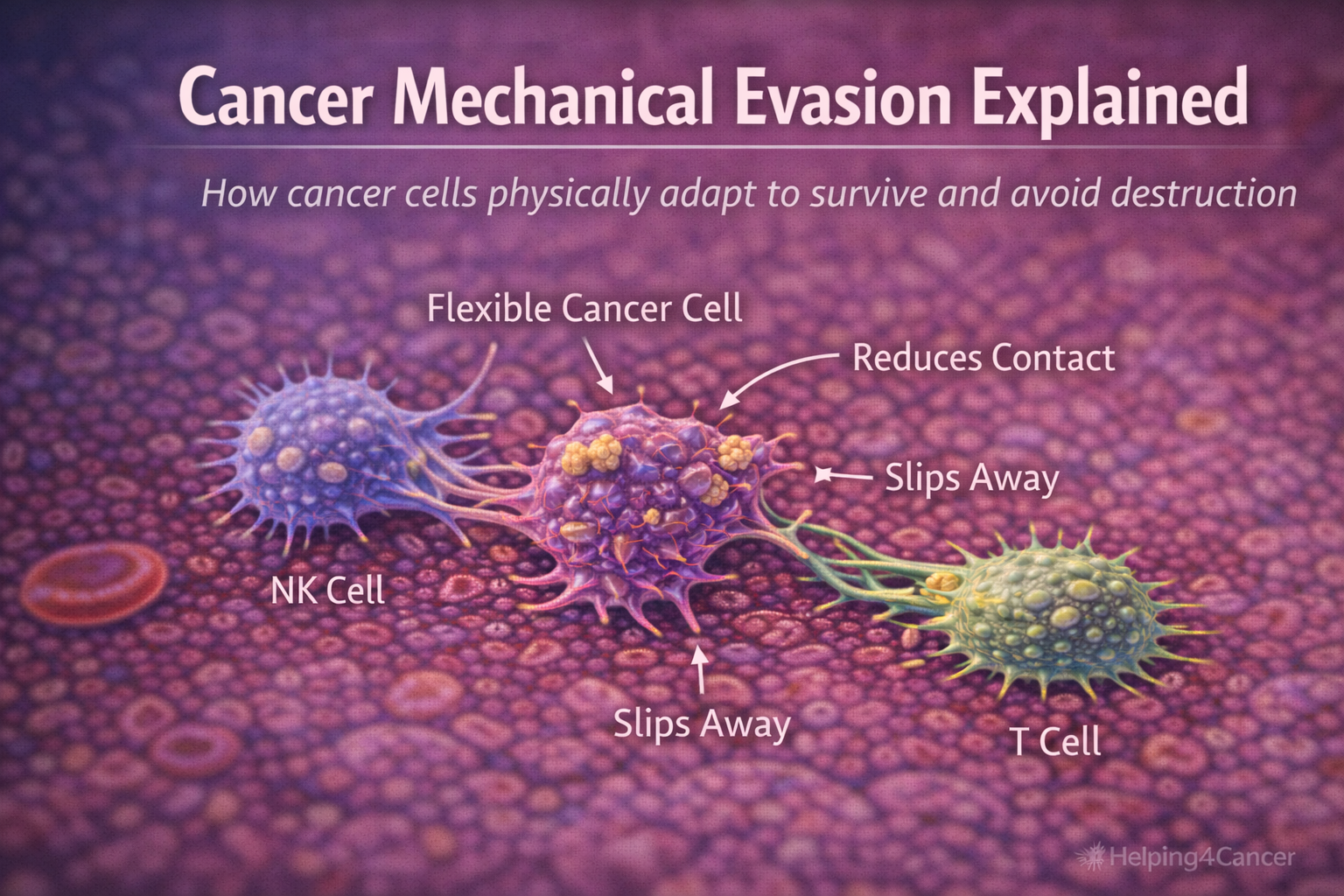
3. Escaping Immune Cells
Immune cells must attach to kill cancer.
Flexible cancer cells:
- Reduce contact
- Slip away
- Avoid destruction
Connection to EMT
Mechanical evasion is closely linked to EMT.
Learn more:
👉 https://www.helping4cancer.com/emt-cancer
What EMT Does
- Increases flexibility
- Reduces cell adhesion
- Improves movement
Connection to Immune Evasion
Mechanical evasion supports immune evasion.
Learn more:
👉 https://www.helping4cancer.com/cancer-immune-evasion
Combined Effect
- Harder to detect
- Harder to attach
- Harder to destroy
Connection to Circulating Tumor Cells
Flexible cells survive better in the bloodstream.
Learn more:
👉 https://www.helping4cancer.com/circulating-tumor-cell
Result
- Higher survival rate
- Increased spread potential
Connection to Dormancy
Mechanical properties also influence dormancy.
Learn more:
👉 https://www.helping4cancer.com/cancer-dormancy
What Happens
- Softer environments support dormancy
- Reduced tension promotes survival
The Role of the Microenvironment
The environment affects cell stiffness.
Learn more:
👉 https://www.helping4cancer.com/tumor-microenvironment/
Key Factors
- Tissue stiffness
- Pressure
- Surrounding cells
Result
👉 Cancer adapts to match its environment
Why This Is Critical for Metastasis
Without mechanical adaptation:
👉 Cancer could not move or survive
With Mechanical Evasion
👉 Cancer becomes more mobile and resilient
The Most Important Concept
Cancer survival is not just biological
It is also physical
How This Connects to the Bigger System
This page connects to:
- EMT
→ https://www.helping4cancer.com/emt-cancer - Circulating tumor cells
→ https://www.helping4cancer.com/circulating-tumor-cell - Immune evasion
→ https://www.helping4cancer.com/cancer-immune-evasion - Dormancy
→ https://www.helping4cancer.com/cancer-dormancy
What Comes Next
Next page:
👉 https://www.helping4cancer.com/emt-cancer
Key Takeaways
- Cancer cells change their physical structure to survive
- Flexibility helps them resist damage
- Softer cells move more easily
- Mechanical changes help avoid immune attack
- Physical adaptation is critical for metastasis
External References
National Cancer Institute
https://www.cancer.gov/about-cancer/understanding/what-is-cancer
Nature Reviews Cancer
https://www.nature.com/articles/nrc.2017.15
Frontiers in Oncology
https://www.frontiersin.org/articles/10.3389/fonc.2019.00019/full
Continue Learning
Next page:
👉 https://www.helping4cancer.com/emt-cancer
Also explore: