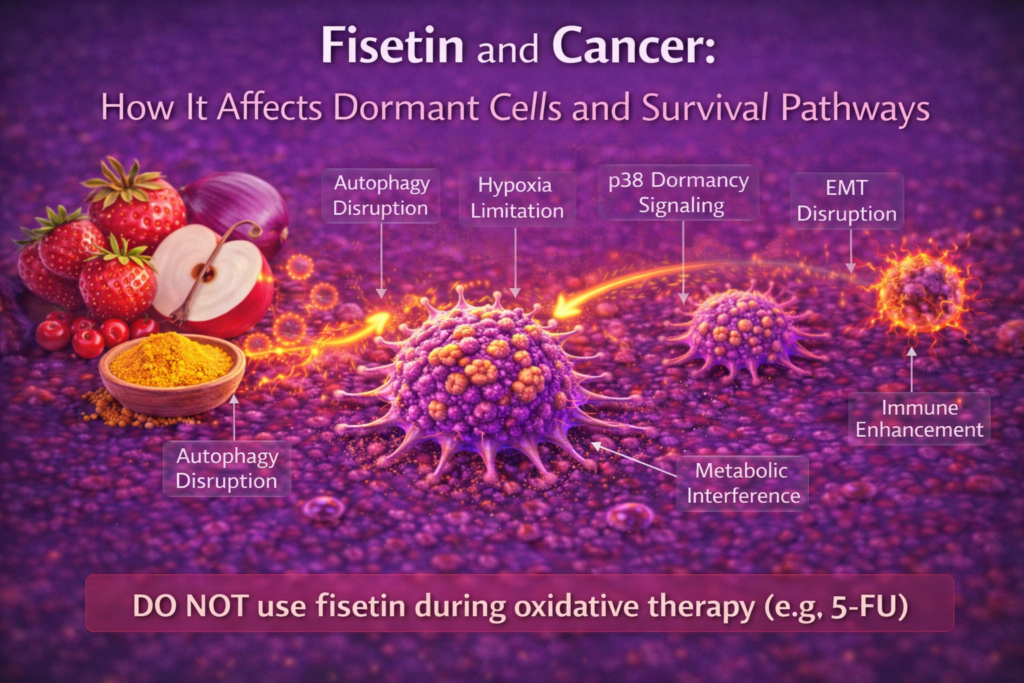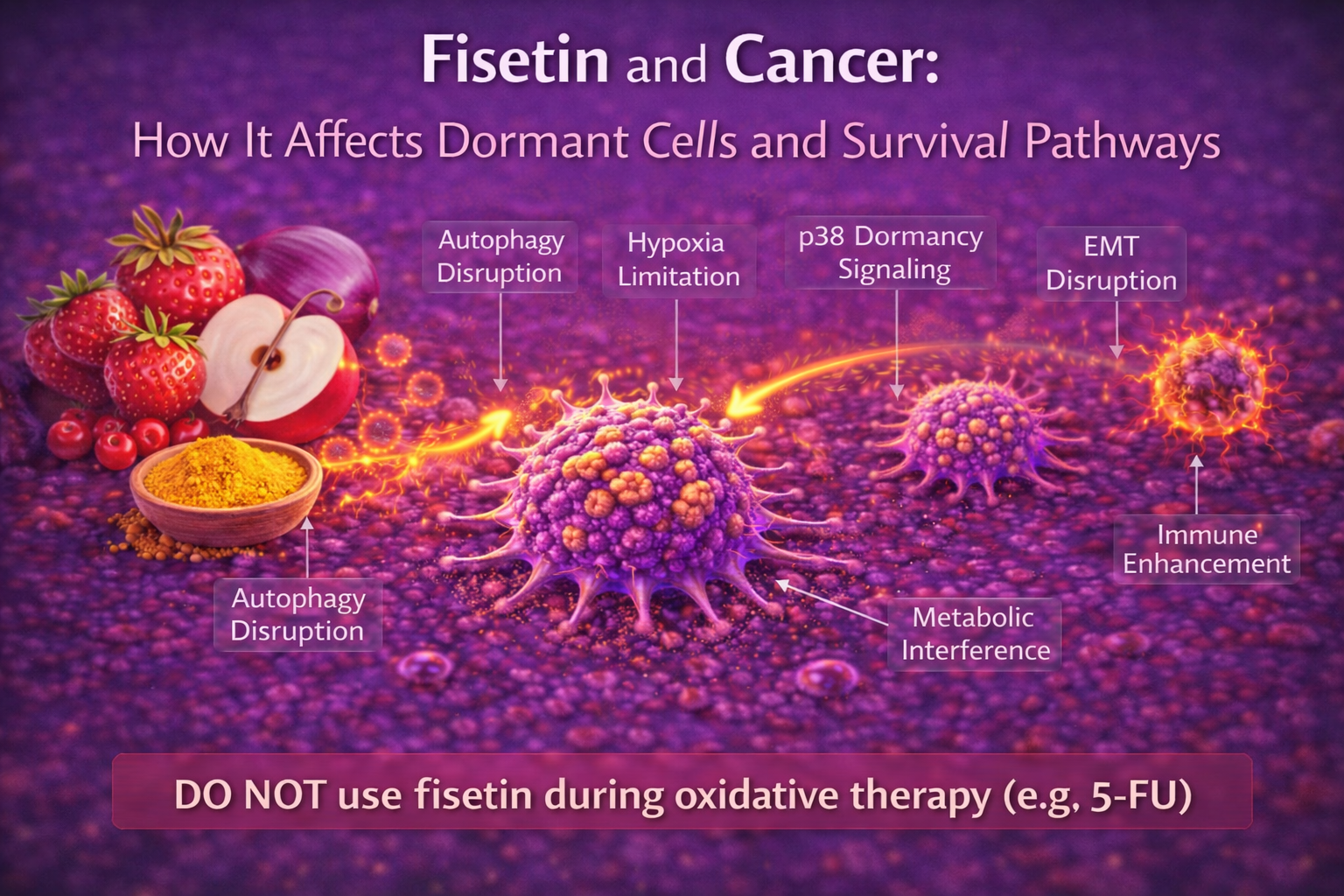
What This Page Explains
This page explains:
- What fisetin is
- How it affects dormant cancer cells
- Which survival systems it targets
- When it may help
- When it may harm
- Why timing is critical
What Is Fisetin?
Fisetin is a plant compound found in foods like strawberries, apples, and onions.
Simple Explanation
- It affects cell signaling
- It influences stress responses
- It interacts with survival pathways
Why Fisetin Matters in Cancer
Fisetin is a multi-target compound.
It interacts with several systems that dormant cancer cells depend on.
Where This Fits in the System
Start here:
Fisetin interacts with:
- Dormancy
- Metabolism
- Immune evasion
- Survival signaling
How Fisetin Affects Dormant Cancer Cells
Dormant cells survive by conserving energy and avoiding stress.
Fisetin can disrupt that balance.
1. Autophagy (Survival Engine)
Dormant cells rely on autophagy to stay alive.
What Fisetin Does
- Interferes with cellular recycling
- Increases internal stress
- Reduces survival efficiency
Result
Dormant cells become less stable.
2. p38 Dormancy Signaling
p38 helps maintain dormancy.
What Fisetin Does
- Modulates signaling balance
- Can destabilize dormancy
Important
This does not eliminate cells.
It weakens stability only.
3. Metabolic Adaptation
Cancer adapts energy use.
What Fisetin Does
- Disrupts metabolic flexibility
- Increases metabolic stress
Result
Cells struggle to survive long-term.
4. Hypoxia (Low Oxygen Survival)
Dormant cells often exist in low oxygen.
What Fisetin Does
- Reduces HIF-1α activity
- Limits adaptation to low oxygen
Result
Cells become more vulnerable.
5. EMT and Flexibility
Cancer cells use EMT to adapt and survive.
What Fisetin Does
- Interferes with EMT signaling
- Reduces flexibility and adaptability
Result
Cells become less capable of surviving stress.
6. Immune Evasion
Dormant cells avoid immune detection.
What Fisetin Does
- Reduces immune suppression signals
- Improves immune visibility
Result
Helps immune cells recognize cancer.
7. Survival Signaling (TGF-beta, AXL, BMP)
https://helping4cancer.com/tgf-beta-cancer/
https://helping4cancer.com/gas6-axl-cancer/
https://helping4cancer.com/bmp-cancer-dormancy/
What Fisetin Does
- Interferes with protective signaling
- Weakens survival pathways
Result
Reduces dormancy stability.
Where Fisetin Can Help
Fisetin may help when:
- Targeting multiple survival pathways
- Increasing stress on dormant cells
- Reducing adaptability
- Supporting immune recognition
Where Fisetin Can Harm (Critical Section)
This is extremely important.
Fisetin Has Antioxidant Properties
It can reduce oxidative stress.
Problem
Some treatments rely on oxidative damage.
DO NOT USE FISETIN DURING ACTIVE OXIDATIVE THERAPY
This includes:
- Chemotherapy using oxidative stress
- Radiation
- 5-FU (fluorouracil) and similar treatments
Why This Matters
These treatments:
- Use oxidative stress to kill cancer cells
- Require high levels of damage
What Fisetin Does
- Reduces oxidative stress
- Protects cells
Result
Fisetin may:
- Reduce treatment effectiveness
- Protect cancer cells
Simple Rule
Do not use antioxidants while oxidants are actively being used to kill cancer cells.
Timing Is Critical
Fisetin is not always helpful.
It Depends On:
- Treatment timing
- Biological state
- System conditions
Strategic Role of Fisetin
Fisetin is best understood as:
- A survival system disruptor
- A stress enhancer
- Not a direct eliminator
How It Fits Into a Complete Strategy
From the system:
Step 1: Destabilize Dormancy
Fisetin helps
Step 2: Remove Survival Systems
Fisetin helps
Step 3: Eliminate Cells
Fisetin does NOT complete this
Why Fisetin Alone Is Not Enough
Fisetin can:
- Increase stress
- Disrupt survival systems
But it does NOT:
- Eliminate cancer cells
- Replace immune function
- Replace treatment
Key Takeaways
- Fisetin targets multiple survival pathways
- It weakens dormant cancer cells
- It reduces adaptability (EMT)
- It disrupts metabolism and signaling
- It may improve immune detection
- It must NOT be used during oxidative therapy
- Timing determines effectiveness
External References
National Cancer Institute
https://www.cancer.gov/about-cancer/understanding/what-is-cancer
Frontiers in Oncology
https://www.frontiersin.org/articles/10.3389/fonc.2019.00019/full
Nature Reviews Cancer
https://www.nature.com/articles/nrc.2017.15
Continue Learning
Main system:
Related pages:
https://helping4cancer.com/autophagy-cancer-survival/
https://helping4cancer.com/cancer-dormancy/
https://helping4cancer.com/cancer-metabolic-evasion/
Disclaimer
This content is for educational purposes only and is not medical advice.