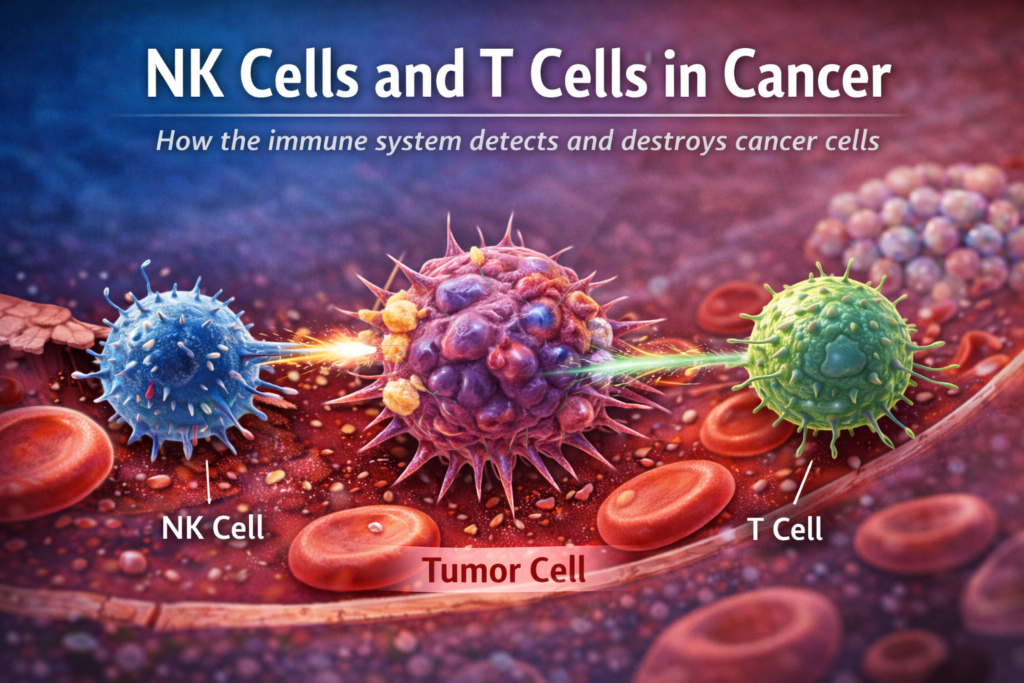
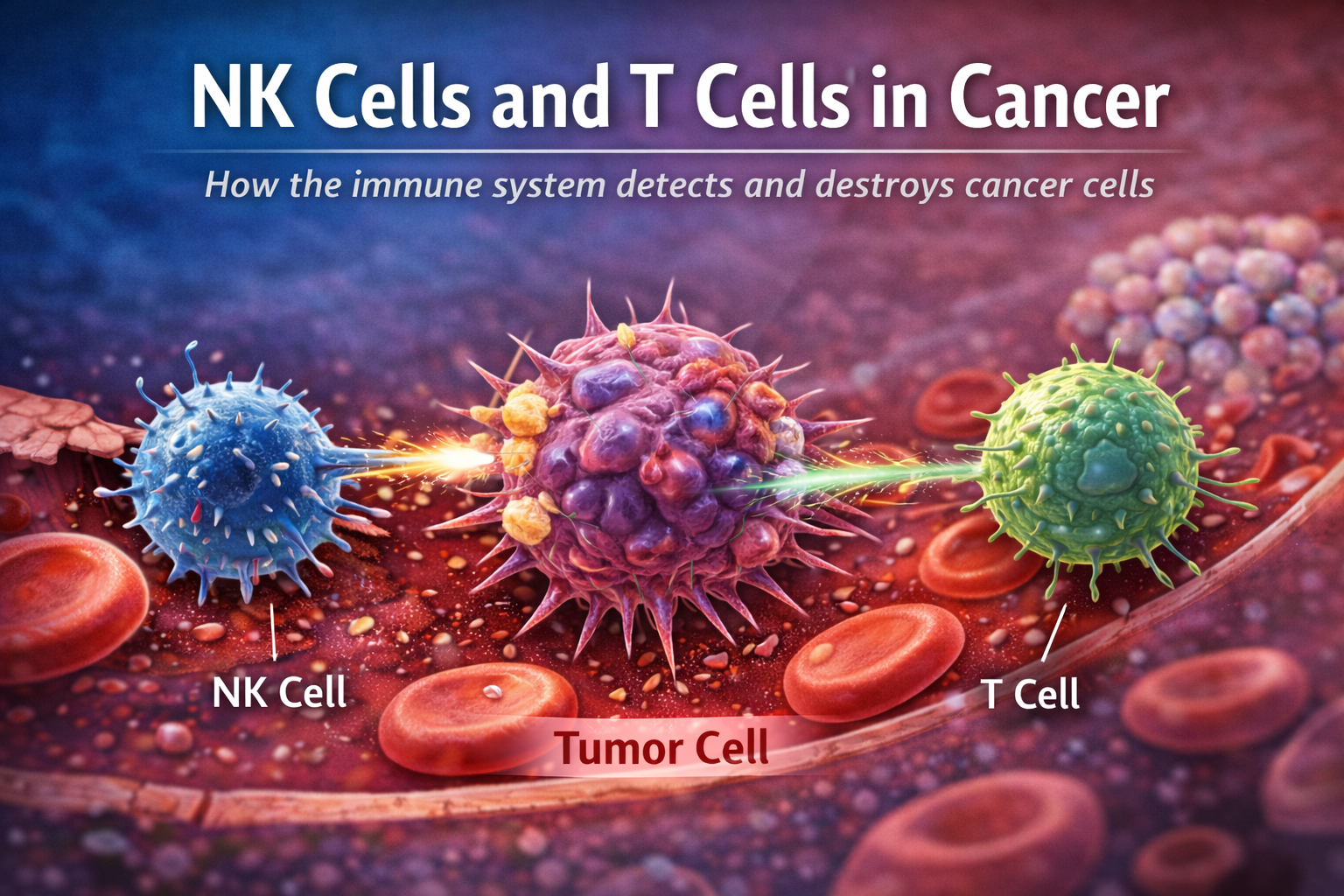
What This Page Explains
This page explains:
- What NK cells are
- What T cells are
- How the immune system detects cancer
- How cancer cells are destroyed
- Why immune cells sometimes fail
- How this connects to cancer spread and survival
The Immune System’s Role in Cancer
Your immune system is constantly checking your body for abnormal cells.
Cancer cells are abnormal.
So in theory:
👉 The immune system should destroy them
And many times, it does.
The Two Most Important Cancer-Fighting Cells
There are many immune cells, but two are critical in cancer control:
- Natural Killer (NK) cells
- T cells
Each has a different role.
Together, they form a powerful system.
What Are NK Cells? (Fast Attack)
NK cells are part of your innate immune system.
This means:
👉 They act immediately
They do not need training or prior exposure.
How NK Cells Detect Cancer
NK cells look for stress signals.
Cancer cells often:
- Lose normal markers
- Show abnormal proteins
- Appear “wrong”
NK cells recognize this quickly.
How NK Cells Kill Cancer
Once activated, NK cells:
- Release toxic molecules
- Damage the cancer cell
- Trigger cell death
This process is fast.
Why NK Cells Are So Important
In the bloodstream especially:
👉 NK cells are the first line of defense
This connects directly to:
👉 https://www.helping4cancer.com/cancer-bloodstream-survival
They destroy many circulating tumor cells early.
What Are T Cells? (Targeted Attack)
T cells are part of the adaptive immune system.
This means:
👉 They are more precise but slower
How T Cells Detect Cancer
T cells recognize cancer by specific markers.
These markers are presented on the surface of cells.
If a marker looks abnormal:
👉 The T cell targets that cell
How T Cells Kill Cancer
T cells:
- Bind to cancer cells
- Release destructive signals
- Trigger programmed cell death
This is highly targeted.
The Difference Between NK Cells and T Cells
NK Cells:
- Fast
- General detection
- Immediate response
T Cells:
- Slower
- Highly specific
- Long-term memory
Why Both Systems Are Needed
Cancer is complex.
No single immune cell is enough.
NK Cells:
- Catch early threats
- Kill quickly
T Cells:
- Provide precision
- Maintain long-term control
Together:
👉 They create a layered defense system
How This Connects to Circulating Tumor Cells
From Page 1:
👉 https://www.helping4cancer.com/circulating-tumor-cell
We learned cancer cells enter the bloodstream.
Once there:
👉 NK cells attack immediately
👉 T cells follow with targeted attacks
Why the Immune System Sometimes Fails
If the immune system is so powerful, why does cancer survive?
Because cancer adapts.
How Cancer Avoids NK Cells
Cancer cells can:
- Reduce stress signals
- Hide abnormal features
- Produce suppressive signals
This makes NK cells less effective.
How Cancer Avoids T Cells
Cancer cells can:
- Reduce antigen presentation
- Hide identifying markers
- Block immune activation
This prevents T cell recognition.
Learn more here:
👉 https://www.helping4cancer.com/cancer-immune-system/
👉 https://www.helping4cancer.com/cancer-immune-evasion/
The Concept of Immune Surveillance
Your immune system is always watching.
This is called:
👉 Immune surveillance
It constantly:
- Detects abnormal cells
- Removes threats
- Maintains balance
When Immune Surveillance Works
- Cancer cells are destroyed early
- No tumor forms
- No spread occurs
When It Fails
- Cancer survives
- Cancer adapts
- Cancer spreads
The Role of NK–T Cell Synergy
The most important concept:
NK cells and T cells work together
NK Cells:
- Provide immediate control
T Cells:
- Provide long-term control
If both are working:
👉 Cancer is suppressed
If both are disrupted:
👉 Cancer survives
What Happens After Immune Escape
If cancer avoids both NK and T cells:
It can:
- Survive in the bloodstream
- Enter new tissue
- Begin the next phase
The Next Phase: Immune Evasion
Cancer cells that survive immune attack must continue hiding.
Learn more:
👉 https://www.helping4cancer.com/cancer-immune-evasion
Connection to Dormancy
Some cancer cells are not destroyed.
Instead:
👉 They are controlled
They enter a state called dormancy.
Learn more:
👉 https://www.helping4cancer.com/cancer-dormancy
👉 https://www.helping4cancer.com/cancer-dormancy-late-recurrence/
Why This Step Is Critical
Immune control determines:
- Whether cancer is eliminated
- Whether cancer survives
- Whether cancer spreads
The Most Important Concept
Cancer survival depends on escaping immune detection
Not just growth.
Not just mutation.
👉 Escape.
How This Connects to the Bigger System
This page connects directly to:
- Circulating tumor cells → https://www.helping4cancer.com/circulating-tumor-cell
- Bloodstream survival → https://www.helping4cancer.com/cancer-bloodstream-survival
- Immune evasion → https://www.helping4cancer.com/cancer-immune-evasion
- Dormancy → https://www.helping4cancer.com/cancer-dormancy
Key Takeaways
- NK cells are fast responders that attack cancer immediately
- T cells are precise and target specific cancer cells
- Both systems are required for full protection
- Cancer survives by avoiding these immune cells
- Immune failure allows cancer to spread
External References
National Cancer Institute – Immune System and Cancer
https://www.cancer.gov/about-cancer/treatment/types/immunotherapy
Nature Reviews Immunology
https://www.nature.com/articles/nri.2017.35
Frontiers in Immunology
https://www.frontiersin.org/articles/10.3389/fimmu.2020.00939/full
Continue Learning
Next page:
👉 https://www.helping4cancer.com/cancer-immune-evasion
Also explore:
- https://www.helping4cancer.com/cancer-dormancy
- https://www.helping4cancer.com/autophagy-cancer-survival
- https://www.helping4cancer.com/p38-erk-cancer