What Is mTOR
mTOR stands for “mechanistic target of rapamycin.”
It is a protein inside cells that acts like a master growth controller.
mTOR tells cells when to:
- grow
- divide
- make proteins
- use nutrients
- produce energy
In healthy cells, this system helps the body grow, repair tissues, and maintain normal metabolism.
But in cancer, the mTOR system often becomes overactive, allowing cancer cells to grow faster and survive when they normally should die.
Because of this, mTOR and cancer is considered one of the most important pathways in cancer biology.
Why mTOR Is Important in Cancer
Cancer cells need three things to grow:
- Energy
- Building materials
- Growth signals
The mTOR pathway controls all three.
When mTOR is activated, it sends signals that tell the cell to:
- produce proteins
- increase metabolism
- divide more quickly
These signals are useful in normal cells, but in cancer they can become permanently switched on, allowing tumors to grow without normal biological limits.
Many cancers show abnormally high mTOR activity, including:
- breast cancer
- prostate cancer
- colon cancer
- lung cancer
- brain tumors
- kidney cancer
Because of this, scientists consider mTOR a central driver of tumor growth.
The mTOR Pathway: How It Works
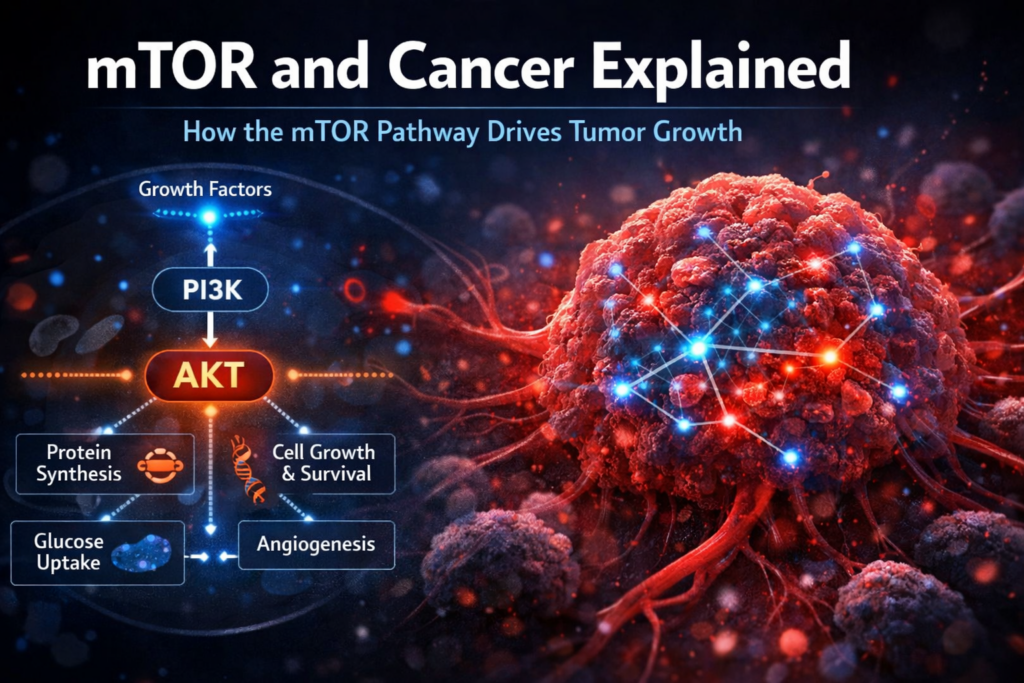
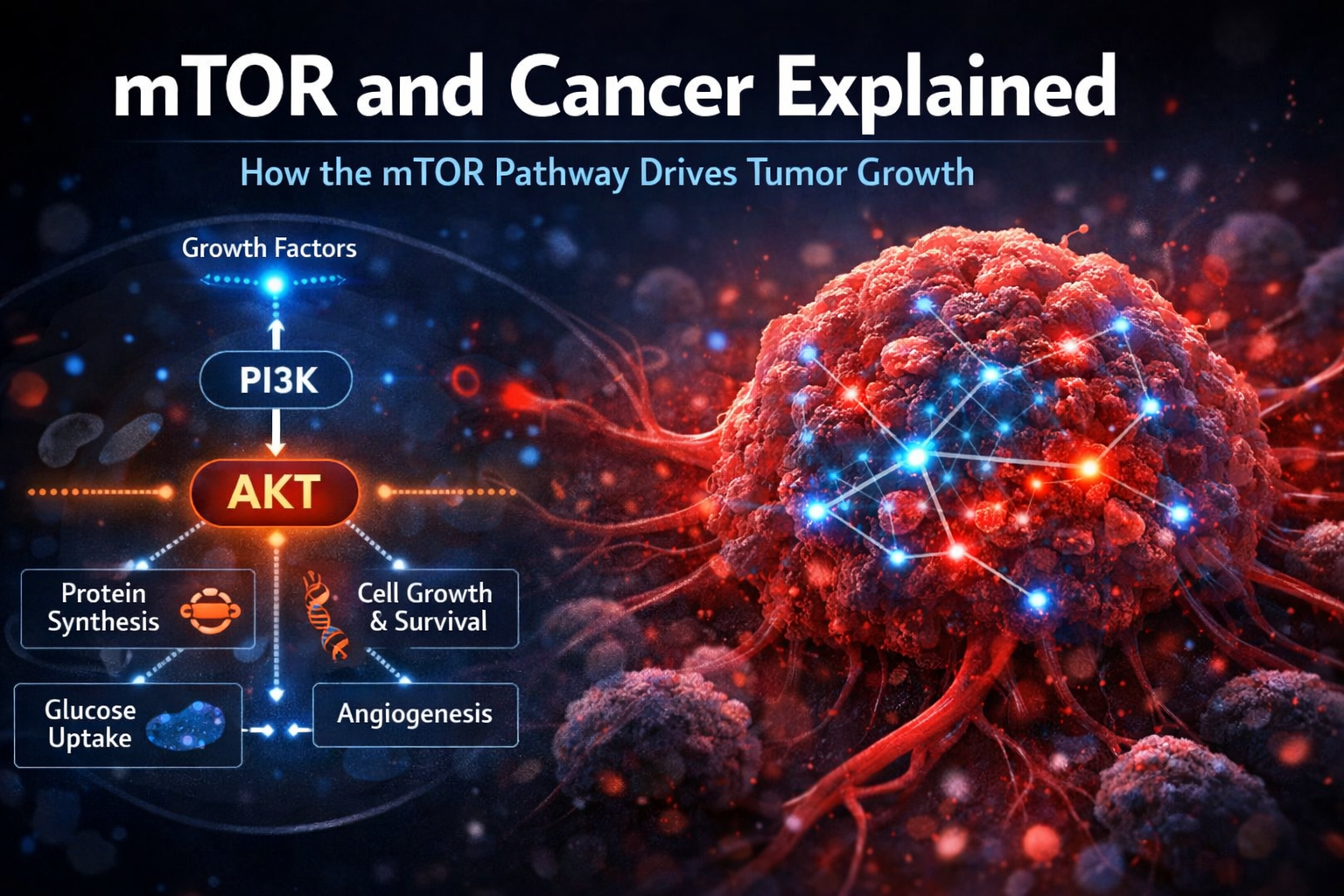
mTOR is part of a larger signaling system inside cells called the PI3K–AKT–mTOR pathway.
This pathway acts like a communication network that tells cells how to respond to their environment.
The system works roughly like this:
- Growth factors activate receptors on the cell surface
- Signals travel through PI3K and AKT proteins
- mTOR receives the signal
- The cell increases growth and metabolism
This pathway integrates signals from:
- nutrients (glucose and amino acids)
- hormones like insulin
- oxygen levels
- stress signals
- growth factors
mTOR essentially acts as a nutrient and energy sensor, deciding whether the cell has enough resources to grow.
In cancer cells, these signals are often permanently activated, allowing the tumor to grow continuously.
Two Main mTOR Complexes
mTOR does not work alone.
Inside the cell, it forms two major protein complexes:
mTORC1
mTOR Complex 1 controls:
- protein production
- cell growth
- metabolism
- lipid synthesis
This complex responds strongly to nutrient levels and growth signals.
mTORC1 is the complex most often linked to cancer growth.
mTORC2
mTOR Complex 2 controls:
- cell survival
- cell movement
- metabolism
- cytoskeleton structure
This complex also helps activate AKT, which further stimulates the growth pathway.
Both complexes contribute to tumor development when they become dysregulated.
How mTOR Helps Cancer Cells Grow
When the mTOR pathway becomes overactive, it supports many of the hallmarks of cancer.
1. Increased Cell Growth
mTOR stimulates the production of proteins and ribosomes, which are needed for cell growth.
Cancer cells use this process to grow larger and divide faster.
2. Faster Cell Division
Active mTOR signals push cells through the cell cycle, encouraging rapid division.
This contributes to tumor expansion.
3. Increased Energy Production
Cancer cells require large amounts of energy.
mTOR helps shift metabolism toward glycolysis, the process cancer cells often use to generate rapid energy.
This metabolic change is related to the Warburg effect, a common feature of cancer metabolism.
4. Blocking Autophagy
Autophagy is a natural process where cells clean out damaged parts.
mTOR suppresses autophagy.
When autophagy is blocked, damaged cells may survive when they should normally be destroyed.
This helps cancer cells persist and resist treatment.
5. Promoting Blood Vessel Growth
Tumors need blood vessels to supply oxygen and nutrients.
mTOR increases production of a molecule called HIF-1α, which stimulates the formation of new blood vessels (angiogenesis).
More blood vessels allow tumors to grow larger.
6. Helping Cancer Survive Stress
Cancer cells often live in harsh environments with:
- low oxygen
- low nutrients
- immune attack
The mTOR pathway helps cells adapt to these stresses, improving survival.
Genetic Changes That Activate mTOR
Several genetic mutations can cause mTOR to become overactive.
Some of the most common involve:
PTEN Loss
PTEN is a tumor suppressor gene.
It normally slows down the PI3K-AKT-mTOR pathway.
When PTEN is lost or mutated, the pathway becomes hyperactive.
PI3K Mutations
Mutations in the PI3K gene increase signaling into mTOR.
This is common in many cancers.
AKT Activation
AKT directly activates mTOR.
When AKT becomes overactive, mTOR signaling increases.
TSC1 / TSC2 Mutations
These genes normally suppress mTOR activity.
Mutations remove this brake and allow uncontrolled growth.
mTOR and Cancer Metabolism
Cancer cells must reprogram their metabolism to support rapid growth.
mTOR plays a central role in this process.
It regulates:
- glucose metabolism
- amino acid use
- lipid synthesis
- nucleotide production
By controlling these metabolic systems, mTOR helps cancer cells produce the materials needed to build new tumor cells.
This metabolic control is one reason scientists call mTOR a master regulator of cancer metabolism.
mTOR and the Tumor Microenvironment
Cancer cells do not exist alone.
They interact with surrounding tissues called the tumor microenvironment.
mTOR influences this environment by affecting:
- immune cell behavior
- inflammation
- blood vessel formation
- stromal cell signaling
These interactions can help tumors evade immune detection and resist therapy.
mTOR as a Target for Cancer Treatment
Because mTOR plays such a major role in tumor growth, scientists have developed drugs that block this pathway.
These are called mTOR inhibitors.
Examples include:
- Rapamycin (sirolimus)
- Everolimus
- Temsirolimus
These drugs work by slowing down mTOR activity, which can reduce tumor growth and metabolism.
mTOR inhibitors are currently used or studied in several cancers, including:
- kidney cancer
- breast cancer
- neuroendocrine tumors
- certain lymphomas
However, cancer cells often activate alternative pathways, so mTOR inhibitors are frequently used in combination with other therapies.
Why mTOR Research Is Important
Understanding the mTOR pathway helps researchers develop better cancer treatments.
mTOR sits at a critical intersection of many biological systems:
- metabolism
- growth signaling
- nutrient sensing
- immune regulation
- cell survival
Because it connects so many cancer processes, it is considered one of the central targets in modern oncology research.
Scientists continue studying ways to:
- block mTOR more effectively
- combine mTOR inhibitors with other therapies
- understand how tumors bypass mTOR blockade
This research may lead to more personalized cancer treatments in the future.
Key Takeaway
The mTOR pathway is one of the most important growth control systems in the body.
In cancer, this system often becomes permanently activated, allowing tumors to:
- grow faster
- resist cell death
- increase metabolism
- form new blood vessels
- evade normal growth limits
Because of its central role in tumor biology, mTOR remains a major focus of cancer research and targeted therapy development.
References
Wikipedia – mTOR
https://en.wikipedia.org/wiki/MTOR
National Cancer Institute – mTOR Pathway and Cancer
https://www.cancer.gov/about-cancer/causes-prevention/genetics/molecular-pathways
National Institutes of Health – Targeting the mTOR Signaling Network for Cancer Therapy
https://www.ncbi.nlm.nih.gov/pmc/articles/PMC2738634/
Nature Reviews – mTOR Signaling in Growth, Metabolism and Disease
https://www.nature.com/articles/nrm.2016.92
National Library of Medicine – mTOR Signaling Pathway in Cancer
https://www.ncbi.nlm.nih.gov/pmc/articles/PMC6387042/
MDPI – mTOR Signaling Pathway and Cancer Metabolism
https://www.mdpi.com/1422-0067/25/11/6141
American Association for Cancer Research – PI3K/AKT/mTOR Pathway
https://aacrjournals.org
Table of Contents