Educational warning
This page is for education only and reflects a supportive supplement strategy, not a diagnosis, prescription, or claim of cure. COVID-19 and HMPV can become medical emergencies, especially with shortness of breath, low oxygen, chest pain, confusion, blue lips, dehydration, or worsening cough. Anyone using blood thinners, transplant drugs, chemotherapy, immune-suppressing drugs, or prescription medicines should clear supplements with a clinician first, because zinc, vitamin D, curcumin, bromelain, omega-3s, and some herbs can interact with treatment plans. HMPV currently has no specific antiviral therapy or vaccine, and medical care remains supportive.
Why I Recommend This Supplement Stack for COVID-19 and HMPV
When people hear that a virus has “no cure,” they often assume that nothing useful can be done. I look at it differently. If a virus does not have a specific cure, then supportive care becomes even more important. That is exactly why I recommend this stack for respiratory viruses such as COVID-19 and human metapneumovirus, or HMPV. HMPV is currently in the news in California, and the CDC says there is still no specific antiviral therapy and no vaccine for it. Care is mainly supportive. That makes it reasonable to focus on the body systems that matter most during respiratory infection: immune readiness, airway clearance, oxidative balance, and inflammatory control.
This is the logic behind my stack. I am not trying to pretend supplements are magic bullets. I am looking at what these viruses do to the body and then matching nutrients and botanicals to those pressure points. COVID-19 and HMPV both affect the respiratory tract. They can increase oxidative stress, irritate the bronchial tree, thicken secretions, and create an inflammatory environment that makes breathing harder and recovery slower. A supportive stack makes sense when it helps the lungs stay clearer, the immune response stay stronger, and the inflammatory response stay better regulated.
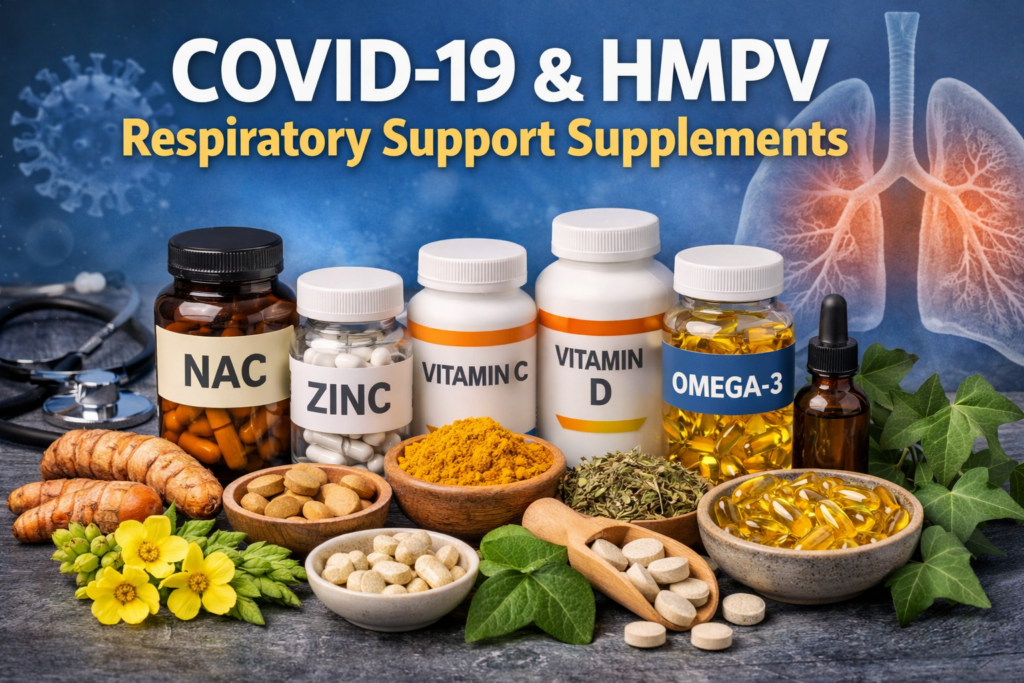
My basic recommendation is NAC, quercetin, zinc, vitamin C, vitamin D, omega-3 fatty acids, curcumin, bromelain, mullein, and ivy leaf extract. I like this combination because it is broad rather than narrow. It does not depend on one mechanism. It supports several. NAC and vitamin C lean into antioxidant defense. Quercetin, curcumin, and omega-3s lean into inflammatory balance. Zinc and vitamin D support immune competence. NAC, bromelain, mullein, and ivy leaf extract support mucus clearance and easier breathing. In other words, the stack is built around function.
The first supplement I recommend is NAC, or N-acetylcysteine. This is one of the strongest foundations of the stack because it addresses two things that matter a lot in viral lung illness: glutathione support and mucus management. NAC is a precursor to glutathione, one of the body’s central antioxidant defenses, and it is also well known for mucolytic activity, meaning it can help break up and thin mucus. In respiratory viruses, that is a very attractive combination. It supports the redox side of recovery and the mechanical side of breathing. I like a practical adult dosing rhythm of 600 mg two or three times daily, often morning, mid-afternoon, and evening, because that keeps support more steady through the day. That schedule also mirrors amounts commonly studied in influenza-like illness and COVID-related literature.
Next is quercetin. I recommend quercetin because it sits at the intersection of immune support, antioxidant protection, and inflammatory balance. It has been studied for its potential effects on viral entry and viral enzymes in SARS-CoV-2 research, and it is also widely discussed because of its ability to act as a zinc ionophore-like compound, helping zinc move where it may be more useful inside the body. I prefer quercetin in divided doses, usually 500 mg twice daily with meals. Dividing it makes sense because it keeps exposure steadier and is easy for most people to follow. If someone uses a more bioavailable quercetin form, the label dose may be lower. The reason I keep quercetin in this stack is simple: it gives the protocol a strong plant-flavonoid backbone.
Zinc is one of the most obvious immune-support choices for respiratory viruses. The NIH notes that zinc is required for proper immune function, and deficiency increases susceptibility to infection. I recommend zinc because it supports antiviral immune activity, barrier integrity, and normal immune signaling. For a short, focused respiratory-support period, I think a common-sense adult range is 15 to 30 mg daily with food. I do not see a need to push it aggressively when the adult upper limit is 40 mg per day. In this stack, zinc works especially well beside quercetin, which is one reason I think of those two as a pair rather than separate ideas. Timing-wise, I like zinc with the first substantial meal of the day or lunch, since that is usually gentler on the stomach.
Vitamin C deserves a place because respiratory illness is metabolically demanding and vitamin C is deeply tied to immune cell function and antioxidant protection. NIH’s vitamin C fact sheet notes that it acts as an antioxidant, and absorption becomes less efficient at very high single doses. That is exactly why I prefer divided dosing instead of one giant serving. My recommendation is usually 500 mg two or three times daily, taken morning and evening, or morning, afternoon, and evening during the most active phase of illness support. The reason is not just “more vitamin C.” The reason is steadier availability without relying on one oversized dose that the body may not use as efficiently. Vitamin C also fits beautifully next to NAC because both support the oxidative-stress side of respiratory recovery.
Vitamin D is different from the rest of the stack because it is not really about fast, same-day symptom support. It is about immune readiness and baseline resilience. The NIH notes that vitamin D plays important roles in immune function, and observational work has repeatedly linked low vitamin D status with poorer respiratory outcomes. I recommend vitamin D because it helps create a better immune foundation rather than because I expect it to act like a rescue supplement. A sensible general adult amount is often 1,000 to 2,000 IU daily with a meal containing fat, while staying mindful that the NIH adult upper limit is 4,000 IU daily unless a clinician advises otherwise. Taken consistently once daily, vitamin D gives the stack long-range support instead of short-range punch.
Omega-3 fatty acids are in the stack because viral lung illness is not just an immunity problem. It is also an inflammation-resolution problem. EPA and DHA are precursors to specialized pro-resolving mediators such as resolvins and protectins, which is one reason omega-3s continue to interest researchers in inflammatory conditions. I recommend omega-3s because they help push the stack toward a calmer, more recovery-oriented response. For day-to-day use, I think in terms of 1 to 2 grams of combined EPA and DHA daily with meals, usually split across breakfast and dinner if the product is large. Taking fish oil with food is also practical for absorption and stomach comfort. In this stack, omega-3s are not about quick relief. They are about improving the terrain.
Curcumin, the primary active compound in turmeric, is here because I want more than one tool aimed at inflammatory pathways. Curcumin has been studied extensively for effects on NF-kB, cytokine signaling, and inflammatory tone, and COVID-era trials and reviews kept bringing it back into the conversation as a potentially useful complementary compound. I recommend 500 mg once or twice daily with food, ideally using a bioavailable formulation. This is one supplement I prefer with meals, both for convenience and because many formulations are designed that way. Curcumin strengthens the anti-inflammatory side of the stack and makes even more sense when paired with omega-3s and quercetin.
Bromelain is a smart addition because it contributes both to inflammatory balance and to secretion management. Reviews describe bromelain as anti-inflammatory and mucolytic, which is exactly what makes it attractive in respiratory illness. It is also one of those supplements that seems to make the stack more functional, not just more theoretical. I usually think of bromelain at 250 to 500 mg once or twice daily. Many people prefer it between meals when the goal is systemic support, though some products are taken with meals depending on the formula. I also like bromelain beside quercetin; that pairing has shown up repeatedly in respiratory-support discussions and COVID-era combination protocols.
Mullein is one of the herbs I keep in because this stack is not only about biochemistry. It is also about comfort, soothing, and movement of mucus. Mullein has a long traditional history in respiratory support, and EMA’s herbal monograph describes mullein flower preparations as traditional herbal medicinal products for relief of cough associated with colds. I recommend it because it adds a gentle expectorant and soothing layer to the protocol. The most practical way to use it is often tea. EMA’s monograph lists an herbal infusion of about 1.5 to 2 grams in 150 mL boiling water three to four times daily for adults and adolescents over 12. For a home routine, two to three cups across the day is an easy rhythm. Mullein is one of the “feel it in the throat and chest” parts of the stack.
Ivy leaf extract is the other herb I really like for the mechanical side of respiratory support. EMA’s monograph recognizes ivy leaf as an expectorant for productive cough, and clinical reviews report quicker reductions in cough severity or frequency in some acute respiratory infection studies. I recommend ivy because it supports the coughing-and-clearing side of recovery. In practical terms, I would use a standardized product and follow label directions, since extracts vary, but adult monograph ranges are commonly in the neighborhood of roughly 45 to 105 mg daily depending on the extract, often divided two or three times daily. That is why many syrup products are taken several times a day. Morning, afternoon, and evening makes sense because cough support is rarely needed only once.
As for timing, I prefer a simple daily rhythm instead of random dosing. Breakfast or the first meal: vitamin D, omega-3, quercetin, zinc, and vitamin C. Midday or afternoon: NAC, bromelain, mullein tea, and ivy leaf if cough support is needed. Evening meal: omega-3, curcumin, quercetin, and vitamin C. Bedtime or late evening: NAC again, plus mullein tea or ivy leaf if the chest still feels heavy. This arrangement makes sense because fat-soluble compounds go with meals, vitamin C is divided, NAC is spread out, and the cough-clearing herbs are used at the times people usually notice respiratory symptoms most. It is not about perfection. It is about staying consistent.
The reason I recommend this stack for viruses said to have “no cure” is that supportive care matters most when a direct cure is missing. HMPV has no specific antiviral therapy or vaccine according to the CDC, and much of what helps people is still rest, hydration, airway support, and good symptom management. COVID-19 may have prescription options in certain cases, but the same supportive principles still matter: help the lungs, help the immune system, help the body handle inflammation, and help mucus move out instead of staying stuck. This stack follows that logic. It is built to support resilience, breathing, and recovery in a way that is practical and understandable.
That is why I recommend it. Not because I think one pill beats a virus, but because this combination makes biological sense. It covers the antioxidant side, the immune side, the inflammatory side, and the airway side. It can be organized into a realistic daily routine. It uses supplements and herbs that have all earned attention in respiratory-support research or long-standing clinical use. And when the headline says there is “no cure,” that is exactly when I want the rest of the support plan to be stronger, clearer, and more intentional.
External Reading Links
CDC — Human Metapneumovirus Overview and Treatment
https://www.cdc.gov/human-metapneumovirus/about/index.html
NIH Office of Dietary Supplements — Dietary Supplements in the Time of COVID-19
https://ods.od.nih.gov/factsheets/COVID19-HealthProfessional/
NIH Office of Dietary Supplements — Vitamin C Fact Sheet for Health Professionals
https://ods.od.nih.gov/factsheets/VitaminC-HealthProfessional/
NIH Office of Dietary Supplements — Vitamin D Fact Sheet for Health Professionals
https://ods.od.nih.gov/factsheets/VitaminD-HealthProfessional/
NIH Office of Dietary Supplements — Zinc Fact Sheet for Health Professionals
https://ods.od.nih.gov/factsheets/Zinc-HealthProfessional/
NIH Office of Dietary Supplements — Omega-3 Fatty Acids Fact Sheet for Health Professionals
https://ods.od.nih.gov/factsheets/Omega3FattyAcids-HealthProfessional/
NIH Office of Dietary Supplements — Dietary Supplements for Immune Function and Infectious Diseases
https://ods.od.nih.gov/factsheets/ImmuneFunction-HealthProfessional/
Herbal Monographs
European Medicines Agency (EMA) — Ivy Leaf (Hedera helix) Herbal Monograph
https://www.ema.europa.eu/en/documents/herbal-monograph/final-european-union-herbal-monograph-hedera-helix-l-folium-revision-2_en.pdf
European Medicines Agency (EMA) — Mullein Flower (Verbascum species) Herbal Monograph
https://www.ema.europa.eu/en/documents/herbal-monograph/final-european-union-herbal-monograph-verbascum-thapsus-l-v-densiflorum-bertol-v-thapsiforme-schrad-and-v-phlomoides-l-flos_en.pdf
Research Papers on Key Supplements
Quercetin and Vitamin C Synergy in COVID-19 Research
https://pmc.ncbi.nlm.nih.gov/articles/PMC7318306/
N-Acetylcysteine (NAC) for Prevention and Treatment of COVID-19 — Review
https://pmc.ncbi.nlm.nih.gov/articles/PMC9651994/
Curcumin and Quercetin Potential in Early-Stage COVID-19
https://pmc.ncbi.nlm.nih.gov/articles/PMC9889936/
Vitamin C Supplementation in COVID-19 Clinical Studies
https://pmc.ncbi.nlm.nih.gov/articles/PMC9570769/
Table of Contents