What Is Angiogenesis?
Angiogenesis is the process by which new blood vessels grow from existing blood vessels. This process is essential for normal life. It helps the body heal wounds, grow new tissues, and maintain healthy organs.
However, the same biological process that supports healing can also help diseases develop. One of the most important examples is cancer.
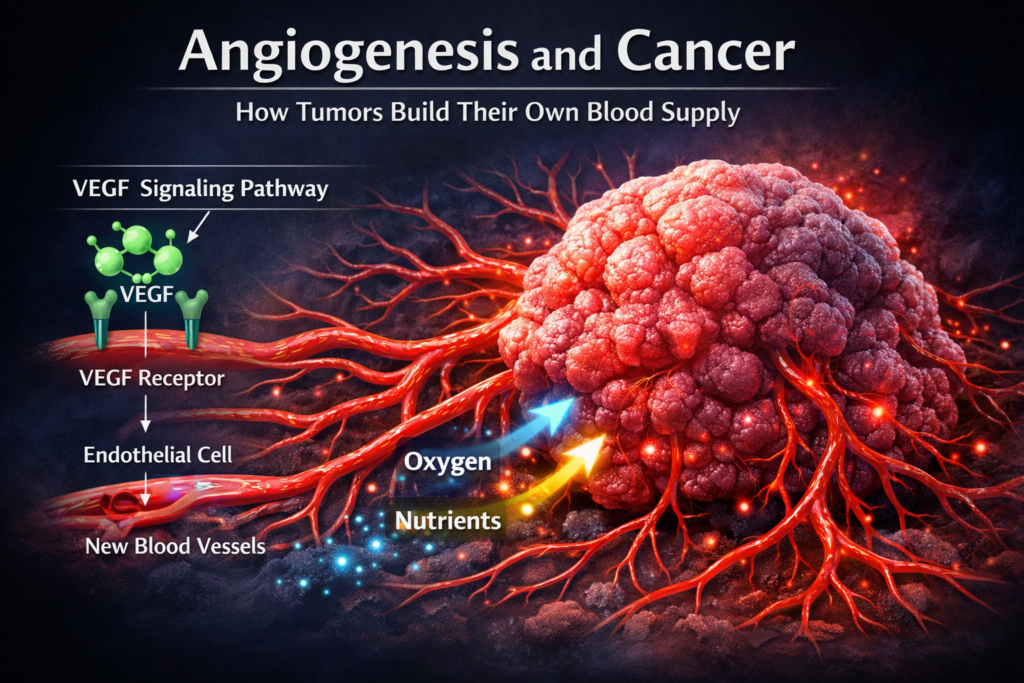
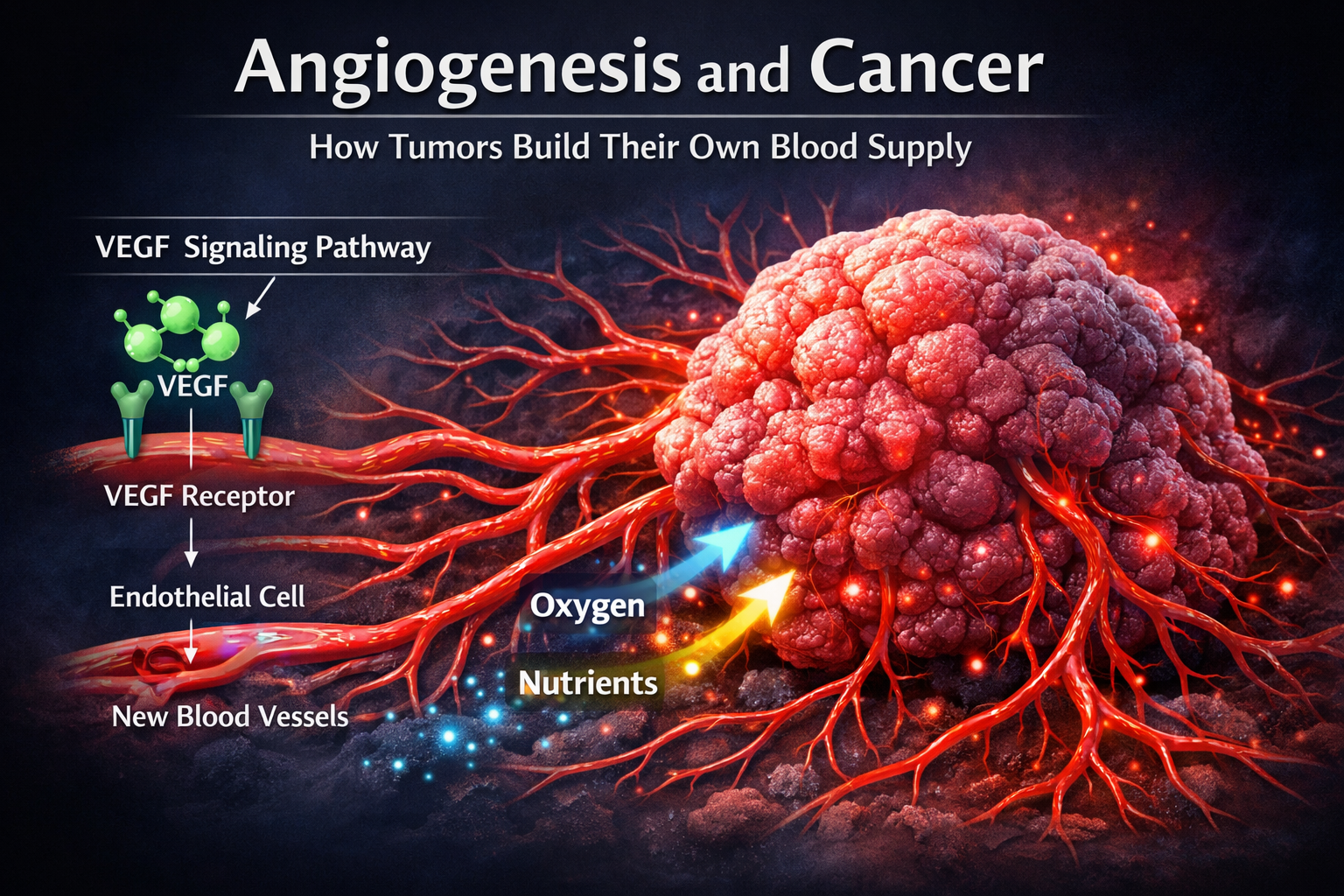
In cancer, angiogenesis allows tumors to create their own blood supply. This supply delivers oxygen, glucose, amino acids, and other nutrients that cancer cells need to survive and multiply.
Without access to blood vessels, tumors remain extremely small.
Research shows that tumors generally cannot grow beyond 1–2 millimeters in size without forming new blood vessels.
Once a tumor successfully stimulates angiogenesis, growth can accelerate rapidly.
Because of this, angiogenesis is considered one of the critical biological steps in tumor development and cancer progression.
Why Tumors Need Blood Vessels
Every cell in the body requires oxygen and nutrients to survive.
Healthy tissues receive these supplies through an organized network of arteries, veins, and capillaries.
Cancer cells are no different.
But tumors grow very quickly. As they expand, they eventually outgrow the oxygen supply available from nearby tissues.
When this happens, the tumor environment becomes hypoxic, meaning oxygen levels drop.
Low oxygen triggers a survival response inside cancer cells. These cells begin producing signaling molecules that tell nearby blood vessels to grow toward the tumor.
This process allows tumors to:
• obtain oxygen
• receive nutrients
• remove metabolic waste
• continue expanding
The resulting network of tumor blood vessels becomes the tumor’s lifeline.
The Angiogenic Switch
Cancer does not always begin with blood vessel formation.
Early tumors often remain small and inactive for long periods. This stage is sometimes called tumor dormancy.
Eventually, many tumors activate a process known as the angiogenic switch.
The angiogenic switch occurs when signals that promote blood vessel growth become stronger than signals that suppress it.
When this shift happens, new blood vessels begin forming around the tumor.
This marks an important turning point in cancer progression because the tumor is no longer limited by nutrient supply.
From this point forward, the tumor can grow much faster and may begin invading nearby tissues.
VEGF: The Key Driver of Tumor Angiogenesis
One of the most important molecules involved in tumor angiogenesis is VEGF, or vascular endothelial growth factor.
VEGF is a signaling protein that stimulates the growth of new blood vessels.
When oxygen levels drop in tumor tissue, cells release VEGF into the surrounding environment.
VEGF then binds to receptors located on endothelial cells, which are the cells that line blood vessels.
Once activated, these endothelial cells begin a complex sequence of events:
- They break down the surrounding extracellular matrix
- They migrate toward the tumor
- They multiply and form new capillary structures
- These structures eventually develop into functional blood vessels
VEGF is considered the central regulator of tumor angiogenesis, and many cancers produce high levels of this protein.
Because of its powerful effects, VEGF has become a major target in cancer treatment research.
How Tumors Recruit Blood Vessels
Tumors do not passively wait for blood vessels to grow toward them.
Instead, they actively manipulate surrounding tissue to stimulate vessel formation.
Cancer cells release a variety of molecules that influence nearby cells and tissues. These include:
• VEGF
• fibroblast growth factor (FGF)
• platelet-derived growth factor (PDGF)
• angiopoietins
These signals activate nearby endothelial cells and encourage them to begin forming new vessels.
The process typically unfolds in several stages.
1. Signal Release
Cancer cells release pro-angiogenic growth factors.
These molecules diffuse into surrounding tissues.
2. Endothelial Cell Activation
Nearby blood vessels detect these signals.
Endothelial cells begin to loosen their connections and prepare to migrate.
3. Vessel Sprouting
New vessel branches begin growing toward the tumor.
These branches are guided by chemical gradients created by angiogenic signals.
4. Vessel Formation
Endothelial cells align and form hollow tubes.
These tubes eventually become new capillaries.
5. Blood Flow
The new vessels connect with existing circulation and begin delivering blood to the tumor.
This process creates the tumor’s vascular network.
Abnormal Tumor Blood Vessels
Unlike healthy blood vessels, tumor blood vessels are often disorganized and poorly formed.
They tend to be:
• irregular in shape
• leaky
• poorly structured
• unstable
This abnormal structure creates several problems.
First, blood flow inside tumors can become uneven. Some areas receive oxygen while others remain hypoxic.
Second, the leaky nature of tumor vessels can increase inflammation and fluid buildup inside the tumor environment.
Third, abnormal vessels may limit the ability of immune cells to reach the tumor.
These characteristics help tumors survive and can contribute to treatment resistance.
Angiogenesis and Cancer Spread
Angiogenesis does more than simply support tumor growth.
It also contributes to metastasis, the spread of cancer to other parts of the body.
New blood vessels create pathways that cancer cells can use to enter the bloodstream.
Once inside circulation, cancer cells can travel to distant organs such as:
• lungs
• liver
• brain
• bones
This is one of the reasons angiogenesis plays such an important role in cancer progression.
Without blood vessel access, metastasis would be far more difficult.
Anti-Angiogenic Cancer Therapies
Because angiogenesis is essential for tumor survival, scientists have developed therapies designed to block this process.
These treatments are called anti-angiogenic therapies.
Instead of directly killing cancer cells, these drugs aim to starve tumors by cutting off their blood supply.
One well-known anti-angiogenic drug is bevacizumab (Avastin).
Bevacizumab works by binding to VEGF and preventing it from activating blood vessel growth signals.
By blocking VEGF, the drug can slow or prevent new blood vessel formation around tumors.
Other anti-angiogenic drugs work by blocking VEGF receptors on endothelial cells.
Examples include:
• sunitinib
• sorafenib
• pazopanib
These medications interfere with the signaling pathways required for angiogenesis.
Anti-angiogenic therapy is now used to treat several cancers, including:
• colorectal cancer
• kidney cancer
• liver cancer
• lung cancer
• brain tumors
The goal is not always to eliminate tumors completely but to slow their growth and limit metastasis.
Challenges with Anti-Angiogenic Therapy
While anti-angiogenic therapies have shown promise, they also have limitations.
Tumors are highly adaptable.
In some cases, cancers can develop alternative ways to obtain blood supply.
These may include:
• recruiting existing blood vessels from nearby tissues
• activating alternative angiogenic pathways
• increasing invasive growth patterns
Some tumors can even grow along existing vessels instead of forming new ones.
Because of these adaptations, anti-angiogenic therapy is often used in combination with chemotherapy, immunotherapy, or radiation.
This combined approach may improve overall treatment effectiveness.
Why Angiogenesis Is a Major Focus of Cancer Research
Understanding angiogenesis has dramatically changed the way scientists view cancer.
For many years, cancer research focused primarily on killing cancer cells directly.
Today, researchers also focus on altering the tumor environment.
Angiogenesis sits at the center of this strategy.
Blocking tumor blood supply may help:
• slow tumor growth
• reduce metastasis
• improve treatment response
• weaken tumor survival mechanisms
Scientists are also studying how angiogenesis interacts with other cancer pathways such as:
• mTOR signaling
• hypoxia signaling
• metabolic reprogramming
• immune suppression
These interactions may reveal new ways to control tumor growth.
The Future of Angiogenesis Research
Research into tumor angiogenesis continues to evolve.
Scientists are exploring new therapeutic strategies, including:
• improved VEGF inhibitors
• drugs targeting multiple angiogenic pathways
• therapies that normalize tumor blood vessels
• combinations with immunotherapy
Some experimental treatments aim not just to block blood vessels but to normalize them, making them more organized and easier for immune cells and drugs to penetrate.
This strategy may improve the effectiveness of existing cancer therapies.
As researchers learn more about how tumors manipulate blood vessel growth, new treatment approaches are likely to emerge.
Summary
Angiogenesis is the process through which new blood vessels form from existing vessels.
While this process is essential for normal tissue growth and healing, it also plays a critical role in cancer.
Tumors rely on angiogenesis to obtain oxygen and nutrients needed for survival.
By releasing signaling molecules such as VEGF, cancer cells stimulate nearby blood vessels to grow toward the tumor.
This process creates a network of tumor blood vessels that supports rapid growth and enables metastasis.
Because of its importance in cancer progression, angiogenesis has become a major target in cancer therapy.
Anti-angiogenic treatments aim to block tumor blood supply and slow disease progression.
Understanding angiogenesis continues to be one of the most important areas of research in modern oncology.
References
- National Library of Medicine – Angiogenesis Overview
https://www.ncbi.nlm.nih.gov/books/NBK53238/ - Carmeliet P. VEGF in Cancer Angiogenesis
https://pubmed.ncbi.nlm.nih.gov/16301830/ - Lugano R. Tumor Angiogenesis Review
https://pmc.ncbi.nlm.nih.gov/articles/PMC7190605/ - Liu ZL. Angiogenic Signaling Pathways in Cancer
https://www.nature.com/articles/s41392-023-01460-1 - National Cancer Institute – Angiogenesis Inhibitors
https://www.cancer.gov/about-cancer/treatment/types/immunotherapy/angiogenesis-inhibitors-fact-sheet - Cleveland Clinic – Angiogenesis
https://my.clevelandclinic.org/health/articles/24206-angiogenesis
Table of Contents