What Is AMPK?
AMPK stands for AMP-activated protein kinase. It is a protein found inside almost every cell in the human body. Scientists often call AMPK the cell’s “energy sensor.”
Its job is to monitor how much energy a cell has available. When energy levels drop, AMPK activates and tells the cell to save energy and restore balance.
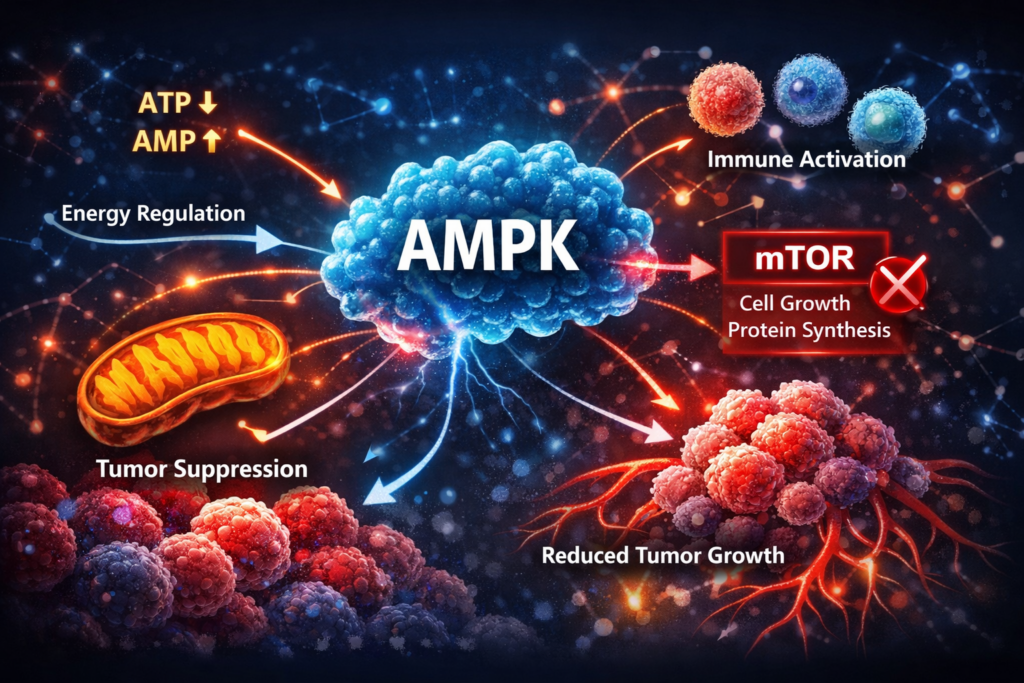
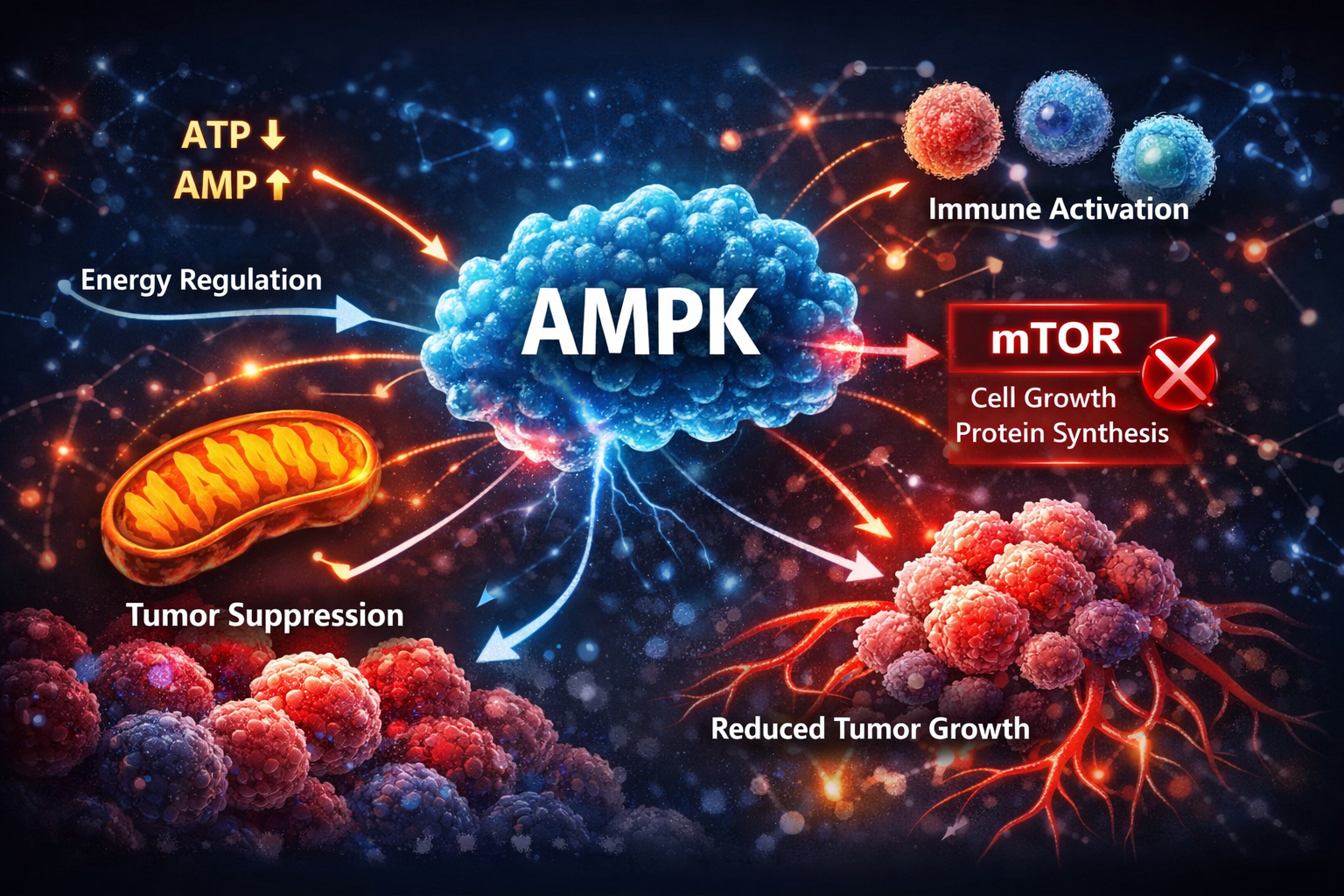
Cells constantly need energy to survive. That energy mainly comes from a molecule called ATP (adenosine triphosphate). When ATP levels fall and AMP levels rise, AMPK turns on and begins regulating many important metabolic processes.
This energy-monitoring role makes AMPK extremely important for overall health, including:
- metabolism
- inflammation
- mitochondrial function
- immune activity
- cell growth
Because cancer cells depend heavily on altered metabolism, researchers have spent many years studying the connection between AMPK and cancer biology.
Why AMPK Is Important in Cancer
Cancer cells grow and divide rapidly. To support this growth, they require large amounts of energy and nutrients.
One of the hallmarks of cancer is metabolic reprogramming. Cancer cells often change the way they produce energy so they can grow faster and survive under stress.
AMPK is deeply involved in these metabolic processes.
When AMPK activates, it generally slows down cell growth and energy-consuming processes while increasing pathways that produce energy.
Because of this, AMPK is often considered a metabolic checkpoint that can influence whether cells grow normally or begin behaving abnormally.
Scientists now recognize AMPK as an important regulator in several areas related to cancer development.
These include:
- tumor metabolism
- cell growth signals
- inflammation
- immune response
- mitochondrial function
Understanding these processes helps researchers design new strategies for preventing or treating cancer.
AMPK as a Tumor Suppressor
In many situations, AMPK acts as a tumor suppressor.
Tumor suppressors are biological systems that prevent cells from becoming cancerous.
One of the main ways AMPK does this is by interacting with another key pathway called mTOR (mechanistic target of rapamycin).
The mTOR pathway is responsible for stimulating:
- cell growth
- protein synthesis
- cell division
When mTOR is highly active, cells grow rapidly. This is useful for normal tissue repair but can also drive cancer growth.
AMPK can turn off or slow down mTOR activity, which helps prevent uncontrolled cell growth.
When AMPK suppresses mTOR, several anti-cancer effects may occur:
- reduced tumor cell growth
- decreased angiogenesis (blood vessel formation)
- increased apoptosis (programmed cell death)
These effects help prevent abnormal cells from expanding into tumors.
AMPK and Cancer Cell Metabolism
Cancer cells rely heavily on altered metabolism to survive. One well-known example is the Warburg Effect.
The Warburg Effect describes how cancer cells prefer to generate energy through glycolysis, even when oxygen is available. This allows cancer cells to grow quickly.
AMPK can interfere with this metabolic shift.
When activated, AMPK can:
- reduce glucose production
- increase fatty acid oxidation
- improve mitochondrial efficiency
- suppress energy-wasting pathways
These changes create a metabolic environment that is less favorable for tumor growth.
Because of this, researchers believe AMPK activation may help slow cancer cell proliferation in some circumstances.
AMPK and the Immune System
Another important role of AMPK involves the immune system.
The immune system constantly searches for abnormal cells, including cancer cells. This process is called immune surveillance.
AMPK helps regulate the metabolism of immune cells such as:
- T cells
- B cells
- macrophages
- natural killer (NK) cells
When AMPK signaling is functioning properly, immune cells can maintain the energy required to identify and destroy abnormal cells.
Some research suggests that activating AMPK may help improve the ability of cytotoxic T cells and NK cells to attack tumor cells.
AMPK can also influence the tumor microenvironment, which is the ecosystem of cells surrounding a tumor.
This environment often becomes immunosuppressive, meaning it weakens immune responses. AMPK may help counter some of these effects by regulating inflammatory signals and metabolic stress.
The Dual Role of AMPK in Cancer
Although AMPK is often described as a tumor suppressor, its role in cancer is complex.
Research shows that AMPK can sometimes help cancer cells survive under extreme stress.
For example, tumors often experience:
- low oxygen
- nutrient shortages
- metabolic stress
Under these conditions, AMPK activation may allow cancer cells to adapt and survive by improving energy efficiency.
Because of this, scientists describe AMPK as having a dual role in cancer.
In early stages, AMPK may suppress tumor formation.
But once a tumor exists, cancer cells may sometimes use AMPK signaling to survive difficult conditions.
This dual behavior is one reason why targeting AMPK in cancer treatment requires careful research.
AMPK and Cancer Treatments
Because AMPK plays such an important role in metabolism, researchers are studying ways to target this pathway in cancer therapy.
Several drugs used for other diseases already influence AMPK.
One of the most studied examples is metformin, a medication commonly used for type 2 diabetes.
Metformin activates AMPK and has been associated in some studies with lower cancer incidence and improved outcomes in certain patients.
Scientists believe this may occur because AMPK activation can:
- reduce insulin signaling
- suppress mTOR activity
- alter cancer cell metabolism
- slow tumor growth
Other compounds being studied for AMPK activation include:
- phenformin
- AICAR
- canagliflozin
These compounds are being investigated in experimental cancer research.
However, most AMPK-targeting strategies are still being studied in laboratory and clinical research settings.
AMPK, Fasting, and Metabolic Stress
AMPK is strongly influenced by metabolic stress.
Situations that may activate AMPK include:
- fasting
- calorie restriction
- exercise
- low glucose availability
- mitochondrial stress
When energy becomes scarce, AMPK activates pathways that help the cell survive.
These include increasing:
- mitochondrial activity
- fatty acid oxidation
- cellular repair processes
Because of this connection, AMPK is often discussed in research related to metabolic therapy and cancer metabolism.
Scientists are interested in whether metabolic stress signals may influence tumor growth through AMPK-related pathways.
AMPK and Future Cancer Research
AMPK remains one of the most important metabolic regulators being studied in cancer biology.
Researchers are exploring many unanswered questions, such as:
- when AMPK suppresses tumors versus supports survival
- how AMPK affects cancer stem cells
- how AMPK interacts with immune therapies
- whether AMPK activation improves treatment response
Because cancer is deeply connected to metabolism, pathways like AMPK may become important targets in future treatments.
Scientists are also studying how AMPK interacts with other major cancer signaling systems such as:
- mTOR
- PI3K/Akt
- p53
- LKB1
These pathways together control how cells grow, divide, and respond to stress.
Understanding these networks could lead to new strategies for preventing cancer progression.
Key Takeaways
AMPK is a critical protein that acts as the energy regulator of cells.
In cancer research, AMPK plays several important roles:
- It monitors cellular energy levels
- It can slow tumor growth by suppressing metabolic pathways
- It interacts with major cancer signaling networks like mTOR
- It influences immune responses to tumors
- It affects how cancer cells adapt to metabolic stress
Because of these functions, AMPK is considered a major link between metabolism and cancer biology.
Researchers continue to study how manipulating this pathway may improve cancer prevention and treatment in the future.
Scientific References
• National Cancer Institute – Cancer Metabolism Research
https://www.cancer.gov
• Frontiers in Immunology – AMPK and Tumor Metabolism
https://www.frontiersin.org/articles/10.3389/fimmu.2023.1114582
• National Library of Medicine – AMPK and Cancer Pathways
https://www.ncbi.nlm.nih.gov/pmc/articles/PMC8820546/
• Nature – AMPK and Tumor Immune Metabolism
https://www.nature.com/articles/s41420-024-02011-5
• Annual Review of Cancer Biology – AMPK Signaling
https://www.annualreviews.org/doi/10.1146/annurev-cancerbio-030419-033619
Table of Contents