Tumor Hypoxia
Introduction
One of the most important — and often overlooked — features of cancer biology is tumor hypoxia. Hypoxia simply means low oxygen levels, and inside many tumors oxygen becomes scarce as cancer cells multiply rapidly.
Unlike healthy tissues that rely on stable oxygen supply from blood vessels, tumors grow so quickly that their blood supply cannot keep up. This creates regions within the tumor where oxygen levels fall dramatically.
Instead of dying in these harsh conditions, cancer cells activate survival programs that allow them to adapt, grow, and become more aggressive.
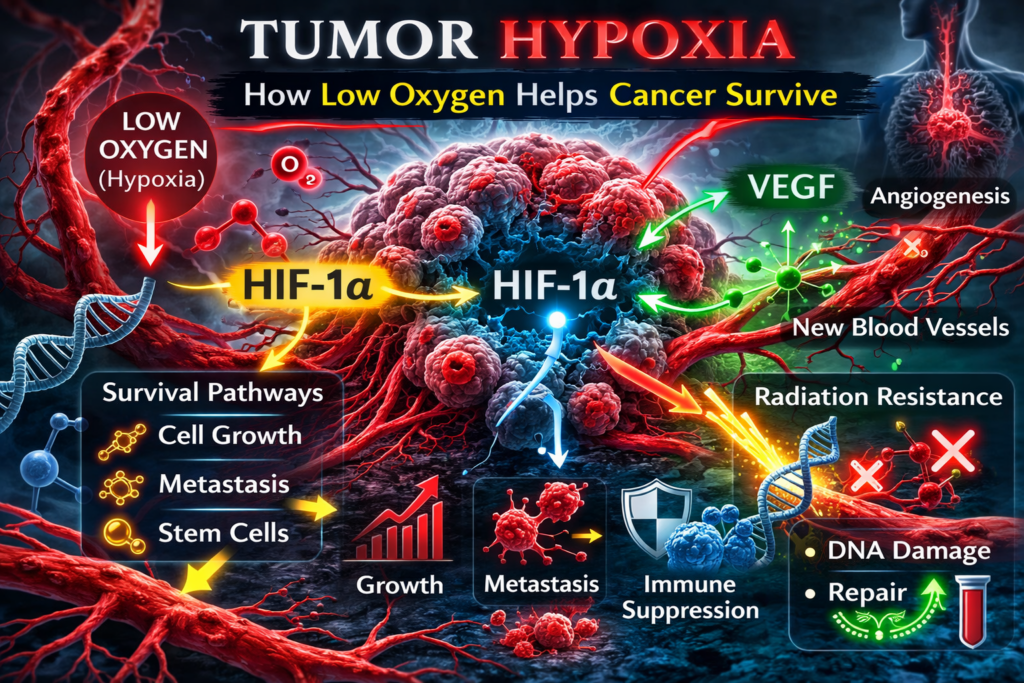
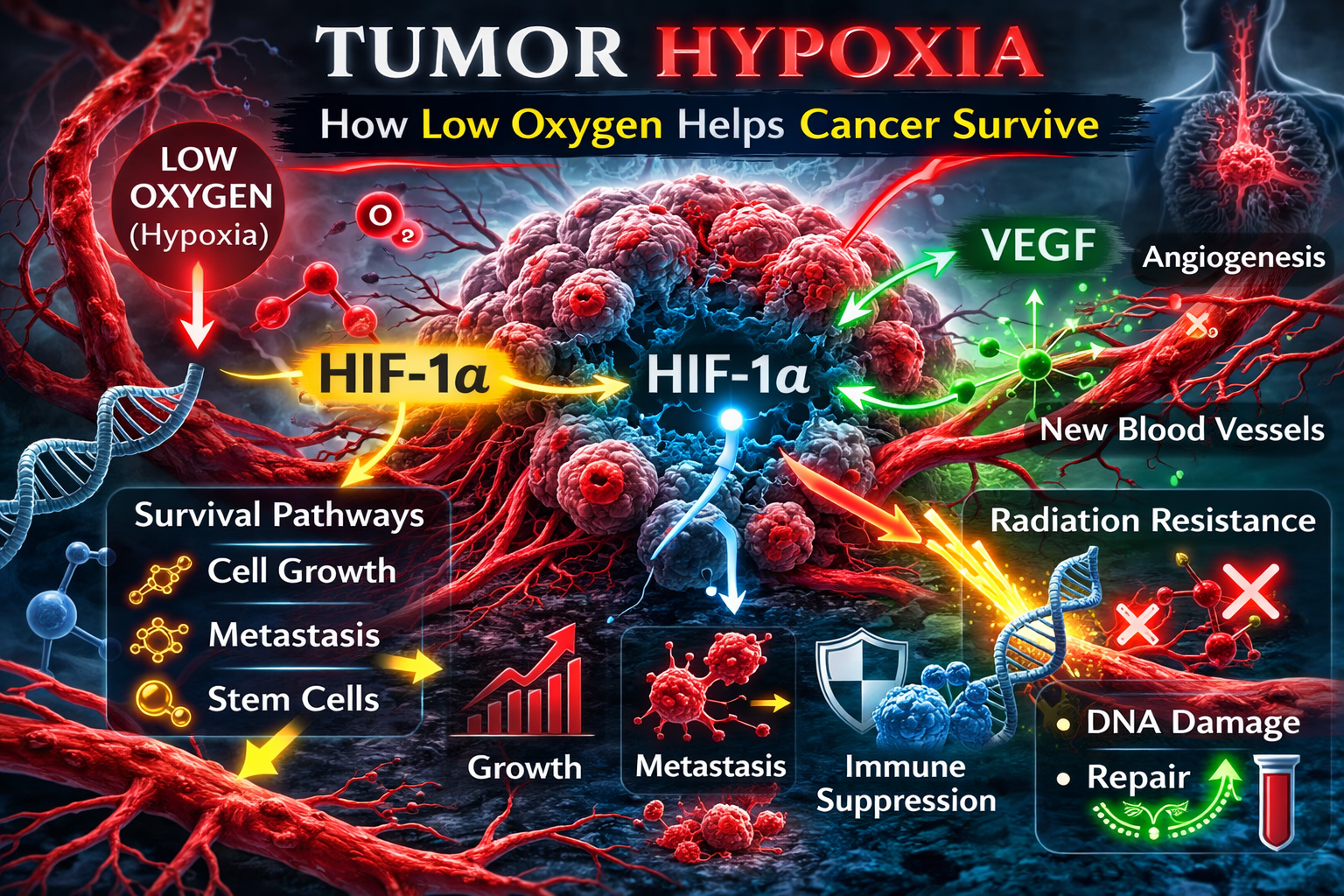
Tumor hypoxia is now recognized as a major driver of cancer progression, influencing:
- tumor growth
- metastasis
- angiogenesis (new blood vessel formation)
- immune evasion
- resistance to radiation therapy
At the center of this survival system is a molecular switch called HIF-1α (Hypoxia-Inducible Factor-1 alpha).
Understanding hypoxia helps explain why tumors behave the way they do — and why certain cancer treatments are more effective than others.
What Is Tumor Hypoxia?
Tumor hypoxia occurs when oxygen levels inside a tumor drop below normal physiological levels.
Healthy tissues usually maintain oxygen levels between 5–10% oxygen. In contrast, oxygen inside tumors may fall below 1–2% in some regions.
This happens because tumors grow rapidly but develop abnormal and inefficient blood vessels.
These tumor blood vessels are often:
- disorganized
- leaky
- poorly structured
- unevenly distributed
As a result, some areas of the tumor receive oxygen while others become severely oxygen-deprived.
Hypoxia is therefore a common characteristic of many cancers, including:
- colon cancer
- breast cancer
- lung cancer
- pancreatic cancer
- glioblastoma
Researchers now consider hypoxia a key feature of the tumor microenvironment.
Learn more about the tumor microenvironment here:
https://helping4cancer.com/tumor-microenvironment/
The Hypoxia Survival Switch: HIF-1α
When oxygen levels drop, cells activate a powerful transcription factor known as HIF-1α (Hypoxia-Inducible Factor-1 alpha).
HIF-1α functions like a master survival switch that turns on dozens of genes designed to help cells survive low oxygen conditions.
Under normal oxygen levels, HIF-1α is rapidly destroyed inside cells. But when oxygen becomes scarce, the protein stabilizes and begins activating survival pathways.
Once activated, HIF-1α triggers genes that control:
- glucose metabolism
- angiogenesis
- cell survival
- migration
- invasion
- immune suppression
This allows cancer cells to adapt to low oxygen and continue growing.
Scientific overview:
Hypoxia and Angiogenesis
One of the most important genes activated by HIF-1α is VEGF (Vascular Endothelial Growth Factor).
VEGF is a signaling protein that tells the body to grow new blood vessels.
This process is called angiogenesis.
When tumors become oxygen-starved, they release VEGF to recruit new blood vessels from nearby tissues. These vessels then grow toward the tumor in an attempt to deliver more oxygen and nutrients.
However, tumor-induced blood vessels are often abnormal and chaotic, which leads to uneven oxygen delivery and continued hypoxia.
This creates a vicious cycle:
- Tumor grows rapidly
- Oxygen becomes limited
- HIF-1α activates
- VEGF triggers angiogenesis
- New but defective vessels form
- Hypoxia persists
Angiogenesis is one of the core Hallmarks of Cancer.
Learn more:
https://helping4cancer.com/hallmarks-of-cancer/
Hypoxia and Tumor Aggressiveness
Hypoxia does more than help tumors survive. It also makes cancer more aggressive.
Low oxygen environments push cancer cells to develop traits that help them escape and spread throughout the body.
These changes include:
Increased invasion
Hypoxia activates genes that allow cancer cells to break down surrounding tissue, making it easier for tumors to expand.
Metastasis
Low oxygen stimulates molecular signals that help cancer cells detach from the primary tumor and travel through the bloodstream.
Stem-like cancer cells
Hypoxia can increase the number of cancer stem cells, which are highly resistant to treatment and capable of regenerating tumors.
These adaptations make hypoxic tumors harder to treat and more likely to recur.
Hypoxia and the Warburg Effect
Tumor hypoxia is closely linked to another major cancer trait known as the Warburg Effect.
Normally, healthy cells generate energy using oxygen inside mitochondria through a process called oxidative phosphorylation.
But cancer cells often rely on glycolysis, even when oxygen is available.
This metabolic shift allows cancer cells to:
- produce energy rapidly
- generate building blocks for cell growth
- survive low oxygen environments
HIF-1α plays a major role in activating genes that support this altered metabolism.
Learn more about tumor metabolism:
https://helping4cancer.com/warburg-effect-cancer-metabolism-2/
Hypoxia and Radiation Resistance
One of the most clinically important effects of hypoxia is its ability to reduce the effectiveness of radiation therapy.
Radiation therapy kills cancer cells primarily by generating reactive oxygen species (ROS) that damage DNA.
These ROS require oxygen to stabilize DNA damage.
When oxygen levels are low:
- fewer ROS are produced
- DNA damage becomes easier for cancer cells to repair
- radiation becomes less effective
This is why hypoxic tumors are often more resistant to radiation treatment.
Researchers estimate that hypoxic tumor cells may be 2–3 times more resistant to radiation therapy than well-oxygenated cells.
Learn more about ROS and cancer therapy:
https://helping4cancer.com/reactive-oxygen-species-cancer/
Hypoxia and Immune Suppression
Tumor hypoxia also interferes with the immune system’s ability to recognize and destroy cancer cells.
Low oxygen conditions promote the production of immune-suppressive signals that affect several important immune cells.
Hypoxia can:
- reduce activity of cytotoxic T cells
- suppress natural killer (NK) cells
- promote regulatory T cells (Tregs)
- recruit tumor-associated macrophages
These immune changes help tumors hide from immune surveillance.
Learn more about immune surveillance:
https://helping4cancer.com/immune-surveillance-cancer/
Hypoxia and Cancer Treatment Research
Because tumor hypoxia is such a major driver of cancer progression, scientists are exploring ways to target it.
Several experimental approaches are currently being studied.
HIF-1α inhibitors
Drugs that block HIF-1α may prevent tumors from activating hypoxia survival pathways.
Anti-angiogenic therapies
Some cancer drugs attempt to block VEGF and slow tumor blood vessel growth.
Examples include:
- bevacizumab
- sorafenib
- sunitinib
Oxygen-enhancing therapies
Some treatments attempt to increase oxygen delivery to tumors to make radiation therapy more effective.
Hypoxia-activated drugs
Certain experimental drugs become active only in low-oxygen environments, targeting hypoxic tumor regions specifically.
These strategies are still under investigation, but they highlight how important hypoxia has become in modern cancer research.
Why Hypoxia Matters for Cancer Patients
Understanding tumor hypoxia helps explain several important features of cancer:
- why tumors grow rapidly
- why some cancers spread aggressively
- why radiation sometimes fails
- why certain therapies work better than others
Hypoxia also helps scientists design new targeted treatments aimed at the tumor microenvironment rather than the cancer cells alone.
By studying how cancer adapts to low oxygen, researchers hope to develop therapies that disrupt these survival mechanisms and improve treatment outcomes.
Key Takeaways
Tumor hypoxia is one of the most important drivers of cancer progression.
When oxygen levels fall inside tumors:
- HIF-1α activates survival genes
- VEGF triggers angiogenesis
- tumors become more aggressive
- immune responses weaken
- radiation therapy becomes less effective
Understanding hypoxia provides valuable insight into how cancer survives and spreads, and it continues to guide the development of new therapies.
As research advances, targeting tumor hypoxia may become a powerful strategy for improving cancer treatment.
Scientific References
National Cancer Institute — Tumor Hypoxia
https://www.cancer.gov/research/areas/diagnosis/hypoxia
Nature Reviews Cancer — Hypoxia in Tumor Biology
https://www.nature.com/articles/nrc3184
National Library of Medicine — HIF-1 Signaling
https://www.ncbi.nlm.nih.gov/books/NBK26859/
Cancer Research UK — Angiogenesis
https://www.cancerresearchuk.org/about-cancer/what-is-cancer/angiogenesis
Table of Contents