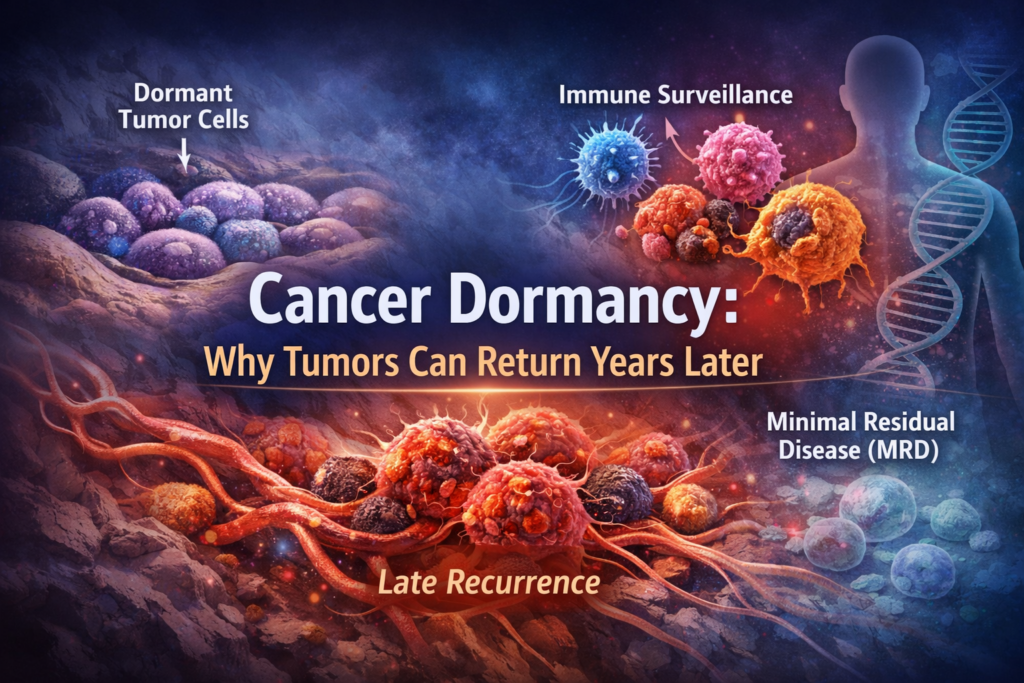
Cancer Dormancy
Cancer treatment can successfully eliminate most tumor cells, yet in some patients the disease returns years or even decades later. This phenomenon is known as cancer dormancy.
Cancer dormancy occurs when small numbers of cancer cells survive treatment but remain inactive for long periods. These cells may not grow, divide, or form detectable tumors during this time. However, under certain conditions they can begin growing again, leading to late recurrence.
Understanding cancer dormancy is a rapidly growing area of cancer research. Scientists now believe that dormant cancer cells play a key role in relapse, metastasis, and minimal residual disease.
This guide explains how cancer dormancy works, what causes tumor cells to remain inactive, and why they can suddenly reactivate years later.
What Is Cancer Dormancy?
Cancer dormancy refers to a state in which cancer cells are present in the body but are not actively growing or dividing.
Instead of forming detectable tumors, these cells remain in a sleep-like state where they survive but do not expand.
Dormant cancer cells can remain hidden in the body for years.
This state often occurs after:
- surgery
- chemotherapy
- radiation therapy
- targeted therapy
- immunotherapy
Even when treatment appears successful and imaging scans show no visible cancer, small numbers of cells may still remain.
These cells can persist in tissues such as:
- bone marrow
- lungs
- liver
- lymph nodes
- brain
Because they grow extremely slowly or not at all, they may evade detection for long periods.
Dormant Tumor Cells
Dormant tumor cells are individual cancer cells or small clusters that survive treatment but stop dividing.
These cells often enter a state called cellular quiescence, where the cell cycle pauses.
In this state the cells:
- stop multiplying
- reduce metabolic activity
- resist many cancer treatments
Chemotherapy and radiation therapy typically target rapidly dividing cells. Because dormant tumor cells divide very slowly, they can sometimes survive treatment.
This survival mechanism allows them to remain hidden until conditions become favorable for growth again.
Research suggests dormant cells may activate in response to:
- inflammation
- immune system changes
- tissue damage
- aging
- changes in the tumor microenvironment
When this happens, dormant cells can begin dividing again and form new tumors.
Types of Cancer Dormancy
Researchers generally describe three main types of dormancy.
Cellular Dormancy
In cellular dormancy, individual cancer cells stop dividing and remain inactive.
These cells survive but stay in a paused state.
They may remain dormant for years before reactivating.
Angiogenic Dormancy
Tumors require blood vessels to grow.
In angiogenic dormancy, a small cluster of cancer cells exists but cannot grow because it lacks sufficient blood supply.
Without new blood vessels, the tumor remains tiny and stable.
If the tumor eventually stimulates angiogenesis (the growth of new blood vessels), growth can resume.
Learn more about angiogenesis:
Immune-Mediated Dormancy
In immune-mediated dormancy, the immune system keeps cancer cells under control.
Immune cells such as:
- T cells
- Natural killer (NK) cells
- macrophages
recognize abnormal cells and prevent them from expanding.
However, if the immune system weakens or cancer cells develop escape mechanisms, the dormant cells may begin growing again.
Minimal Residual Disease (MRD)
A key concept related to dormancy is minimal residual disease (MRD).
MRD refers to extremely small numbers of cancer cells that remain after treatment.
These cells may be too few to detect using standard imaging tests such as CT scans or MRIs.
Advanced laboratory methods can sometimes detect MRD, including:
- circulating tumor DNA (ctDNA)
- molecular genetic tests
- flow cytometry
- next-generation sequencing
MRD is important because it may represent the source of future cancer recurrence.
For example, in some leukemias researchers can detect one cancer cell among hundreds of thousands of normal cells.
Monitoring MRD helps doctors evaluate how effective treatment has been and estimate relapse risk.
More information about MRD:
The Role of Immune Surveillance
The immune system plays a major role in controlling dormant cancer cells.
This process is called immune surveillance.
Immune surveillance refers to the body’s ability to detect and eliminate abnormal cells before they grow into tumors.
Key immune cells involved include:
T Cells
Cytotoxic T cells recognize cancer cells through abnormal proteins displayed on the cell surface.
Once identified, these immune cells release molecules that destroy the tumor cell.
Natural Killer (NK) Cells
NK cells are particularly important in detecting cells that lack normal immune signals.
Because many cancer cells attempt to hide from the immune system, NK cells act as a backup defense that can destroy suspicious cells.
Dendritic Cells
Dendritic cells help activate the immune system by presenting cancer antigens to T cells.
This process helps the immune system recognize tumor cells as threats.
If immune surveillance weakens, dormant tumor cells may escape detection and begin growing again.
Factors that can influence immune surveillance include:
- aging
- chronic inflammation
- immune suppression
- certain cancer mutations
Learn more about immune surveillance:
Why Cancer Can Return Years Later
One of the most frustrating aspects of cancer is late recurrence.
Some cancers return many years after successful treatment.
Examples include:
- breast cancer
- melanoma
- prostate cancer
- colon cancer
Dormant tumor cells are believed to be responsible for many of these recurrences.
Several triggers may reactivate dormant cancer cells.
Changes in the Tumor Microenvironment
Cancer cells interact with surrounding tissues, blood vessels, and immune cells.
This environment is called the tumor microenvironment.
Changes in this environment can provide signals that allow dormant cells to grow again.
Examples include:
- inflammation
- tissue remodeling
- new blood vessel growth
Loss of Immune Control
If immune surveillance declines, dormant tumor cells may escape control.
This can happen due to:
- aging immune systems
- immune suppressive tumors
- stress and inflammation
When immune pressure is reduced, cancer cells may begin expanding again.
Genetic Evolution of Tumor Cells
Cancer cells continue evolving even when dormant.
Over time, mutations may allow them to:
- resist immune detection
- resist therapies
- grow faster
When these changes occur, dormant cells can transform into aggressive tumors.
Dormancy and Metastasis
Dormancy is especially important in metastatic cancer.
Metastasis occurs when cancer spreads to other parts of the body.
In many cases, metastatic cancer cells reach distant organs but remain dormant for long periods before forming new tumors.
For example:
Breast cancer cells can travel to the bone marrow and remain dormant for years.
Later they may activate and form bone metastases.
Scientists believe interactions between tumor cells and the surrounding tissue environment play a key role in determining whether metastases remain dormant or begin growing.
How Scientists Study Cancer Dormancy
Understanding dormancy is difficult because dormant cells are extremely rare and difficult to detect.
Researchers use several techniques to study them.
Animal Models
Scientists study cancer dormancy using laboratory animals where dormant tumor cells can be tracked over time.
Molecular Analysis
Advanced sequencing technologies allow scientists to analyze the genes and proteins of dormant cancer cells.
Circulating Tumor DNA
Fragments of tumor DNA circulating in the bloodstream may help detect dormant disease before tumors appear.
This technology is rapidly advancing and may become an important tool for monitoring recurrence risk.
Can Cancer Dormancy Be Prevented?
Preventing dormancy-related recurrence is one of the biggest goals in oncology.
Several strategies are being explored.
Maintaining Immune Surveillance
Strong immune function may help keep dormant cancer cells under control.
Research is exploring:
- cancer vaccines
- immunotherapy
- immune-modulating treatments
Targeting Dormant Cells
Scientists are searching for therapies that specifically target dormant tumor cells.
Possible strategies include:
- metabolic targeting
- microenvironment disruption
- immune activation
Detecting Minimal Residual Disease
Earlier detection of MRD could allow doctors to treat cancer before it becomes visible again.
Liquid biopsy technologies are becoming increasingly important in this area.
Future Directions in Dormancy Research
Cancer dormancy is one of the most important unanswered questions in oncology.
Understanding how dormant cells survive and reactivate could transform cancer treatment.
Future research aims to:
- identify dormant tumor cell markers
- improve MRD detection
- develop therapies that eliminate dormant cells
- strengthen immune surveillance
By targeting these hidden cancer cells, doctors hope to reduce recurrence and improve long-term survival.
Key Takeaways
Cancer dormancy occurs when cancer cells survive treatment but remain inactive.
These dormant tumor cells can persist in the body for years without forming detectable tumors.
Minimal residual disease represents small numbers of remaining cancer cells that may later cause recurrence.
The immune system plays a critical role in keeping these cells under control through immune surveillance.
When dormant cancer cells reactivate, they can lead to late recurrence or metastasis.
Understanding and targeting cancer dormancy is one of the most promising areas of modern cancer research.
External References
National Cancer Institute – What Is Cancer
https://www.cancer.gov/about-cancer/understanding/what-is-cancer
National Cancer Institute – Minimal Residual Disease
https://www.cancer.gov/publications/dictionaries/cancer-terms/def/minimal-residual-disease
NIH Research – Cancer Immunosurveillance
https://www.ncbi.nlm.nih.gov/pmc/articles/PMC6615709/
Nature Reviews Cancer – Tumor Dormancy
https://www.nature.com/articles/nrc3240
Table of Contents