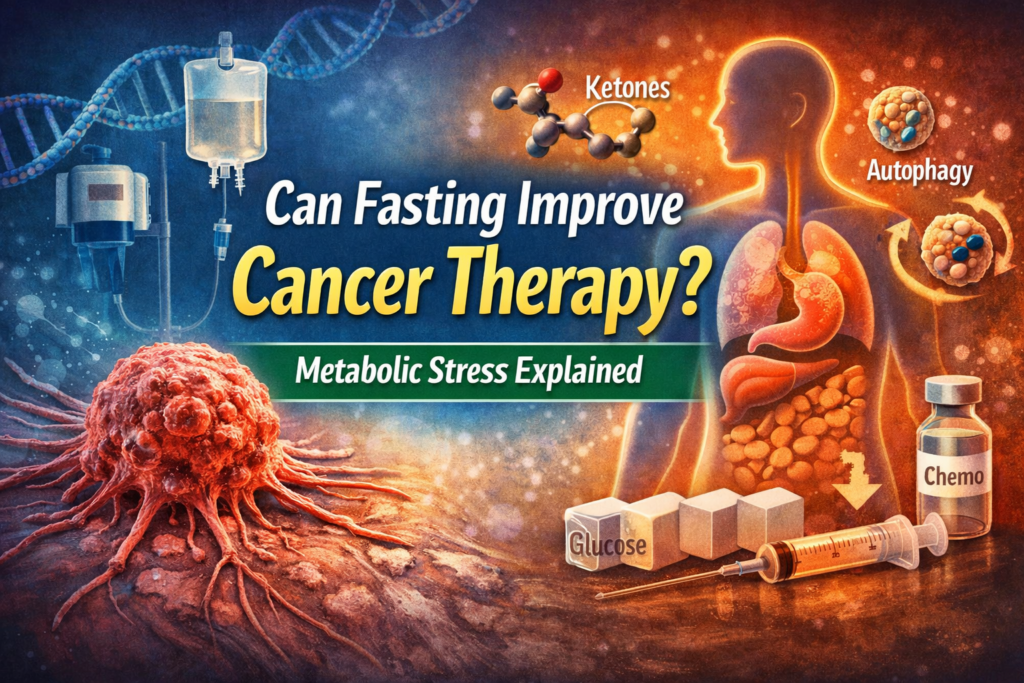
Can Fasting Improve Cancer Therapy? Metabolic Stress Explained
Fasting has been practiced for thousands of years for cultural, religious, and health reasons. In recent years, scientists have begun exploring a fascinating question:
Could fasting make cancer treatments more effective?
Early research suggests that temporary periods without food may influence how cancer cells respond to treatments such as chemotherapy and radiation. This concept is often called metabolic therapy, where changes in metabolism are used to stress cancer cells.
Fasting may alter several biological pathways linked to cancer growth, including:
- glucose metabolism
- insulin signaling
- autophagy
- oxidative stress
- cellular repair mechanisms
While fasting is not a cure for cancer, scientists are actively studying whether it could support conventional treatments.
This guide explains the science behind fasting and cancer therapy in clear and simple terms.
Understanding Metabolic Stress
To understand fasting’s potential role in cancer therapy, we first need to understand metabolic stress.
Metabolism refers to how cells convert nutrients into energy. When food intake stops for a period of time, the body undergoes several metabolic changes:
- Blood sugar levels drop
- Insulin levels decline
- The body shifts toward fat burning
- Ketones begin to rise
- Cellular repair processes activate
These metabolic changes create a stressful environment for certain cancer cells, which often depend heavily on constant nutrient availability.
Many tumors rely on high levels of glucose and growth signals to maintain rapid cell division.
Learn more:
https://www.ncbi.nlm.nih.gov/pmc/articles/PMC3946160/
How Cancer Cells Depend on Nutrients
Cancer cells often behave differently from normal cells when it comes to energy production.
Many tumors exhibit a metabolic phenomenon called the Warburg Effect, where cancer cells rely heavily on glucose and glycolysis for energy production, even when oxygen is available.
This metabolic strategy allows tumors to:
- grow rapidly
- produce building blocks for new cells
- adapt to hostile environments
Because of this dependency, scientists have wondered whether reducing nutrient availability could stress cancer cells.
Fasting may temporarily reduce several growth signals including:
- glucose
- insulin
- IGF-1 (insulin-like growth factor)
These signals normally encourage cell growth and division.
Learn more about cancer metabolism:
https://www.nature.com/articles/nrc.2017.8
Internal link:
Glycolysis and Cancer
Insulin and Growth Signaling
One major metabolic change during fasting is the reduction of insulin levels.
Insulin is a hormone that helps regulate blood sugar, but it also activates growth pathways inside cells.
Lower insulin levels may reduce activation of pathways such as:
- PI3K/Akt
- mTOR
- MAPK
These signaling networks are frequently overactive in cancer cells and are associated with tumor growth and survival.
Research suggests fasting may temporarily suppress some of these pathways, creating a metabolic environment less favorable for cancer growth.
For example, fasting can lower IGF-1, a growth factor linked to cancer risk and tumor progression.
Research reference:
https://www.cell.com/cell-metabolism/fulltext/S1550-4131(14)00044-0
Autophagy: Cellular Recycling
Another process strongly influenced by fasting is autophagy.
Autophagy is the body’s natural cellular recycling system. When nutrients are scarce, cells begin breaking down damaged components and reusing them.
This process helps maintain cellular health and energy balance.
Internal link:
Autophagy and Cancer
Autophagy has a complex role in cancer.
In early stages, it may help prevent cancer by removing damaged cellular components. However, in established tumors, autophagy can sometimes help cancer cells survive stress.
Fasting may temporarily increase autophagy in many tissues, which researchers are studying for its potential therapeutic effects.
Research reference:
https://www.ncbi.nlm.nih.gov/pmc/articles/PMC2990190/
Fasting and Chemotherapy Response
One of the most interesting areas of research is how fasting may influence chemotherapy effectiveness.
Some studies suggest fasting could potentially create a biological phenomenon called:
Differential Stress Resistance (DSR)
This means:
- Normal cells become more resistant to stress
- Cancer cells remain vulnerable
During fasting, healthy cells may enter a protective mode by slowing growth and activating repair mechanisms.
Cancer cells, however, often have mutations that prevent them from adapting to metabolic stress in the same way.
As a result, some researchers believe fasting could:
- protect normal cells from chemotherapy toxicity
- increase cancer cell sensitivity to treatment
Research reference:
https://www.ncbi.nlm.nih.gov/pmc/articles/PMC4102383/
However, these findings are still under investigation.
Fasting-Mimicking Diets
Because prolonged fasting can be difficult and potentially unsafe for some patients, researchers have developed fasting-mimicking diets (FMDs).
These diets aim to reproduce the metabolic effects of fasting while still providing small amounts of nutrients.
Fasting-mimicking diets typically:
- last about 4–5 days
- contain very low calories
- reduce protein and sugar intake
- emphasize plant-based nutrients
Studies suggest these diets may produce metabolic changes similar to fasting, including:
- reduced insulin
- lower IGF-1
- increased cellular stress in tumors
Research reference:
https://www.science.org/doi/10.1126/scitranslmed.aai8700
Effects on the Immune System
Fasting may also influence the immune system.
Some studies suggest fasting can stimulate immune regeneration, particularly after chemotherapy.
Research indicates fasting may promote:
- stem cell activation
- immune cell renewal
- reduced inflammation
This could potentially support recovery of immune cells such as:
- T cells
- natural killer (NK) cells
These immune cells play an important role in identifying and destroying abnormal cells.
Research reference:
https://www.cell.com/cell-stem-cell/fulltext/S1934-5909(14)00151-9
Internal link:
Immune Surveillance and Cancer
Ketones and Cancer Metabolism
When fasting continues for extended periods, the body begins producing ketones, molecules made from fat.
Ketones serve as an alternative fuel source when glucose is limited.
Healthy cells can typically adapt to using ketones efficiently. However, some cancer cells may struggle to use ketones due to mitochondrial dysfunction.
This metabolic difference has led scientists to investigate ketogenic strategies in cancer therapy.
Internal link:
Ketones vs Cancer Cells
Research is ongoing to determine which tumors may be sensitive to these metabolic shifts.
Potential Benefits Being Studied
Scientists are currently studying several potential ways fasting could influence cancer therapy.
Possible mechanisms include:
Reduced Tumor Growth Signals
Lower insulin and IGF-1 may reduce growth stimulation.
Increased Treatment Sensitivity
Metabolic stress may make tumors more vulnerable to chemotherapy or radiation.
Protection of Normal Cells
Healthy cells may enter protective states during fasting.
Improved Metabolic Health
Lower glucose and insulin may support metabolic balance.
However, these potential benefits remain under active research.
Important Safety Considerations
Fasting during cancer treatment must be approached carefully.
Cancer patients often face challenges such as:
- weight loss
- reduced appetite
- nutritional deficiencies
- fatigue
For these reasons, fasting may not be appropriate for everyone.
Individuals undergoing treatment should always consult their medical team before attempting fasting or significant dietary changes.
Clinical trials are ongoing to better understand when fasting strategies may be safe and beneficial.
Current Research and Clinical Trials
Interest in fasting and cancer therapy continues to grow rapidly.
Researchers are investigating fasting in combination with treatments such as:
- chemotherapy
- radiation therapy
- immunotherapy
- targeted therapies
Some clinical trials are examining whether fasting or fasting-mimicking diets can improve treatment outcomes while reducing side effects.
Research reference:
https://clinicaltrials.gov/ct2/results?cond=Cancer&term=fasting
While early results are promising, larger studies are still needed to determine the full impact of fasting on cancer treatment.
The Future of Metabolic Cancer Therapy
Fasting research is part of a broader field known as metabolic oncology.
Scientists are increasingly studying how cancer cells depend on:
- glucose metabolism
- amino acids
- lipid metabolism
- iron metabolism
- mitochondrial function
Understanding these vulnerabilities may lead to new strategies that combine metabolic interventions with conventional treatments.
Internal link:
Cancer Metabolism Explained
Future therapies may combine approaches such as:
- metabolic stress
- targeted drugs
- immune therapies
- precision nutrition
These strategies aim to exploit weaknesses in cancer metabolism.
Final Thoughts
Fasting is an intriguing area of cancer research that highlights the importance of metabolism in tumor biology.
Early studies suggest fasting may influence:
- insulin signaling
- metabolic stress
- autophagy
- chemotherapy response
- immune system activity
However, fasting is not a standalone treatment and should never replace evidence-based cancer therapies.
Researchers continue studying how metabolic interventions may safely complement traditional cancer treatments.
As science advances, fasting and metabolic therapy may become part of a broader strategy to improve cancer treatment outcomes.
External References
National Cancer Institute
https://www.cancer.gov
Longo & Mattson – Fasting and cancer
https://www.ncbi.nlm.nih.gov/pmc/articles/PMC4102383/
Science Translational Medicine – Fasting Mimicking Diet
https://www.science.org/doi/10.1126/scitranslmed.aai8700
Nature Reviews Cancer – Cancer Metabolism
https://www.nature.com/articles/nrc.2017.8
Table of Contents