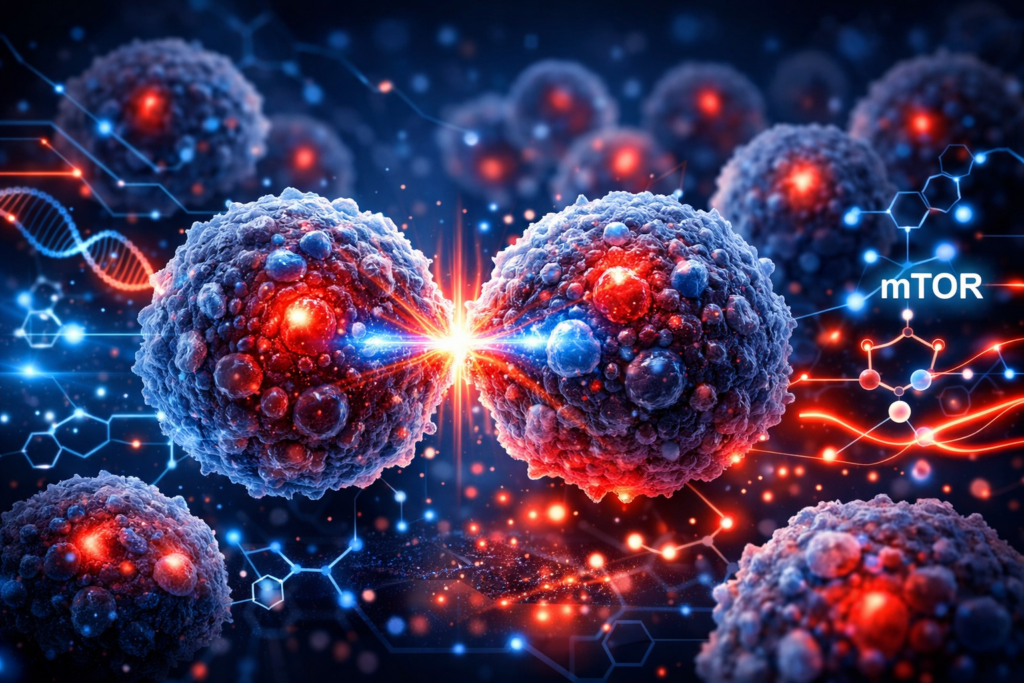
Introduction: Why Cancer Cells Grow So Fast
Cancer cells are defined by one of their most dangerous characteristics: uncontrolled and rapid growth. Unlike normal cells, which follow strict biological rules for division, cancer cells bypass these controls and multiply aggressively.
This accelerated growth allows tumors to expand quickly, invade surrounding tissues, and potentially spread throughout the body.
This guide explores the key mechanisms behind rapid cancer growth, including growth signals, the mTOR pathway, and disruptions in the cell cycle.
What Controls Normal Cell Growth
In healthy tissues, cell growth is tightly regulated by a balance of signals that tell cells when to divide, repair, or die.
Growth Signals in Healthy Cells
Normal cells rely on external growth signals such as hormones and growth factors. These signals bind to receptors on the cell surface and activate controlled pathways that regulate:
- Cell division
- DNA repair
- Energy production
- Apoptosis (programmed cell death)
Cells only divide when necessary, such as during tissue repair or normal turnover.
Built-In Safety Mechanisms
Healthy cells also have internal checkpoints that prevent uncontrolled growth:
- DNA damage checkpoints
- Tumor suppressor genes (like p53)
- Contact inhibition (cells stop growing when crowded)
These systems ensure that growth remains controlled and balanced.
How Cancer Cells Override Growth Signals
Cancer cells bypass normal regulatory systems and create a constant “grow” signal, even when the body does not need new cells.
Constant Activation of Growth Pathways
Cancer cells often mutate genes that control growth signaling pathways, leading to continuous activation. These include:
- Overactive growth factor receptors
- Mutations in signaling proteins
- Increased sensitivity to growth signals
As a result, cancer cells behave as if they are constantly being told to divide.
Autocrine Signaling
Some cancer cells produce their own growth signals in a process called autocrine signaling. This creates a self-sustaining loop that continuously stimulates proliferation.
Loss of Growth Inhibition
Cancer cells ignore signals that normally stop growth. This includes resistance to anti-growth signals and loss of contact inhibition, allowing tumors to grow densely and invade nearby tissue.
The Role of mTOR in Cancer Growth
One of the most important drivers of rapid cancer cell growth is the mTOR pathway.
What Is mTOR
mTOR (mechanistic target of rapamycin) is a central regulator of cell growth, metabolism, and protein synthesis. It acts as a sensor for nutrient availability, energy status, and growth signals.
When activated, mTOR promotes:
- Protein synthesis
- Cell growth and proliferation
- Increased metabolism
mTOR Overactivation in Cancer
In cancer cells, mTOR is often permanently activated. This leads to continuous growth regardless of environmental conditions.
Key effects include:
- Accelerated protein production
- Increased cell size and division rate
- Enhanced survival under stress
mTOR essentially removes the brakes on cell growth, allowing tumors to expand rapidly.
Why mTOR Matters for Treatment
Because of its central role, mTOR is a major target in cancer therapy. Drugs that inhibit mTOR aim to slow tumor growth and restore metabolic control.
Cell Cycle Dysregulation: The Engine of Rapid Division
The cell cycle is the process by which cells grow and divide. In normal cells, this process is tightly controlled by checkpoints.
Phases of the Cell Cycle
The cell cycle consists of several phases:
- G1 phase (cell growth)
- S phase (DNA replication)
- G2 phase (preparation for division)
- M phase (cell division)
Each phase is regulated by proteins such as cyclins and cyclin-dependent kinases (CDKs).
What Goes Wrong in Cancer
Cancer cells disrupt the cell cycle by:
- Mutating genes that regulate checkpoints
- Overproducing cyclins
- Inactivating tumor suppressor genes
This leads to:
- Faster progression through the cell cycle
- Reduced DNA repair
- Increased mutation rates
Loss of Checkpoints
One of the most critical failures is the loss of the G1/S checkpoint, which normally ensures DNA integrity before replication.
Without this checkpoint, damaged DNA is copied and passed on, accelerating tumor evolution.
The Link Between Growth and Metabolism
Rapid growth requires massive amounts of energy and raw materials. Cancer cells adapt their metabolism to support this demand.
Increased Glucose Consumption
Cancer cells rely heavily on glucose through a process known as aerobic glycolysis (the Warburg effect). This allows them to generate energy quickly, even in low-oxygen conditions.
Learn more:
https://helping4cancer.com/tumor-metabolism-vs-normal-cells/
Amino Acid Dependency
Cancer cells also depend on nutrients like glutamine to fuel growth and maintain cellular function.
Related article:
https://helping4cancer.com/cancer-cells-need-glutamine/
Constant Resource Demand
This metabolic reprogramming supports:
- Rapid cell division
- Biomass production
- Resistance to stress
Why Fast Growth Makes Cancer Dangerous
The speed at which cancer cells grow contributes directly to disease progression.
Tumor Expansion
Rapid division allows tumors to grow quickly, increasing the likelihood of:
- Organ dysfunction
- Physical compression of tissues
- Increased symptom severity
Increased Mutation Rate
Faster division leads to more DNA replication errors, which can result in:
- Drug resistance
- More aggressive tumor behavior
- Greater heterogeneity
Metastasis Potential
As tumors grow, they are more likely to invade surrounding tissues and spread to distant organs.
Learn more:
https://helping4cancer.com/cancer-lymphatic-system/
How Therapies Target Rapid Growth
Many cancer treatments are designed to exploit the fast growth rate of cancer cells.
Chemotherapy
Chemotherapy drugs target rapidly dividing cells by interfering with DNA replication or cell division.
Radiation Therapy
Radiation damages DNA, particularly in fast-dividing cells that cannot repair damage efficiently.
Learn more:
https://helping4cancer.com/radiation-therapy-kills-cancer-cells/
Targeted Therapies
Modern treatments focus on specific pathways such as:
- mTOR inhibitors
- CDK inhibitors
- Growth factor receptor blockers
These therapies aim to slow or stop tumor growth at the molecular level.
Conclusion
Cancer cells grow so fast because they bypass the normal controls that regulate cell division. By constantly activating growth signals, overdriving pathways like mTOR, and disabling cell cycle checkpoints, they create an environment of continuous proliferation.
This rapid growth is supported by metabolic adaptations that provide the energy and materials needed for expansion. While this makes cancer aggressive, it also creates vulnerabilities that modern therapies can target.
Understanding these mechanisms is key to developing effective treatment strategies and improving outcomes for patients.
External References (Authoritative Sources)
Core Cancer Biology & Growth
National Cancer Institute – Cancer Biology Overview
https://www.cancer.gov/about-cancer/understanding/what-is-cancer
American Cancer Society – How Cancer Grows and Spreads
https://www.cancer.org/cancer/understanding-cancer/what-is-cancer.html
Growth Signals & Cell Cycle
Nature Reviews Cancer – Hallmarks of Cancer (Hanahan & Weinberg)
https://www.nature.com/articles/nrc.2010.15
National Library of Medicine – Cell Cycle Regulation in Cancer
https://www.ncbi.nlm.nih.gov/pmc/articles/PMC3706872/
mTOR Pathway and Cancer
National Cancer Institute – mTOR in Cancer
https://www.cancer.gov/research/key-initiatives/ras/ras-central/blog/2018/mtor-pathway
PubMed – Targeting mTOR in Cancer Therapy
https://pubmed.ncbi.nlm.nih.gov/29606353/
Nature Reviews Molecular Cell Biology – mTOR Signaling
https://www.nature.com/articles/nrm.2017.107
Cancer Metabolism & Rapid Growth
National Cancer Institute – Cancer Metabolism
https://www.cancer.gov/research/areas/treatment/cancer-metabolism
Science – The Warburg Effect Explained
https://www.science.org/doi/10.1126/science.1160809
Mutation & Tumor Evolution
National Library of Medicine – Tumor Evolution and Heterogeneity
https://www.ncbi.nlm.nih.gov/pmc/articles/PMC3660034/
Table of Contents