Introduction
The cell cycle is the fundamental process that allows cells to grow, replicate DNA, and divide. In healthy tissue, this process is tightly controlled to maintain balance between cell growth and cell death. In cancer, however, the cell cycle becomes dysregulated, allowing cells to divide continuously without normal limits.
This uncontrolled proliferation is one of the defining features of cancer. Tumor cells bypass regulatory checkpoints, ignore damage signals, and continue dividing even when their DNA is unstable or mutated. Understanding the cancer cell cycle is essential for explaining how tumors grow, spread, and resist treatment.
This guide explores how the cell cycle works, how cancer disrupts it, and why targeting cell division is a central strategy in cancer therapy.
What Is the Cell Cycle?
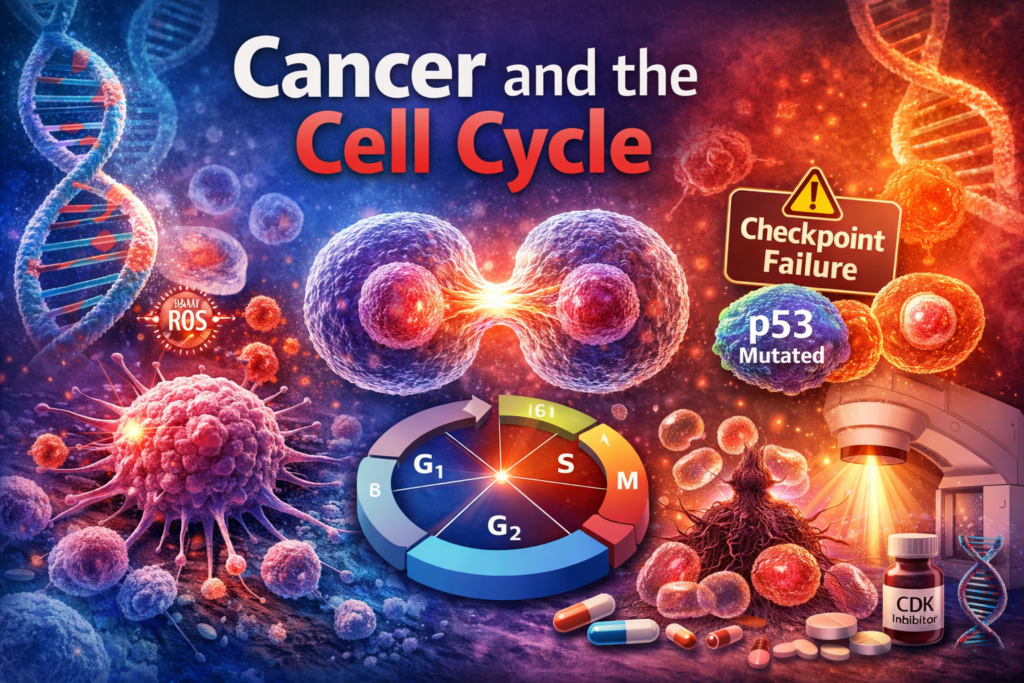
The cell cycle is a series of phases that a cell goes through to duplicate itself. It ensures that DNA is accurately copied and distributed into two daughter cells.
The Main Phases of the Cell Cycle
- G1 Phase (Growth Phase): The cell grows and prepares for DNA replication
- S Phase (Synthesis Phase): DNA is replicated
- G2 Phase (Preparation Phase): The cell prepares for division
- M Phase (Mitosis): The cell divides into two identical cells
Each phase is regulated by complex signaling pathways that ensure everything occurs in the correct order.
In normal cells, the cycle only proceeds if conditions are favorable. In cancer cells, these safeguards are often disabled.
DNA Replication in Cancer Cells
DNA replication occurs during the S phase of the cell cycle. This process must be highly accurate to prevent mutations.
Cancer cells often replicate DNA rapidly and with reduced accuracy, leading to:
- Accumulation of mutations
- Genomic instability
- Increased adaptability to stress and therapy
Rapid DNA replication also increases metabolic demand. Cancer cells require large amounts of:
- Glucose
- Nucleotides
- Amino acids
This is why tumor metabolism is closely tied to cell cycle progression. You can explore this connection further here:
https://helping4cancer.com/tumor-metabolism-vs-normal-cells/
Mitosis and Tumor Expansion
Mitosis is the phase where a cell physically divides into two daughter cells. In cancer, mitosis becomes highly active and often abnormal.
Key Features of Cancer Mitosis
- Faster division rates
- Chromosomal mis-segregation
- Aneuploidy (abnormal chromosome numbers)
- Increased mutation burden
These abnormalities allow tumors to evolve rapidly, creating more aggressive and treatment-resistant cells.
Drugs like chemotherapy specifically target mitosis because rapidly dividing cells are more vulnerable during this phase.
Cell Cycle Checkpoints: The Body’s Safety System
Cell cycle checkpoints are control mechanisms that ensure cells only divide when it is safe to do so.
Major Checkpoints
- G1 Checkpoint: Ensures DNA is intact before replication
- G2 Checkpoint: Verifies DNA replication is complete
- M Checkpoint: Confirms proper chromosome alignment before division
These checkpoints act as quality control systems.
If damage is detected, the cell can:
- Pause the cycle
- Repair DNA
- Trigger apoptosis (programmed cell death)
How Cancer Cells Bypass Checkpoints
Cancer cells develop mutations that disable checkpoint control, allowing them to divide unchecked.
Key Mechanisms
- Loss of tumor suppressor genes (such as p53)
- Overactivation of growth signals (such as cyclins and CDKs)
- Reduced DNA repair capacity
- Resistance to apoptosis
The tumor suppressor protein p53 is especially important. It acts as a “guardian of the genome,” stopping the cycle when DNA damage is detected.
When p53 is mutated, cells continue dividing despite severe genetic damage.
External reference: https://www.ncbi.nlm.nih.gov/pmc/articles/PMC6616752/
Cyclins, CDKs, and Cell Cycle Control
The cell cycle is regulated by proteins called cyclins and cyclin-dependent kinases (CDKs). These molecules act as switches that move the cell from one phase to the next.
How They Work
- Cyclins rise and fall during the cycle
- CDKs are activated by cyclins
- Together, they drive progression through each phase
In cancer:
- Cyclins are often overproduced
- CDKs become hyperactive
- Cell division becomes continuous
This is why CDK inhibitors are used in modern cancer therapies to slow tumor growth.
The Role of Apoptosis in Cell Cycle Regulation
Apoptosis is programmed cell death. It serves as a backup system when cells are damaged beyond repair.
In healthy cells:
- DNA damage triggers apoptosis
- Faulty cells are eliminated
In cancer cells:
- Apoptosis pathways are suppressed
- Damaged cells survive and continue dividing
This allows cancer cells to accumulate mutations and become more aggressive.
Learn more about this process here:
https://helping4cancer.com/apoptosis-resistance-cancer/
Metabolic Demands of Rapid Cell Division
Cancer cell division requires enormous amounts of energy and raw materials.
Key Metabolic Changes
- Increased glucose uptake (Warburg effect)
- Enhanced glycolysis
- Increased nucleotide synthesis
- Elevated mitochondrial stress
These changes support rapid DNA replication and cell division.
However, they also create vulnerabilities. Cancer cells operate near metabolic limits, making them sensitive to:
- Oxidative stress
- Nutrient restriction
- Mitochondrial disruption
Explore this further:
https://helping4cancer.com/metabolic-therapy-cancer/
Reactive Oxygen Species (ROS) and the Cell Cycle
Reactive oxygen species (ROS) are chemically reactive molecules that can damage DNA, proteins, and cell membranes.
Dual Role of ROS
- Low levels: Promote cell signaling and growth
- High levels: Cause cellular damage and death
Cancer cells often maintain elevated ROS levels to support proliferation. However, excessive ROS can overwhelm them.
This creates a therapeutic opportunity:
- Increasing ROS can push cancer cells into death
- Normal cells are better equipped to manage oxidative stress
External reference: https://www.nature.com/articles/nrc.2017.88
Why the Cell Cycle Matters in Cancer Treatment
Many cancer therapies specifically target the cell cycle.
Chemotherapy
Chemotherapy drugs often target rapidly dividing cells by:
- Damaging DNA
- Blocking mitosis
- Interfering with replication
Because cancer cells divide faster than normal cells, they are more affected.
Radiation Therapy
Radiation causes DNA damage, especially in dividing cells.
- Double-strand DNA breaks
- Increased ROS production
- Cell cycle arrest and apoptosis
Learn more here:
https://helping4cancer.com/radiation-therapy-kills-cancer-cells/
Targeted Therapies
Modern treatments focus on specific cell cycle regulators:
- CDK inhibitors
- Growth factor blockers
- Signal pathway inhibitors
These therapies aim to slow or stop tumor growth with fewer side effects.
The Link Between the Cell Cycle and Tumor Growth
Tumor growth is essentially uncontrolled cell cycle progression.
Cancer cells:
- Ignore stop signals
- Divide without limits
- Accumulate mutations
- Adapt to stress
This creates a cycle of continuous expansion.
Understanding this process explains why cancer can grow rapidly and become resistant to treatment.
Cell Cycle Dysregulation and Cancer Progression
As tumors evolve, cell cycle control becomes increasingly disrupted.
Advanced Tumor Characteristics
- Shortened cell cycle duration
- Increased mutation rates
- Greater heterogeneity
- Resistance to therapy
This makes late-stage cancers more difficult to treat.
Cell cycle dysregulation is also closely linked to other cancer processes, including:
- Tumor survival pathways
- Immune evasion
- Metabolic reprogramming
Related topic:
https://helping4cancer.com/tumor-survival-network/
Key Takeaways
- The cell cycle controls how cells grow and divide
- Cancer disrupts this process, leading to uncontrolled proliferation
- DNA replication and mitosis become accelerated and error-prone
- Checkpoints fail due to mutations in key genes like p53
- Cyclins and CDKs drive continuous cell division in tumors
- Apoptosis is suppressed, allowing damaged cells to survive
- Cancer cells depend on altered metabolism to sustain rapid division
- ROS plays a dual role in promoting and destroying cancer cells
- Many treatments work by targeting different stages of the cell cycle
Conclusion
The cancer cell cycle is at the core of tumor growth and progression. By bypassing normal regulatory controls, cancer cells gain the ability to divide endlessly, adapt quickly, and resist treatment.
This process is not random. It is driven by specific molecular changes in DNA replication, checkpoint control, and metabolic function. These vulnerabilities provide opportunities for targeted therapies that disrupt cancer’s ability to multiply.
Understanding the cell cycle gives a clear framework for how cancer operates—and how it can be stopped.
External References
https://www.ncbi.nlm.nih.gov/pmc/articles/PMC6616752/
https://www.nature.com/articles/nrc.2017.88
https://pubmed.ncbi.nlm.nih.gov/31341284/
https://www.cancer.gov/about-cancer/understanding/what-is-cancer
Table of Contents