What Is the Endoplasmic Reticulum?
The endoplasmic reticulum (ER) is a critical organelle responsible for protein folding, lipid synthesis, and calcium storage. It acts as a quality control system, ensuring proteins are correctly shaped before being sent to their final destinations.
In healthy cells, this process is tightly regulated. However, when protein folding becomes disrupted, the ER enters a state known as ER stress.
ER stress occurs when misfolded or unfolded proteins accumulate faster than the cell can process them. This imbalance activates a protective signaling network called the unfolded protein response (UPR).
What Causes ER Stress in Cancer?
Cancer cells exist in a highly stressful environment. Rapid growth, poor blood supply, and metabolic dysfunction create constant pressure on cellular systems.
Key drivers of ER stress in tumors include:
- Hypoxia (low oxygen levels)
- Nutrient deprivation
- High protein synthesis demand
- Oxidative stress (ROS buildup)
- Disrupted calcium signaling
- Mitochondrial dysfunction
These conditions overload the ER, forcing cancer cells to rely heavily on adaptive stress pathways to survive.
The Unfolded Protein Response (UPR): A Survival System
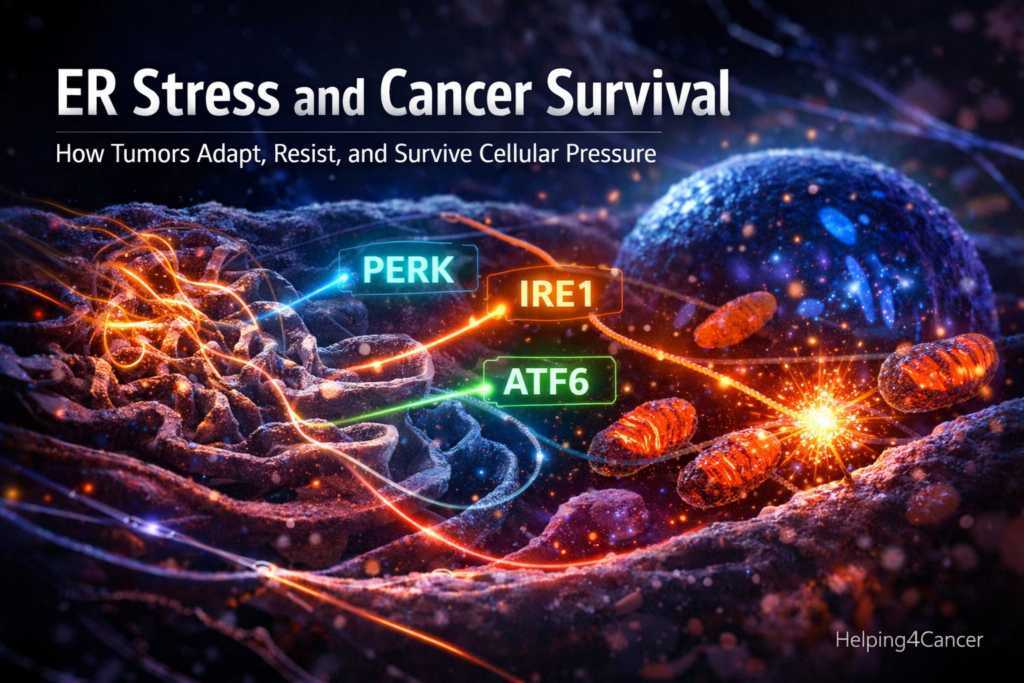
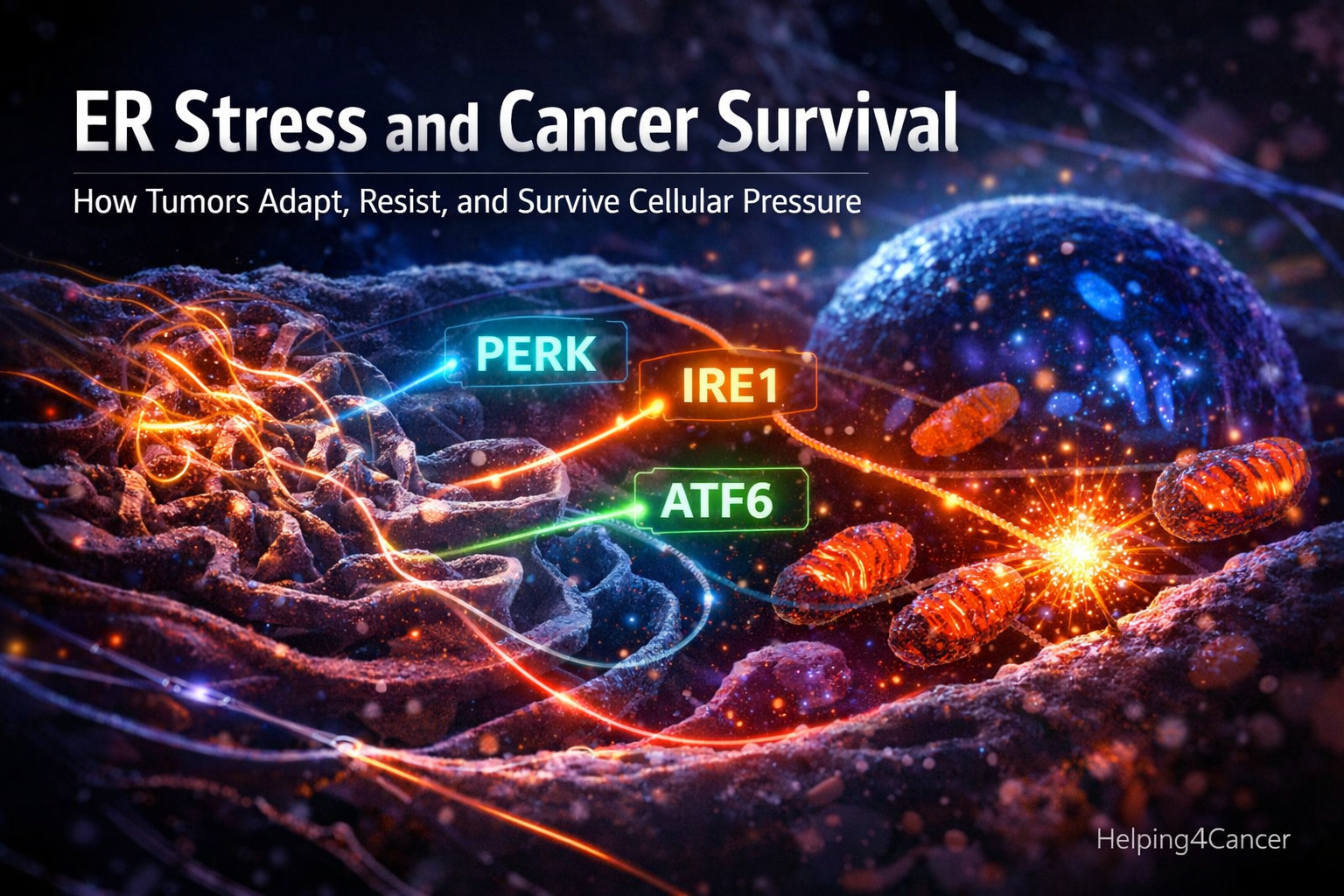
The unfolded protein response is a set of signaling pathways designed to restore balance inside the ER. It has three primary sensors:
PERK (Protein Kinase RNA-like ER Kinase)
PERK reduces overall protein production to decrease the folding burden.
- Slows translation to prevent overload
- Activates ATF4, which promotes stress adaptation
- Increases antioxidant defenses
PERK helps cancer cells survive oxidative stress and nutrient scarcity.
IRE1 (Inositol-Requiring Enzyme 1)
IRE1 is involved in both survival and inflammation signaling.
- Splices XBP1 mRNA to increase protein folding capacity
- Enhances lipid synthesis for membrane expansion
- Activates survival pathways like JNK and NF-κB
IRE1 supports tumor growth and adaptation under stress.
ATF6 (Activating Transcription Factor 6)
ATF6 increases the production of chaperone proteins.
- Enhances protein folding machinery
- Expands ER capacity
- Promotes cellular recovery
Together, PERK, IRE1, and ATF6 form a coordinated response that allows cancer cells to survive hostile conditions.
ER Stress and Cancer Metabolism
Cancer metabolism is fundamentally altered compared to normal cells. Tumors rely on rapid protein production and metabolic reprogramming, which increases ER workload.
ER stress is tightly linked to:
- Glycolysis (Warburg effect)
- Lipid synthesis
- Amino acid metabolism
- Mitochondrial signaling
The UPR helps cancer cells maintain metabolic flexibility, allowing them to adapt to changing conditions.
For example:
- PERK activation supports antioxidant production to balance ROS
- IRE1 enhances lipid synthesis for rapidly dividing cells
- ATF6 increases folding capacity to sustain high protein output
This makes ER stress a central hub connecting metabolism and survival.
ER Stress and Reactive Oxygen Species (ROS)
Reactive oxygen species (ROS) play a dual role in cancer.
- Moderate ROS levels promote tumor growth and signaling
- Excess ROS can trigger cell death
ER stress interacts closely with ROS production.
- Protein folding generates oxidative byproducts
- Calcium imbalance affects mitochondrial ROS output
- PERK signaling increases antioxidant defenses
Cancer cells use the UPR to maintain ROS within a survivable range. This balance is critical.
Too little ROS reduces therapeutic effectiveness. Too much ROS overwhelms defenses and triggers apoptosis.
This is why ER stress is deeply connected to oxidative stress-based therapies.
ER Stress and Tumor Survival Pathways
The UPR does not operate in isolation. It connects with major tumor survival pathways:
- PI3K/Akt: Promotes growth and survival under stress
- NF-κB: Drives inflammation and resistance
- STAT3: Supports immune evasion and proliferation
- mTOR: Regulates protein synthesis and metabolism
ER stress amplifies these pathways, creating a network of protection around cancer cells.
This network allows tumors to:
- Resist chemotherapy
- Survive radiation-induced damage
- Adapt to immune attack
- Continue growing under metabolic stress
ER Stress and Apoptosis: The Tipping Point
While the UPR is primarily protective, it has a built-in fail-safe.
If ER stress becomes too severe or prolonged, the system shifts from survival to cell death.
Key pro-apoptotic signals include:
- CHOP (C/EBP homologous protein)
- Caspase activation
- Mitochondrial dysfunction
This creates a critical tipping point.
- Mild to moderate ER stress = survival and adaptation
- Severe ER stress = apoptosis and cell death
Cancer cells attempt to stay just below this threshold, maintaining survival without triggering collapse.
ER Stress and Drug Resistance
One of the most important roles of ER stress in cancer is its contribution to treatment resistance.
The UPR allows cancer cells to:
- Recover from chemotherapy-induced damage
- Repair misfolded proteins caused by stress
- Increase antioxidant defenses
- Adapt to targeted therapies
For example:
- PERK signaling reduces damage from oxidative therapies
- IRE1 supports tumor regrowth after treatment
- ATF6 enhances recovery after cellular stress
This makes ER stress a major barrier to effective treatment.
ER Stress and the Tumor Microenvironment
Tumors do not exist in isolation. The surrounding microenvironment plays a key role in cancer progression.
ER stress influences:
- Immune cell suppression
- Inflammation signaling
- Angiogenesis (new blood vessel formation)
The UPR can suppress immune responses, helping tumors avoid detection.
It also promotes the release of signaling molecules that reshape the tumor microenvironment to support growth.
ER Stress as a Therapeutic Target
Because ER stress is essential for tumor survival, it has become a target for new therapies.
Strategies include:
Increasing ER Stress Beyond the Tipping Point
By overwhelming the ER, therapies can push cancer cells into apoptosis.
- Proteasome inhibitors
- ROS-inducing agents
- Metabolic stress strategies (fasting, glucose restriction)
Blocking the UPR
Inhibiting key UPR pathways can remove the tumor’s protective shield.
- PERK inhibitors
- IRE1 inhibitors
- ATF6 modulation
Disrupting Protein Folding
Targeting chaperone proteins prevents proper protein folding, increasing stress.
- Heat shock protein inhibitors
- ER chaperone blockers
These approaches aim to destabilize cancer cells from within.
Why ER Stress Matters in Cancer Treatment
Understanding ER stress provides insight into how cancer survives under pressure.
Key takeaways:
- Cancer cells rely on ER stress adaptation to survive harsh conditions
- The unfolded protein response acts as a protective shield
- ER stress connects metabolism, ROS, and survival pathways
- Tumors balance stress carefully to avoid triggering cell death
- Targeting ER stress may improve treatment outcomes
ER stress is not just a side effect of cancer. It is a central survival mechanism.
Internal Links (Helping4Cancer.com)
Metabolic Therapy for Cancer
https://helping4cancer.com/metabolic-therapy-cancer/
Cancer and Oxidative Stress
https://helping4cancer.com/cancer-oxidative-stress/
Tumor Survival Network
https://helping4cancer.com/tumor-survival-network/
Cancer and Mitochondria
https://helping4cancer.com/cancer-and-mitochondria/
Tumor Immune Cloaking
https://helping4cancer.com/tumor-immune-cloaking/
External References
National Cancer Institute – https://www.cancer.gov
PubMed – https://pubmed.ncbi.nlm.nih.gov
Nature Reviews Cancer – https://www.nature.com/nrc
NIH – https://www.nih.gov
Cell Press – https://www.cell.com
Table of Contents