What This Page Explains
This page explains:
- Why the bloodstream is dangerous for cancer cells
- How cancer cells avoid being destroyed
- How platelets protect cancer cells
- How immune cells attack cancer
- Why only a small number of cells survive
- How survival leads to metastasis
Why Survival in the Bloodstream Is So Difficult
When a cancer cell enters the bloodstream, it enters a hostile environment.
From the previous page:
👉 https://helping4cancer.com/circulating-tumor-cell
We learned that most cancer cells die quickly.
Now we explain why.
The Bloodstream Is Not Designed for Cancer Cells
Cancer cells evolved to live in tissue, not in flowing blood.
In the bloodstream, they face:
- Constant movement
- Strong physical forces
- Direct immune exposure
- No structural support
This makes survival extremely difficult.
The Three Main Threats to Cancer Cells in Blood
1. Physical Forces (Shear Stress)
Blood flow creates pressure and friction.
This can:
- Damage the cell membrane
- Break cells apart
- Cause immediate death
Only stronger, more flexible cells survive.
2. Loss of Support
Inside a tumor, cells rely on:
- Nearby cells
- Growth signals
- Nutrient supply
In the bloodstream:
- These supports are gone
- The cell must survive alone
3. Immediate Immune Attack
The bloodstream is constantly monitored.
Immune cells are always searching for threats.
Learn more here:
https://helping4cancer.com/cancer-immune-system/
The Immune System: First Line of Defense
Two main immune cells attack cancer in the blood:
Natural Killer (NK) Cells
- Fast and aggressive
- Attack abnormal cells immediately
- Do not require prior exposure
They are the first to respond to circulating tumor cells.
T Cells
- Slower but precise
- Recognize specific cancer markers
- Deliver targeted destruction
These cells are part of adaptive immunity.
Why Most Cancer Cells Are Destroyed
Because of these threats:
The majority of circulating tumor cells are eliminated within hours
This is why metastasis is rare compared to the number of cells that enter the bloodstream.
How Cancer Cells Survive the Bloodstream
A small number of cancer cells survive using advanced strategies.
These are not normal cells.
They are highly adapted.
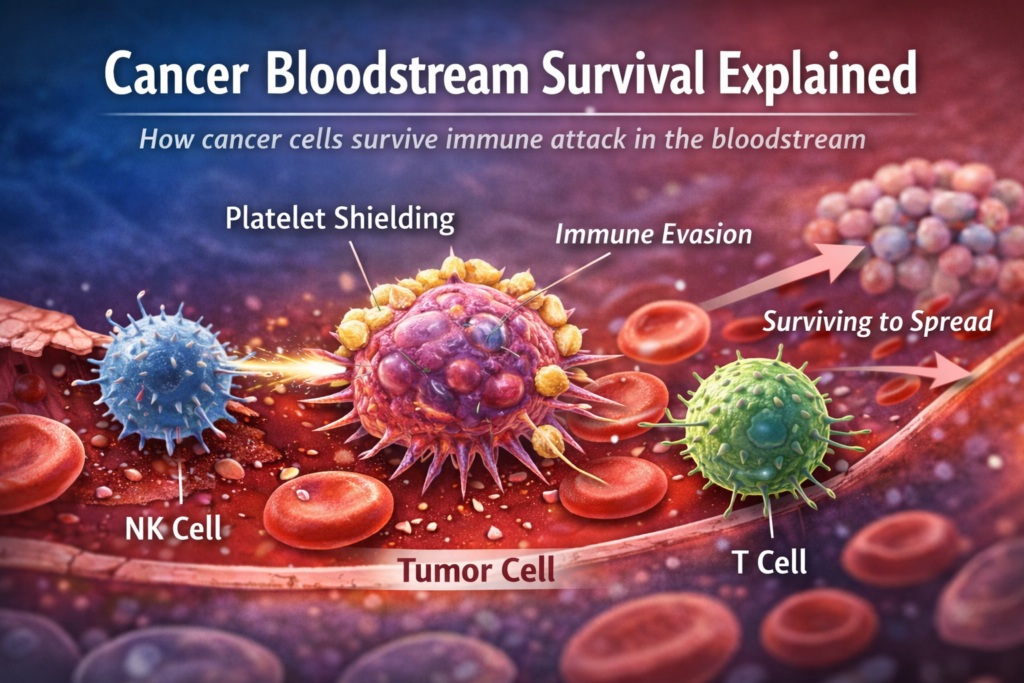
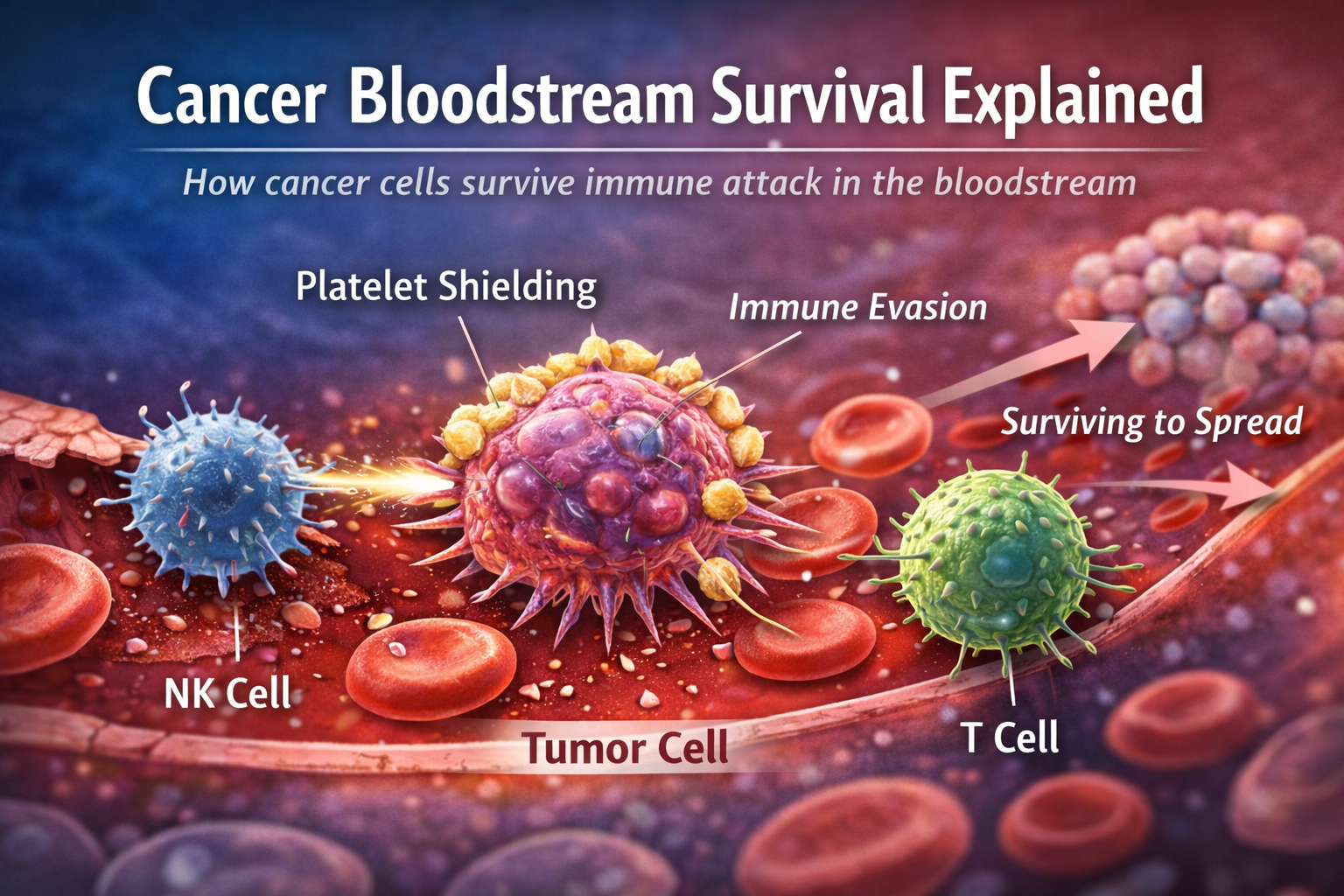
1. Platelet Cloaking (One of the Most Important Mechanisms)
Cancer cells can attach themselves to platelets.
Platelets are normal blood components involved in clotting.
What This Does:
- Covers the cancer cell
- Hides it from immune detection
- Protects it from physical damage
This is called:
👉 Platelet cloaking
Why It Works
Immune cells recognize abnormal cells.
But when cancer is covered in platelets:
- It looks like normal tissue
- Immune cells are less likely to attack
2. Immune Evasion
Cancer cells actively avoid detection.
They do this by:
- Reducing surface signals
- Blocking immune recognition
- Suppressing immune response
Learn more:
👉 https://helping4cancer.com/cancer-immune-evasion
3. Traveling in Clusters
Some cancer cells travel in groups.
These clusters:
- Protect inner cells
- Increase survival rates
- Are more resistant to stress
Cluster survival is much higher than single-cell survival.
4. Mechanical Flexibility
Cancer cells that survive are often more flexible.
This allows them to:
- Withstand blood flow
- Avoid breaking apart
- Navigate tight spaces
This connects to:
👉 https://helping4cancer.com/emt-cancer
5. Metabolic Adaptation
Surviving cancer cells adjust how they produce energy.
They can:
- Use alternative fuel sources
- Reduce energy needs
- Adapt to stress
Learn more:
https://helping4cancer.com/cancer-metabolism-explained/
The Role of the Tumor Microenvironment
Even in the bloodstream, cancer cells carry signals from their original environment.
These signals help them:
- Stay alive
- Avoid detection
- Prepare for the next stage
Learn more:
https://helping4cancer.com/tumor-microenvironment/
What Happens After Survival?
If a cancer cell survives the bloodstream, it moves to the next phase.
Step 1: Attachment
The cell attaches to the wall of a blood vessel.
Step 2: Exit (Extravasation)
The cell exits the bloodstream into new tissue.
👉 https://helping4cancer.com/cancer-extravasation
Step 3: Decision Point
Once in new tissue, the cell can:
- Grow immediately
- Or enter dormancy
Why Many Cells Do NOT Grow Immediately
Most surviving cancer cells do not start growing right away.
Instead, they:
- Slow down
- Hide
- Conserve energy
This is called dormancy.
Learn more:
👉 https://helping4cancer.com/cancer-dormancy
👉 https://helping4cancer.com/cancer-dormancy-late-recurrence/
The Critical Reality of Cancer Spread
Here is the key idea:
Survival is the hardest step in cancer spread
Not entry.
Not growth.
👉 Survival.
Connecting to the Bigger System
Bloodstream survival connects directly to:
- Circulating tumor cells → /circulating-tumor-cell
- Immune evasion → /cancer-immune-evasion
- Dormancy → /cancer-dormancy
- Autophagy survival → /autophagy-cancer-survival
Each step builds on the previous one.
The Most Important Concept
Cancer does not spread easily.
It spreads because a few cells:
- Survive
- Adapt
- Avoid the immune system
Key Takeaways
- The bloodstream is extremely dangerous for cancer cells
- Most circulating tumor cells die quickly
- The immune system attacks immediately
- Platelets help cancer cells hide
- Clusters and flexibility improve survival
- Only a small number of cells survive to spread cancer
External References
National Cancer Institute
https://www.cancer.gov/about-cancer/understanding/what-is-cancer
Nature Reviews Cancer – Tumor Cell Survival
https://www.nature.com/articles/nrc.2017.15
Frontiers in Oncology – Circulating Tumor Cells
https://www.frontiersin.org/articles/10.3389/fonc.2019.00019/full
Continue Learning
Next page:
👉 https://helping4cancer.com/nk-t-cell-cancer
Also explore:
- https://helping4cancer.com/cancer-immune-evasion
- https://helping4cancer.com/cancer-dormancy
- https://helping4cancer.com/autophagy-cancer-survival
- https://helping4cancer.com/p38-erk-cancer