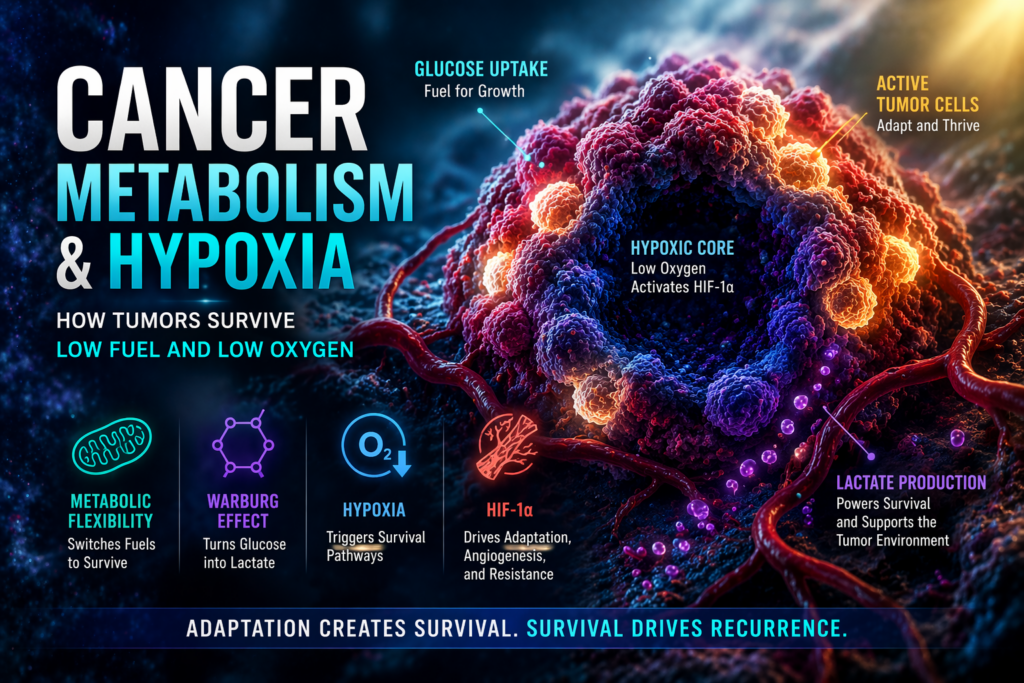
Cancer cells survive by changing how they produce and use energy.
Research shows that tumors are not limited to a single fuel system. Instead, cancer cells adapt continuously based on oxygen levels, nutrient availability, and environmental stress. This flexibility allows survival in conditions that would normally kill healthy cells.
Cancer Uses Multiple Fuel Systems
Cancer cells can shift between:
- glucose metabolism (glycolysis)
- oxygen-based metabolism (oxidative phosphorylation)
- fatty acid metabolism
- glutamine metabolism
Internal Link:
https://helping4cancer.com/cancer-metabolic-evasion/
This is known as metabolic flexibility.
Instead of relying on one pathway, cancer cells switch depending on what is available. This makes them highly adaptable and difficult to target.
The Warburg Effect
One of the most studied features of cancer metabolism is the Warburg effect.
Cancer cells often convert glucose into lactate even when oxygen is available.
Internal Link:
https://helping4cancer.com/cancer-lactate-acid/
This allows:
- rapid ATP production
- generation of building materials for growth
- changes to the tumor environment
Reverse Metabolism and Tumor Support
Research shows that cancer cells can also rely on surrounding cells.
Nearby stromal cells may:
- produce lactate
- release nutrients
- support tumor metabolism
Cancer cells then use these resources, creating a cooperative environment that supports survival.
Hypoxia: Survival in Low Oxygen
As tumors grow, oxygen supply becomes limited. This leads to hypoxia.
Internal Link:
https://helping4cancer.com/tumor-hypoxia-hif1a/
Hypoxia activates HIF-1 alpha, a key survival regulator.
What HIF-1 Alpha Does
When oxygen levels drop:
- HIF-1 alpha stabilizes
- moves into the nucleus
- activates survival genes
These genes include:
- VEGF → promotes blood vessel formation
- GLUT1 → increases glucose uptake
- LDHA → increases lactate production
This allows cancer cells to survive and adapt in low oxygen environments.
Why Hypoxia Increases Resistance
Hypoxic tumors are more difficult to treat because:
- reduced blood flow limits drug delivery
- radiation therapy becomes less effective
- immune cell activity is reduced
- survival pathways are increased
Hypoxia and Dormancy
Hypoxia is closely linked to dormancy.
Low oxygen environments can:
- slow cell growth
- increase stress tolerance
- support survival signaling
Internal Links:
https://helping4cancer.com/cancer-dormancy/
https://helping4cancer.com/disseminated-tumor-cell/
This allows cancer cells to remain alive without actively dividing.
Metabolic Adaptation and Treatment Resistance
Metabolic flexibility allows cancer cells to:
- survive nutrient deprivation
- adapt to therapy
- maintain energy under stress
Instead of dying, cells shift into alternative metabolic states.
This is a major contributor to treatment resistance.
External Research Sources
Cancer metabolism review
https://pmc.ncbi.nlm.nih.gov/articles/PMC11529905/
Hypoxia and tumor progression
https://pmc.ncbi.nlm.nih.gov/articles/PMC5045092/
These sources describe how metabolic flexibility and hypoxia contribute to survival and resistance in cancer.
Internal Links for Site Structure
Metabolic Evasion → https://helping4cancer.com/cancer-metabolic-evasion/
Hypoxia → https://helping4cancer.com/tumor-hypoxia-hif1a/
Lactate & Acid → https://helping4cancer.com/cancer-lactate-acid/
Dormancy → https://helping4cancer.com/cancer-dormancy/
Key Takeaway
Cancer cells that can:
- switch fuel systems
- survive low oxygen
- adapt metabolism
gain a strong survival advantage.
Metabolism and hypoxia are central to how cancer persists under stress and resists treatment.
Final Line
Cancer survival depends on energy and environment.
When metabolism adapts and oxygen becomes limited, survival increases and elimination becomes more difficult.
Next Page: EMT and Immune Evasion in Cancer: How Tumors Change Identity and Hide from the Immune System