Cancer survival depends not only on growth, but on adaptability and avoidance.
Research shows that cancer cells can change identity, move through the body, and avoid immune detection. These abilities are driven by two major systems:
- EMT (epithelial-mesenchymal transition)
- immune evasion
Together, these systems allow cancer to spread, survive, and resist treatment.
EMT: How Cancer Cells Change Identity
EMT is a biological process where cells shift from a stable, attached state to a more mobile and adaptable state.
During EMT, cancer cells:
- lose tight cell-to-cell connections
- gain mobility
- become more resistant to stress
Internal Link:
https://helping4cancer.com/emt-cancer/
Key EMT Changes
During this transition:
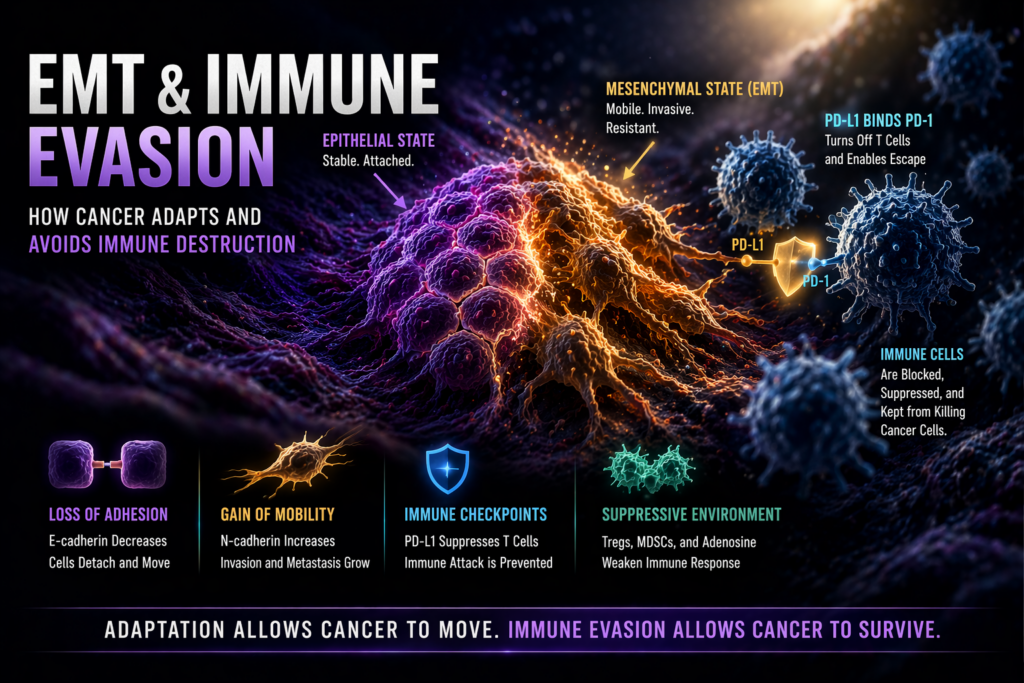
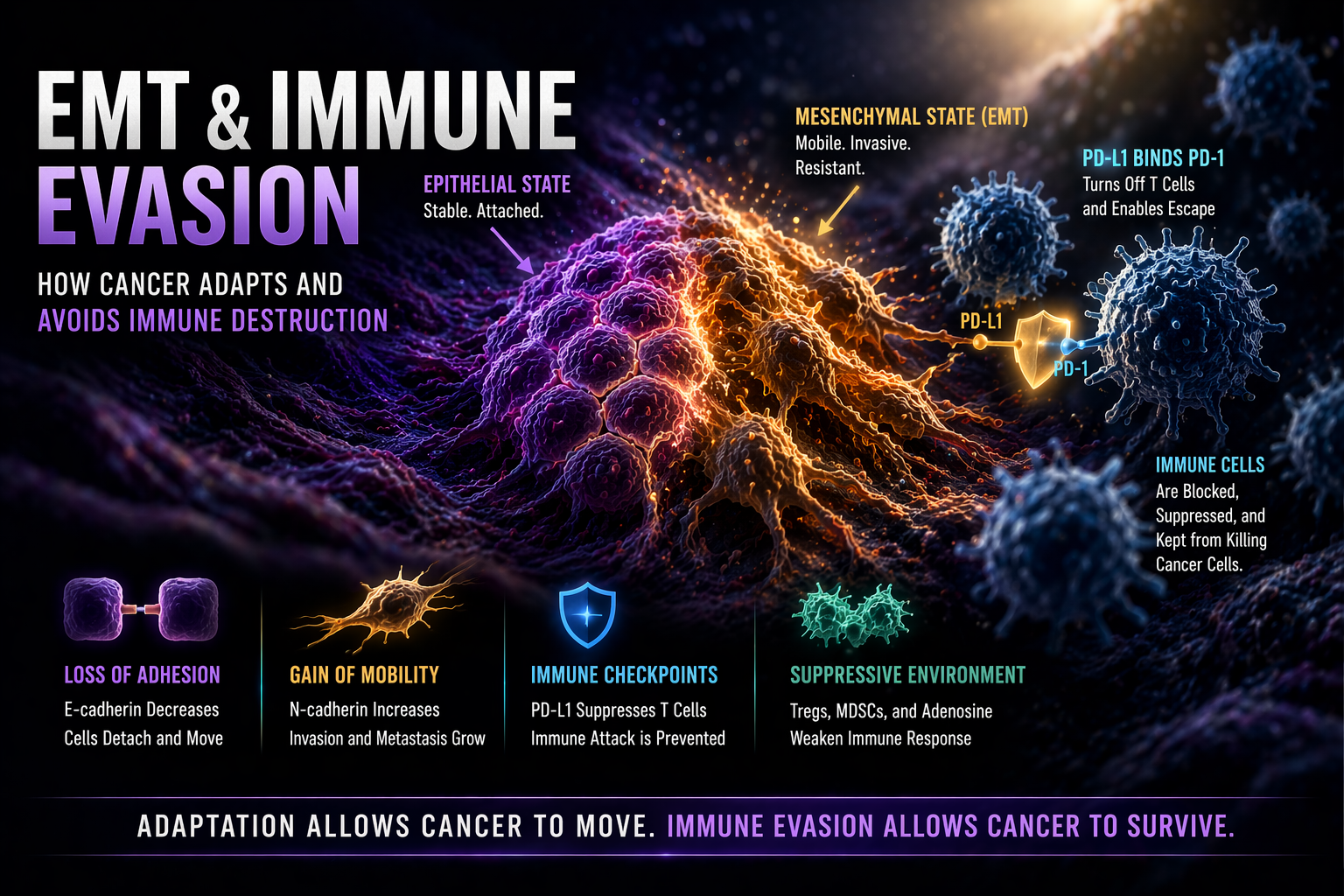
- E-cadherin decreases (loss of adhesion)
- N-cadherin increases (enhanced mobility)
- cells become more flexible and invasive
This allows cancer cells to move through tissue and enter the bloodstream.
EMT and Metastasis
EMT plays a major role in metastasis.
Cancer cells that undergo EMT can:
- detach from the primary tumor
- survive in circulation
- invade distant tissues
Internal Links:
https://helping4cancer.com/circulating-tumor-cell/
https://helping4cancer.com/cancer-extravasation/
Hybrid EMT States
Research shows EMT is not a simple on/off switch.
Many cancer cells exist in hybrid states that combine:
- mobility
- survival
- partial adhesion
These hybrid cells may be especially dangerous because they balance adaptability with survival.
EMT and Treatment Resistance
EMT is linked to:
- chemotherapy resistance
- radiation resistance
- survival under stress
Cells in EMT states often activate survival pathways that make them harder to eliminate.
Immune Evasion: Avoiding Detection
The immune system is designed to detect and destroy abnormal cells.
Cancer survives by avoiding this process.
How Cancer Evades the Immune System
Cancer cells use several strategies:
1. Reduced Visibility
- lower antigen presentation
- reduced MHC expression
2. Immune Checkpoints
- PD-L1 binds to PD-1 on T cells
- T cells become inactive
3. Suppressive Environment
- recruitment of Tregs
- activation of MDSCs
- macrophage polarization
Internal Links:
https://helping4cancer.com/cancer-immune-evasion/
https://helping4cancer.com/nk-t-cell-cancer/
Tumor Microenvironment and Immune Suppression
The tumor microenvironment supports immune evasion.
Cancer cells create conditions that weaken immune response:
- release of suppressive cytokines
- increased adenosine levels
- metabolic competition
Internal Link:
https://helping4cancer.com/cancer-adenosine-immune/
Immune Suppression and Dormancy
Immune evasion is closely linked to dormancy.
Dormant cells:
- are less visible
- produce fewer signals
- survive longer
Internal Links:
https://helping4cancer.com/cancer-dormancy/
https://helping4cancer.com/disseminated-tumor-cell/
This allows cancer to persist even when active growth is not occurring.
External Research Sources
Immune evasion review
https://pmc.ncbi.nlm.nih.gov/articles/PMC9171538/
EMT and cancer progression review
https://www.mdpi.com/2072-6694/13/3/533
These studies describe how EMT and immune evasion contribute to metastasis, resistance, and tumor survival.
Why EMT and Immune Evasion Matter
Cancer survival depends on two key abilities:
- the ability to adapt
- the ability to avoid destruction
EMT provides adaptability.
Immune evasion provides protection.
Together, they allow cancer to:
- spread
- survive
- resist treatment
- return later
Internal Links for Site Structure
EMT → https://helping4cancer.com/emt-cancer/
Immune Evasion → https://helping4cancer.com/cancer-immune-evasion/
NK & T Cells → https://helping4cancer.com/nk-t-cell-cancer/
Dormancy → https://helping4cancer.com/cancer-dormancy/
Key Takeaway
Cancer cells survive not only by growing, but by:
- changing identity
- avoiding immune attack
This combination creates one of the strongest survival advantages in cancer biology.
Final Line
Adaptation allows cancer to move.
Immune evasion allows cancer to survive.
Together, they drive persistence and recurrence.
Next Page: TGF-β, AXL, and BMP in Cancer: The Signaling Network That Connects Dormancy, EMT, and Resistance