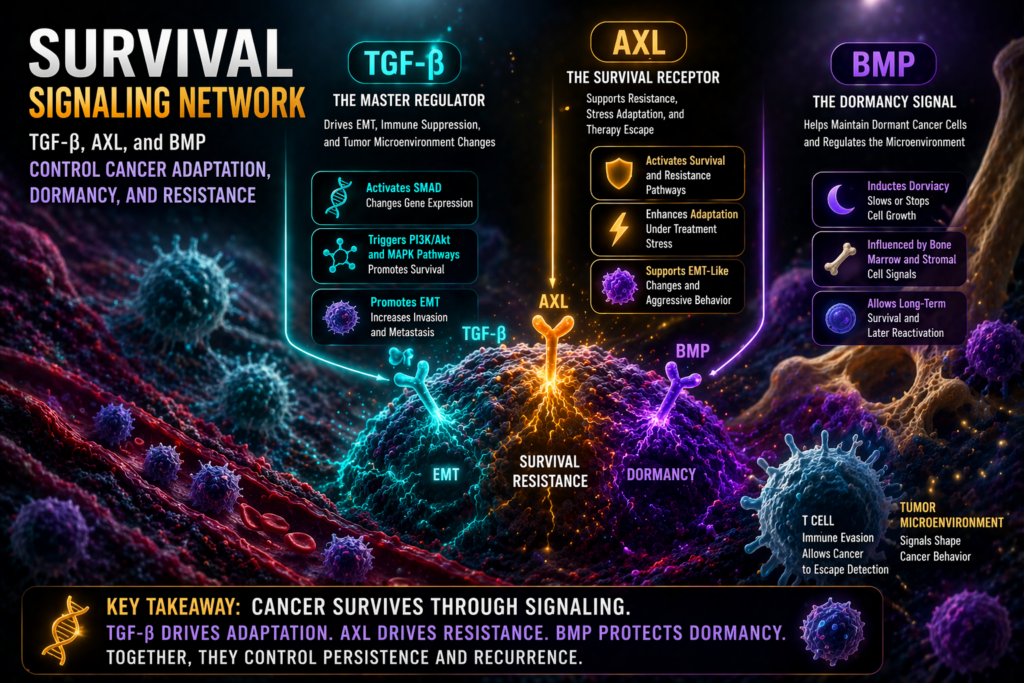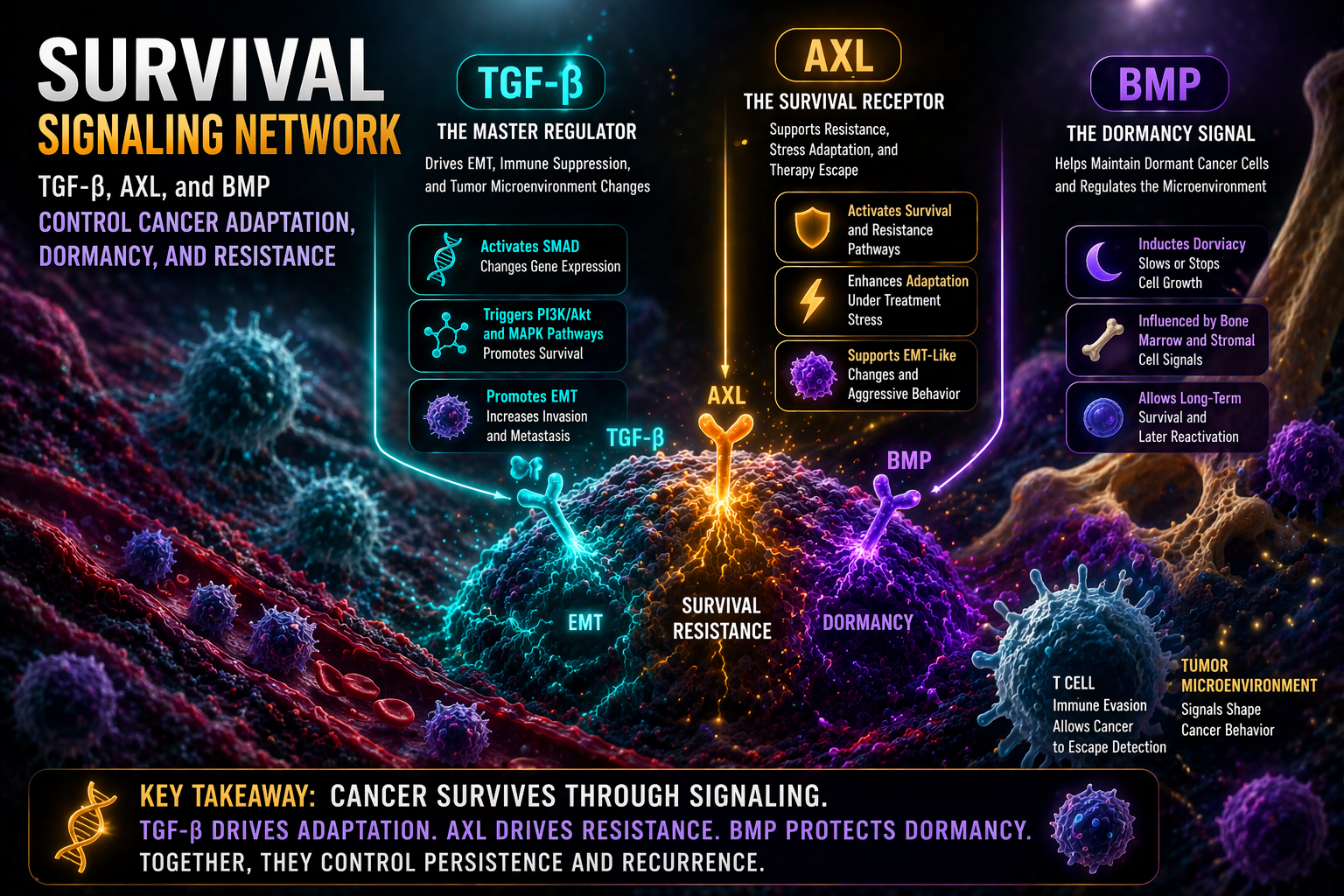
Cancer survival is controlled by signaling systems that determine how cells behave.
Research shows that certain pathways act as central regulators, influencing whether cancer cells grow, adapt, remain dormant, or resist treatment.
Three of the most important are:
- TGF-β
- AXL
- BMP
These pathways connect many of the major survival systems.
Why These Pathways Matter
Cancer cells respond to signals from their environment.
These signals determine whether cells:
- divide or stop growing
- become invasive
- suppress immune response
- remain dormant
- reactivate later
This makes signaling pathways critical to survival and recurrence.
TGF-β: The Master Regulator
TGF-β (transforming growth factor beta) plays a complex role in cancer.
Internal Link:
https://helping4cancer.com/tgf-beta-cancer/
Early vs Late Role
- Early stages → suppresses tumor growth
- Advanced stages → promotes survival and progression
Effects in Cancer
TGF-β drives:
- EMT (increased invasion and adaptability)
- immune suppression
- tumor microenvironment changes
- metastasis
Pathway Overview
TGF-β activates:
- SMAD signaling (gene regulation)
- PI3K/Akt and MAPK pathways (survival signaling)
This allows cancer cells to adapt and resist stress.
AXL: Survival and Resistance Signaling
AXL is a receptor that plays a major role in treatment resistance.
Internal Link:
https://helping4cancer.com/gas6-axl-cancer/
What AXL Does
AXL signaling promotes:
- cell survival
- resistance to therapy
- EMT-like changes
- adaptability under stress
Why It Matters
Cancer cells often increase AXL when stressed.
This allows them to:
- bypass treatment effects
- activate alternative survival pathways
- remain viable under pressure
AXL is strongly linked to aggressive and resistant cancer behavior.
BMP: Dormancy Control System
BMP (bone morphogenetic protein) is part of the TGF-β family.
Internal Link:
https://helping4cancer.com/bmp-cancer-dormancy/
Role in Dormancy
BMP signaling can:
- maintain cancer cells in a dormant state
- prevent immediate tumor growth
- regulate interaction with surrounding tissue
Microenvironment Control
BMP is often influenced by:
- bone marrow environment
- stromal cells
- extracellular signaling
This makes it a key factor in long-term survival.
How These Pathways Work Together
These pathways do not act alone.
They form a connected network:
- TGF-β promotes EMT and immune suppression
- AXL supports survival and resistance
- BMP maintains dormancy
Together, they control:
- whether cancer grows
- whether it spreads
- whether it remains hidden
- whether it returns
Connection to Other Survival Systems
These signaling pathways link to multiple systems:
Internal Links:
Dormancy → https://helping4cancer.com/cancer-dormancy/
EMT → https://helping4cancer.com/emt-cancer/
Immune Evasion → https://helping4cancer.com/cancer-immune-evasion/
Hypoxia → https://helping4cancer.com/tumor-hypoxia-hif1a/
This shows how signaling acts as a control layer across the entire survival system.
External Research Sources
TGF-β and cancer progression
https://pmc.ncbi.nlm.nih.gov/articles/PMC6352861/
AXL and therapy resistance
https://pmc.ncbi.nlm.nih.gov/articles/PMC6628824/
BMP and tumor dormancy
https://pmc.ncbi.nlm.nih.gov/articles/PMC4387884/
These studies describe how signaling pathways regulate survival, dormancy, and resistance in cancer.
Why Signaling Drives Resistance
Cancer cells do not rely on a single pathway.
When one pathway is blocked:
- another pathway can take over
- survival signaling can be rerouted
- resistance develops
This is one reason targeted therapies often lose effectiveness over time.
Role in Recurrence
These signaling systems help explain recurrence.
Cancer cells may:
- remain dormant through BMP signaling
- suppress immune detection through TGF-β
- survive stress through AXL
When conditions change, these cells can reactivate and begin growing again.
Key Takeaway
TGF-β, AXL, and BMP form a control network that determines:
- survival
- dormancy
- adaptation
- resistance
These pathways connect multiple survival systems into one coordinated response.
Internal Links for Site Structure
TGF-β → https://helping4cancer.com/tgf-beta-cancer/
AXL → https://helping4cancer.com/gas6-axl-cancer/
BMP → https://helping4cancer.com/bmp-cancer-dormancy/
Dormancy → https://helping4cancer.com/cancer-dormancy/
Final Line
Cancer survival is not controlled by one pathway.
It is controlled by networks that allow adaptation, protection, and persistence over time.
Next Page : Supplement Mechanism Atlas for Cancer Survival Systems: How Compounds Interact with Tumor Defense Pathways