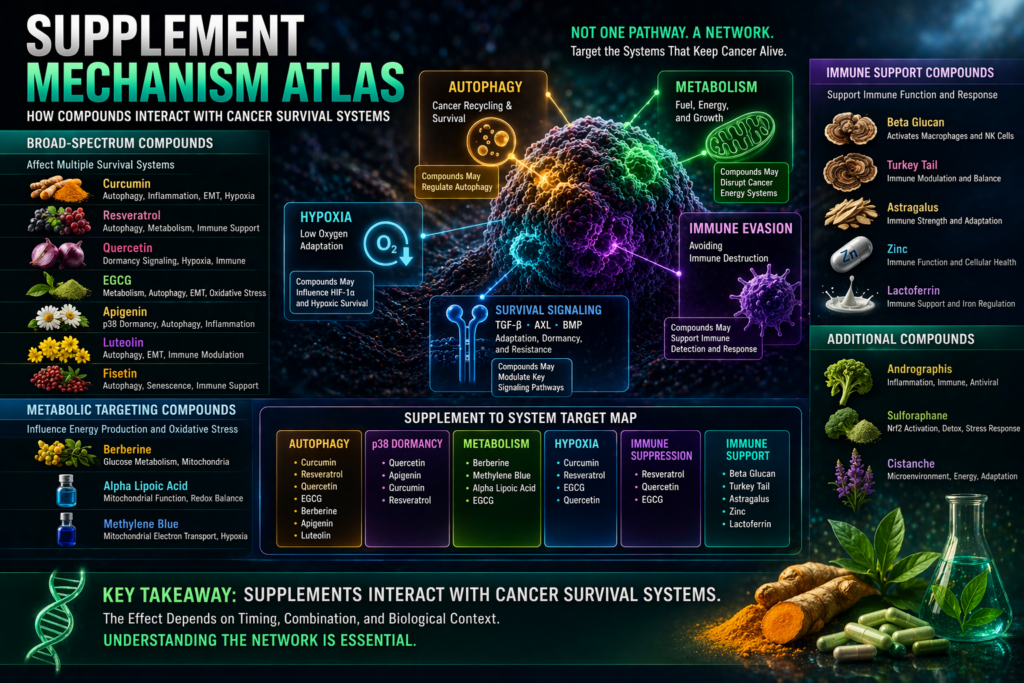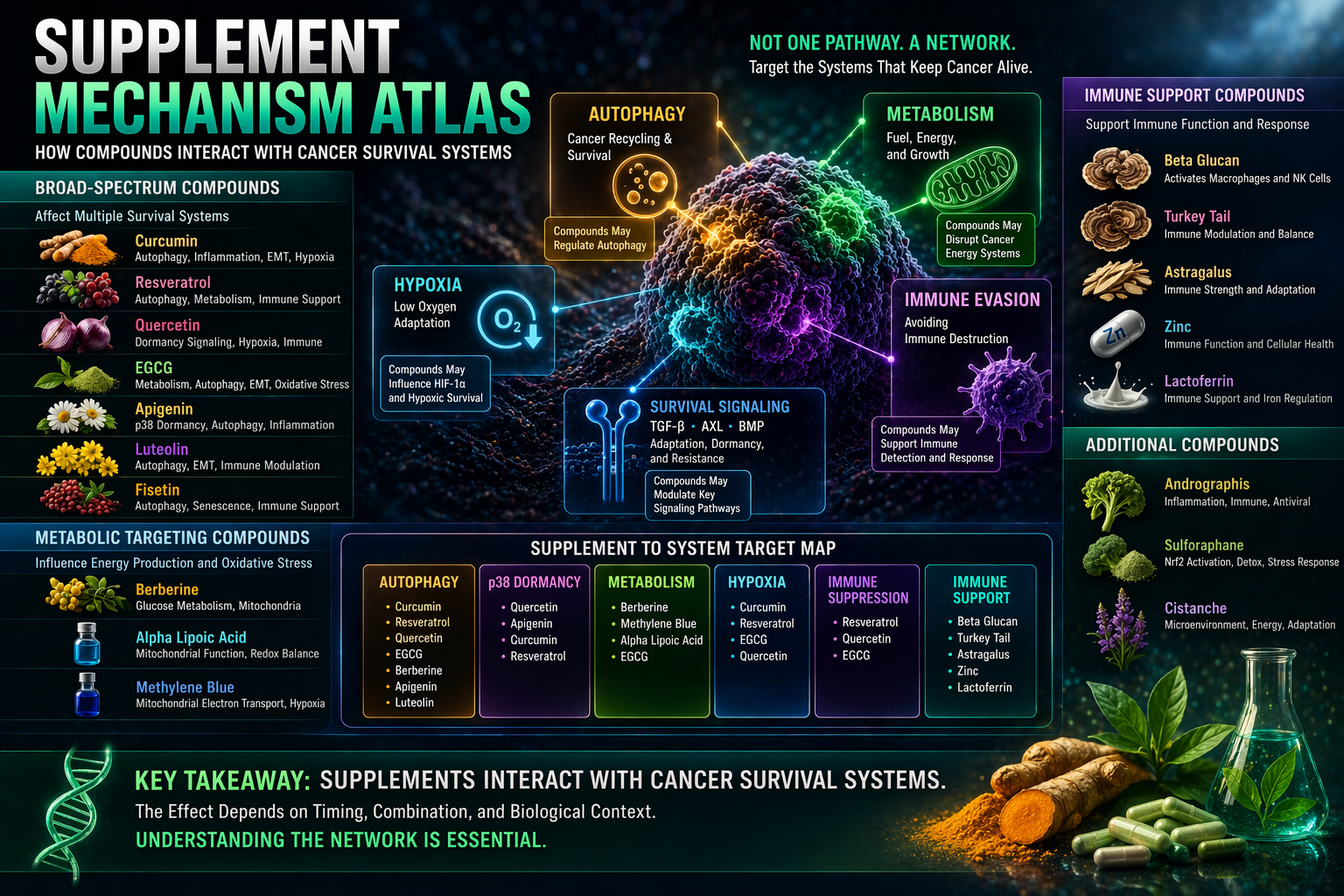
Cancer survival is driven by multiple systems working together.
Research shows that many compounds interact with these systems, sometimes affecting more than one pathway at the same time. This creates both opportunities and risks depending on how they are used.
This page connects major supplement compounds to the core survival systems described across the site.
Why This Matters
Cancer is not controlled by a single pathway.
It relies on overlapping systems:
- autophagy
- dormancy signaling
- metabolism
- hypoxia
- immune evasion
- signaling networks
Because these systems are connected, compounds that affect one system may influence others.
Core Broad-Spectrum Compounds
These compounds interact with multiple survival systems.
Curcumin
Resveratrol
Quercetin
EGCG
Apigenin
Luteolin
Fisetin
Systems Affected
These compounds are associated in research with:
- autophagy regulation
- oxidative stress modulation
- hypoxia signaling influence
- inflammatory signaling pathways
- EMT-related pathways
Internal Links:
Autophagy → https://helping4cancer.com/autophagy-cancer-survival/
Hypoxia → https://helping4cancer.com/tumor-hypoxia-hif1a/
EMT → https://helping4cancer.com/emt-cancer/
Metabolic Targeting Compounds
These compounds interact more directly with energy systems.
Berberine
Alpha Lipoic Acid
Methylene Blue
Systems Affected
Research suggests these compounds influence:
- mitochondrial function
- glucose metabolism
- oxidative stress
- cellular energy balance
Internal Link:
https://helping4cancer.com/cancer-metabolic-evasion/
Immune Support Compounds
These compounds are associated with immune system support.
Beta Glucan
Turkey Tail
Astragalus
Zinc
Lactoferrin
Systems Affected
These compounds are associated with:
- immune activation
- macrophage and NK cell activity
- modulation of immune signaling
Internal Links:
Immune System → https://helping4cancer.com/nk-t-cell-cancer/
Immune Evasion → https://helping4cancer.com/cancer-immune-evasion/
Additional Compounds
Andrographis
Sulforaphane
Cistanche
These compounds are associated with:
- antioxidant activity
- stress response pathways
- cellular signaling modulation
Supplement to System Target Map
Autophagy
curcumin, resveratrol, quercetin, EGCG, berberine, apigenin, luteolin
p38 Dormancy
quercetin, apigenin, curcumin, resveratrol
Metabolism
berberine, methylene blue, alpha lipoic acid, EGCG
Hypoxia
curcumin, resveratrol, EGCG, quercetin
Immune Suppression
resveratrol, quercetin, EGCG
Immune Support
beta glucans, turkey tail, astragalus, zinc, lactoferrin
Critical Strategy Considerations
Research suggests that compounds do not act in isolation.
Some compounds may:
- reduce stress
- support survival pathways
- protect cells under certain conditions
This means context matters.
Dormancy and Activation Risk
One of the key challenges is that some compounds may:
- influence dormancy signaling
- reduce stress signals
- shift cellular states
If survival systems are altered without elimination pressure, cancer cells may transition rather than die.
Strategy Model
A structured approach is based on three steps:
Destabilize dormancy
Disrupt survival systems
Promote elimination
This reflects how survival systems are connected.
External Research Sources
Autophagy and cancer review
https://pmc.ncbi.nlm.nih.gov/articles/PMC5992019/
Cancer metabolism review
https://pmc.ncbi.nlm.nih.gov/articles/PMC11529905/
Immune evasion review
https://pmc.ncbi.nlm.nih.gov/articles/PMC9171538/
These sources describe how survival pathways interact and how different mechanisms influence cancer persistence.
Internal Links for Site Structure
Autophagy → https://helping4cancer.com/autophagy-cancer-survival/
Metabolism → https://helping4cancer.com/cancer-metabolic-evasion/
Hypoxia → https://helping4cancer.com/tumor-hypoxia-hif1a/
Immune Evasion → https://helping4cancer.com/cancer-immune-evasion/
Key Takeaway
Supplements interact with multiple cancer survival systems.
Their effects depend on:
- timing
- combination
- biological context
Understanding how these compounds connect to survival pathways is essential.
Final Line
Cancer survival is system-based.
Any intervention that targets one system may influence many others.