What This Page Explains
This page explains:
- What sulforaphane is
- How it affects cancer cells
- How it targets cancer stem cells
- How it interacts with dormant cells
- Where it may help
- Where it may create risk
- How it fits into a complete strategy
What Is Sulforaphane?
Sulforaphane is a natural compound found in:
- Broccoli sprouts
- Broccoli
- Other cruciferous vegetables
Simple Explanation
- It activates detox systems
- It changes gene expression
- It affects how cells survive and adapt
Why Sulforaphane Matters in Cancer
Sulforaphane is important because it targets:
👉 Cancer stem cells (CSCs)
What Are Cancer Stem Cells?
Cancer stem cells are:
- Long-living cancer cells
- Responsible for recurrence
- Highly resistant to treatment
They behave very similarly to:
👉 Dormant cancer cells
Where This Fits in the System
Start here:
https://helping4cancer.com/cancer-spread-learning-hub
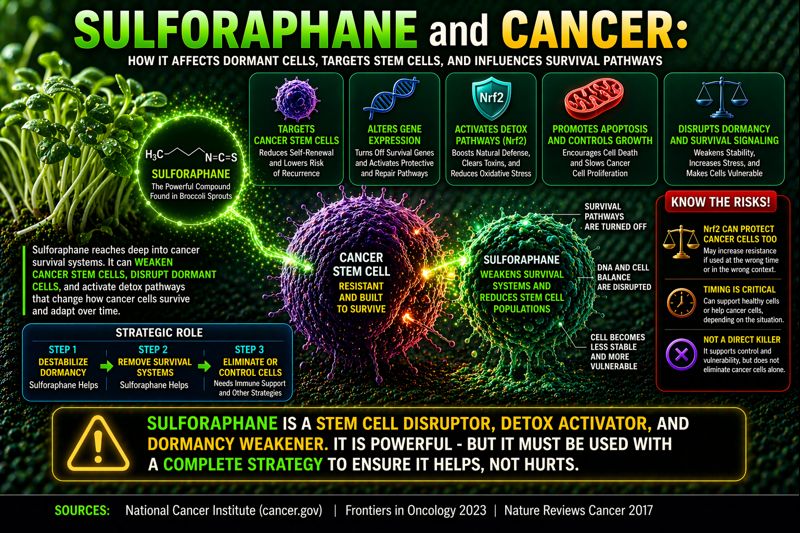
Sulforaphane primarily affects:
- Stem cell survival
- Detox pathways
- Gene regulation
- Dormancy systems
How Sulforaphane Affects Cancer Cells (Research-Based)
1. Targeting Cancer Stem Cells (Most Important Effect)
Research shows sulforaphane can:
- Reduce stem cell populations
- Interfere with self-renewal
- Limit tumor regrowth potential
Why This Matters
Cancer stem cells are:
- The source of recurrence
- Highly resistant
- Often dormant
Result
Sulforaphane may:
- Reduce long-term cancer survival
- Lower recurrence risk
2. Epigenetic Regulation (Gene Control)
Sulforaphane affects how genes are expressed.
What It Does
- Modifies gene activity
- Turns off survival-promoting genes
- Activates protective genes
Result
Cancer cells lose some control over:
- Growth
- Survival
- adaptation
3. Detox Pathway Activation (Nrf2)
Sulforaphane strongly activates:
👉 Nrf2 (a detox and protection pathway)
What Nrf2 Does
- Protects cells from damage
- Activates detox enzymes
- Reduces oxidative stress
What Sulforaphane Does
- Strongly activates Nrf2
- Enhances detox systems
Result
- Improved cellular protection
- Reduced toxin load
4. Apoptosis and Growth Control
Sulforaphane can:
- Promote apoptosis (cell death)
- Reduce proliferation
Result
- Slower tumor growth
- Increased cancer cell stress
How Sulforaphane Affects Dormant Cancer Cells
Dormant cells are similar to stem cells.
They survive by:
- Staying inactive
- Maintaining control systems
- Avoiding stress
Sulforaphane interferes with this.
1. Disrupting Stem-Like Behavior
Dormant cells rely on stem-like properties.
What Sulforaphane Does
- Interferes with self-renewal
- Weakens long-term survival
Result
Cells lose their ability to persist.
2. Altering Dormancy Stability
Dormancy depends on stable signaling.
What Sulforaphane Does
- Changes gene expression
- Disrupts signaling balance
Result
Dormant cells become less stable.
3. Increasing Cellular Stress
Dormant cells avoid stress to survive.
What Sulforaphane Does
- Alters internal balance
- Increases pressure on survival systems
Result
Cells may become vulnerable.
Where Sulforaphane Can Help
Sulforaphane may help when:
- Targeting cancer stem cells
- Reducing recurrence risk
- Disrupting long-term survival systems
- Supporting detox pathways
Where Sulforaphane Can Harm (Critical Section)
This is extremely important.
1. Nrf2 Can Protect Cancer Cells
While Nrf2 protects healthy cells…
👉 It can also protect cancer cells
What This Means
Sulforaphane may:
- Strengthen cell defenses
- Reduce damage to cancer cells
Result
In some cases:
- Cancer cells become more resistant
2. Protection vs Elimination Conflict
Sulforaphane:
- Protects cells
- Reduces stress
But elimination requires:
- Stress
- Damage
- destruction
Result
If used incorrectly:
- It may support survival instead of elimination
3. Timing Is Critical
Sulforaphane should NOT be viewed as universally beneficial.
It Depends On:
- Treatment timing
- Cellular state
- Overall strategy
4. Not a Direct Killer
Sulforaphane does NOT:
- Directly eliminate cancer cells
- Replace immune function
- Replace metabolic targeting
Strategic Role of Sulforaphane
Sulforaphane is best understood as:
- A stem cell disruptor
- A gene regulator
- A detox activator
How It Fits Into a Complete Strategy
From the system:
https://helping4cancer.com/cancer-spread-learning-hub
Step 1: Destabilize Dormancy
✔ Sulforaphane helps
Step 2: Remove Survival Systems
✔ Sulforaphane helps
Step 3: Eliminate Cells
✘ Sulforaphane does NOT complete this
Why Sulforaphane Is Powerful
It targets:
- Stem cells
- Dormant cells
- Long-term survival mechanisms
Few compounds do this.
Why Sulforaphane Alone Is Not Enough
Sulforaphane can:
- Reduce recurrence potential
- Disrupt survival systems
But it does NOT:
- Eliminate cancer cells directly
- Replace immune system action
- Replace treatment
Key Takeaways
- Sulforaphane targets cancer stem cells
- It disrupts long-term survival systems
- It alters gene expression and detox pathways
- It may reduce recurrence risk
- It can also protect cancer cells via Nrf2
- Timing determines whether it helps or harms
- It must be used within a complete strategy
External References
National Cancer Institute
https://www.cancer.gov/about-cancer/understanding/what-is-cancer
Frontiers in Oncology
https://www.frontiersin.org/articles/10.3389/fonc.2023.1089115/full
Nature Reviews Cancer
https://www.nature.com/articles/nrc.2017.15
Continue Learning
Main system:
https://helping4cancer.com/cancer-spread-learning-hub
Related pages:
https://helping4cancer.com/andrographis-cancer/
https://helping4cancer.com/cancer-dormancy/
https://helping4cancer.com/cancer-metabolic-evasion/
Disclaimer
This content is for educational purposes only and is not medical advice.