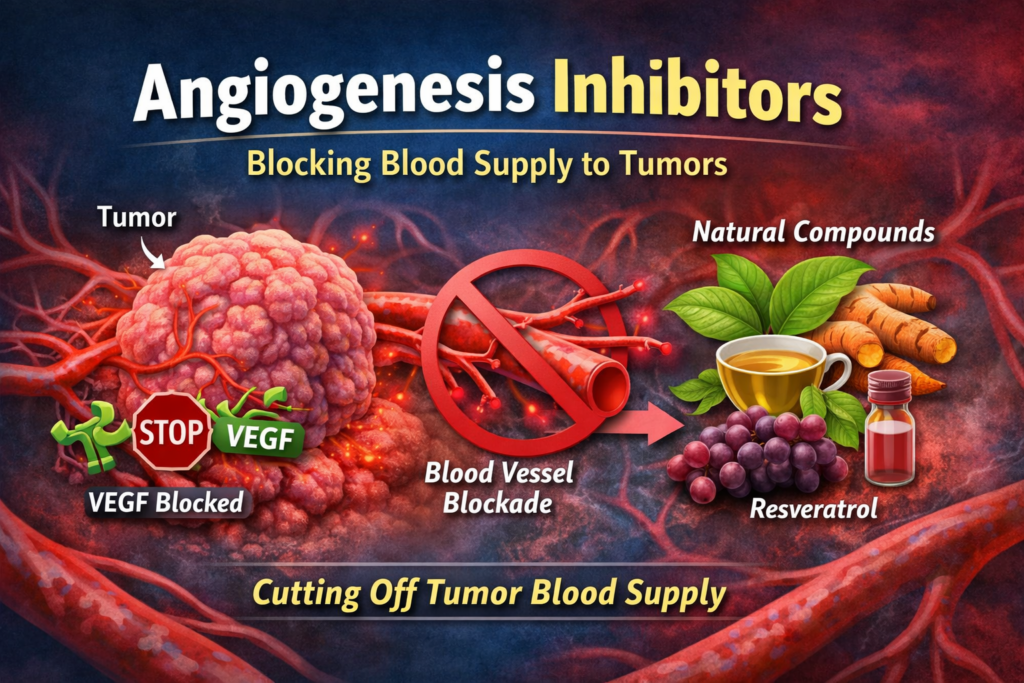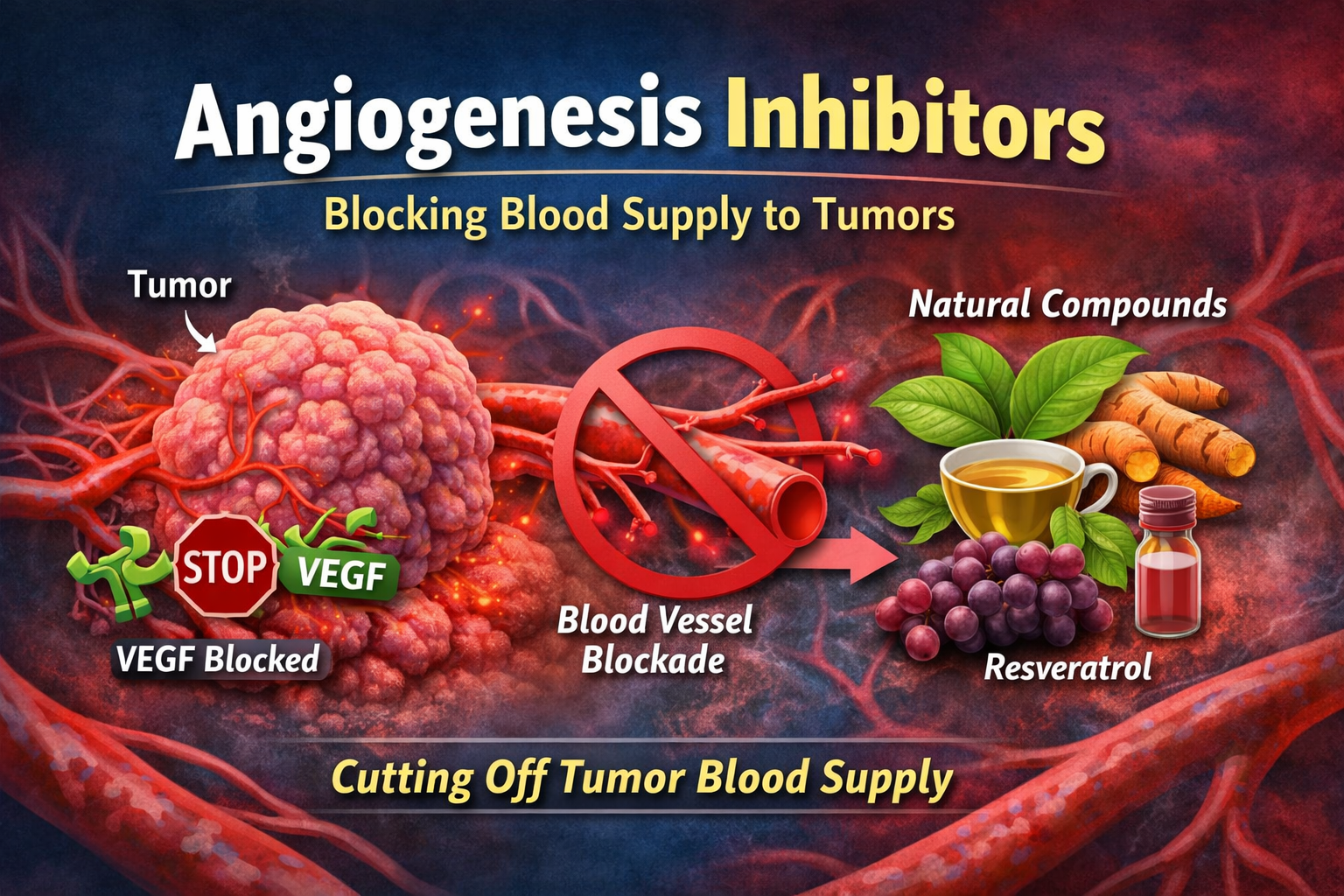
Angiogenesis Inhibitors
Cancer tumors cannot grow without a blood supply. In fact, once a tumor reaches about 1–2 millimeters in size, it needs oxygen and nutrients from nearby blood vessels to continue expanding. To achieve this, tumors trigger a biological process called angiogenesis, which means the formation of new blood vessels.
Angiogenesis is a normal and necessary process in the body. It occurs during wound healing, tissue repair, and development. However, cancer cells hijack this process to support tumor growth and metastasis.
Because tumors rely heavily on angiogenesis, scientists have developed therapies called angiogenesis inhibitors. These treatments attempt to starve tumors by blocking the formation of new blood vessels.
This guide explains:
- What angiogenesis is
- How tumors stimulate blood vessel growth
- The role of VEGF (vascular endothelial growth factor)
- Medical anti-angiogenic drugs used in oncology
- Natural compounds that may influence angiogenesis
Understanding this process is essential because angiogenesis is one of the core survival strategies used by cancer cells.
What Is Angiogenesis?
Angiogenesis refers to the formation of new blood vessels from existing blood vessels. It is controlled by a complex network of chemical signals that regulate when and where blood vessels should grow.
Normally, the body maintains a balance between:
- pro-angiogenic signals (which promote vessel growth)
- anti-angiogenic signals (which inhibit vessel formation)
In healthy tissue, these signals remain tightly regulated. Blood vessels only grow when necessary.
Tumors disrupt this balance.
Cancer cells release signals that strongly activate angiogenesis, allowing them to create their own nutrient delivery system.
Learn more about tumor survival strategies in our guide to:
Immune Surveillance and Cancer
https://helping4cancer.com/immune-surveillance-cancer/
Why Tumors Need Blood Vessels
Cancer cells divide rapidly and consume large amounts of energy. Without a constant supply of oxygen and nutrients, tumor cells would die.
Blood vessels provide tumors with:
- oxygen
- glucose
- amino acids
- growth signals
In addition, blood vessels allow cancer cells to enter the bloodstream, which is how metastasis occurs.
This means angiogenesis does more than support tumor growth—it also helps cancer spread to distant organs.
For this reason, angiogenesis is considered one of the major hallmarks of cancer biology.
Related guide:
The Hallmarks of Cancer
https://helping4cancer.com/hallmarks-of-cancer/
VEGF: The Master Switch of Angiogenesis
One of the most important molecules controlling angiogenesis is VEGF, which stands for vascular endothelial growth factor.
VEGF is a protein that signals nearby blood vessels to begin growing toward a tumor.
When cancer cells produce VEGF, several events occur:
- Nearby blood vessels become activated
- Endothelial cells begin dividing
- New vessels grow toward the tumor
- The tumor becomes supplied with oxygen and nutrients
These new tumor blood vessels are often abnormal. They tend to be:
- disorganized
- leaky
- poorly structured
Despite being imperfect, these vessels still allow tumors to obtain the resources needed for continued growth.
Tumor hypoxia often increases VEGF production. Learn more:
Tumor Hypoxia Explained
https://helping4cancer.com/hypoxia-cancer/
Anti-Angiogenic Cancer Drugs
Because VEGF plays such a central role in tumor blood vessel growth, many cancer therapies are designed to block it.
These medications are called anti-angiogenic drugs.
They do not usually kill cancer cells directly. Instead, they starve tumors by cutting off their blood supply.
Common examples include:
Bevacizumab (Avastin)
Bevacizumab is a monoclonal antibody that binds to VEGF and prevents it from activating blood vessel growth.
It is commonly used to treat:
- colorectal cancer
- lung cancer
- kidney cancer
- glioblastoma
- cervical cancer
Sunitinib
Sunitinib blocks several receptors involved in angiogenesis signaling.
It is frequently used for:
- kidney cancer
- gastrointestinal stromal tumors (GIST)
Sorafenib
Sorafenib inhibits multiple kinases involved in both tumor growth and blood vessel formation.
It is often used in:
- liver cancer
- thyroid cancer
- kidney cancer
These drugs are considered targeted therapies because they specifically disrupt biological pathways used by tumors.
More on targeted treatments:
Cancer Targeted Therapy
https://helping4cancer.com/targeted-therapy-cancer/
Limitations of Anti-Angiogenic Therapy
Although anti-angiogenic drugs can slow tumor growth, they are not a complete cure.
Several challenges exist.
Tumors Can Adapt
Cancer cells are highly adaptable. When VEGF is blocked, tumors may activate alternative pathways to continue forming blood vessels.
Temporary Effects
In some cases, tumors shrink initially but later resume growth once new blood vessel pathways emerge.
Side Effects
Anti-angiogenic drugs can cause side effects such as:
- high blood pressure
- bleeding complications
- impaired wound healing
- fatigue
Despite these limitations, anti-angiogenic therapy remains an important part of modern oncology treatment strategies.
Natural Anti-Angiogenic Compounds
In addition to pharmaceutical drugs, many plant-derived compounds appear to influence angiogenesis signaling in laboratory studies.
These compounds are not considered replacements for medical treatment, but researchers are studying their potential roles in supporting cancer prevention and recovery.
Below are some compounds that have been investigated for their potential anti-angiogenic effects.
Green Tea (EGCG)
Green tea contains epigallocatechin gallate (EGCG), a polyphenol that has shown anti-angiogenic activity in laboratory experiments.
Studies suggest EGCG may:
- reduce VEGF expression
- inhibit endothelial cell growth
- slow tumor vascularization
Research source:
National Cancer Institute
https://www.cancer.gov/about-cancer/treatment/cam/patient/green-tea-pdq
Curcumin (Turmeric)
Curcumin, the active compound in turmeric, has been studied for its ability to influence multiple cancer pathways.
Research suggests curcumin may:
- suppress VEGF signaling
- reduce inflammatory cytokines
- inhibit tumor blood vessel formation
Curcumin is also studied for effects on pathways like NF-κB and STAT3, which influence tumor growth.
Resveratrol
Resveratrol is a plant compound found in grapes, berries, and peanuts.
Research suggests it may:
- suppress angiogenesis signaling
- inhibit endothelial cell proliferation
- influence tumor metabolism pathways
Resveratrol is also studied for effects on cancer metabolism.
Learn more:
Cancer Metabolism Explained
https://helping4cancer.com/cancer-metabolism-explained/
Quercetin
Quercetin is a flavonoid found in onions, apples, and many fruits.
Some studies suggest it may:
- inhibit VEGF signaling
- reduce inflammatory mediators
- slow endothelial cell migration
Quercetin is widely studied in cancer biology due to its influence on several tumor survival pathways.
Sulforaphane
Sulforaphane is a compound found in broccoli and other cruciferous vegetables.
Research suggests it may:
- suppress tumor growth signals
- influence epigenetic regulation
- inhibit angiogenesis signaling
Sulforaphane has also been studied for its role in detoxification enzymes and cellular protection mechanisms.
The Role of Angiogenesis in Metastasis
Angiogenesis does more than feed tumors—it also enables metastasis.
When blood vessels grow into a tumor, they provide cancer cells with a pathway into the bloodstream.
Once inside circulation, cancer cells can travel to distant organs such as:
- liver
- lungs
- bones
- brain
These migrating cells can then form new tumors in other parts of the body.
Preventing angiogenesis may therefore reduce both tumor growth and metastatic spread.
Related guide:
Cancer Metastasis Explained
https://helping4cancer.com/cancer-metastasis/
Angiogenesis and the Tumor Microenvironment
Tumors exist within a complex ecosystem known as the tumor microenvironment.
This environment contains:
- immune cells
- fibroblasts
- blood vessels
- signaling molecules
These components interact with cancer cells and influence tumor progression.
Angiogenesis is tightly connected to this environment because inflammatory signals, immune suppression, and metabolic stress can all stimulate VEGF production.
Learn more:
Tumor Microenvironment Explained
https://helping4cancer.com/tumor-microenvironment/
Why Angiogenesis Research Matters
Understanding angiogenesis has transformed modern cancer research.
Scientists now recognize that tumors behave less like isolated masses and more like complex ecosystems that manipulate their surroundings.
Angiogenesis inhibitors represent one strategy to disrupt that ecosystem.
Although these treatments are rarely used alone, they often form part of combination therapy, which may include:
- chemotherapy
- immunotherapy
- radiation therapy
- targeted therapy
By attacking cancer from multiple angles, doctors attempt to prevent tumors from adapting and surviving.
Future Directions in Angiogenesis Research
Scientists continue to explore new strategies for blocking tumor blood vessel formation.
Emerging research areas include:
Combination Therapy
Combining angiogenesis inhibitors with immunotherapy may improve immune cell access to tumors.
Tumor Vessel Normalization
Some therapies aim not only to block vessels but to normalize abnormal tumor vessels, improving drug delivery.
Personalized Treatment
Future therapies may use biomarkers to determine which patients benefit most from anti-angiogenic drugs.
As researchers better understand tumor biology, new strategies for disrupting cancer blood supply may continue to improve treatment outcomes.
Key Takeaways
Angiogenesis is a critical process that allows tumors to grow and spread.
Key points include:
- Tumors need blood vessels to obtain oxygen and nutrients
- VEGF is one of the main signals driving tumor angiogenesis
- Anti-angiogenic drugs attempt to starve tumors by blocking blood vessel growth
- Natural compounds such as EGCG, curcumin, and resveratrol have been studied for anti-angiogenic properties
- Angiogenesis plays a major role in tumor growth, metastasis, and the tumor microenvironment
Because of its importance in cancer biology, angiogenesis remains one of the most actively studied areas of oncology research.
Scientific References
National Cancer Institute – Angiogenesis in Cancer
https://www.cancer.gov/about-cancer/causes-prevention/genetics/angiogenesis-fact-sheet
Nature Reviews Cancer – Tumor Angiogenesis
https://www.nature.com/articles/nrc2355
American Association for Cancer Research
https://www.aacr.org/patients-caregivers/about-cancer/angiogenesis/
Table of Contents