Introduction: What Is Autophagy?
Autophagy is one of the most fascinating and complex survival systems inside the human body. The word autophagy comes from Greek and literally means “self-eating.” While that may sound alarming, autophagy is actually a natural and essential process that allows cells to clean themselves.
In simple terms, autophagy is the body’s cellular recycling program. It breaks down damaged proteins, dysfunctional mitochondria, and other cellular debris so the cell can reuse those components for energy and repair.
This process is critical for maintaining healthy cells. Without autophagy, damaged components would accumulate inside cells and interfere with normal biological function.
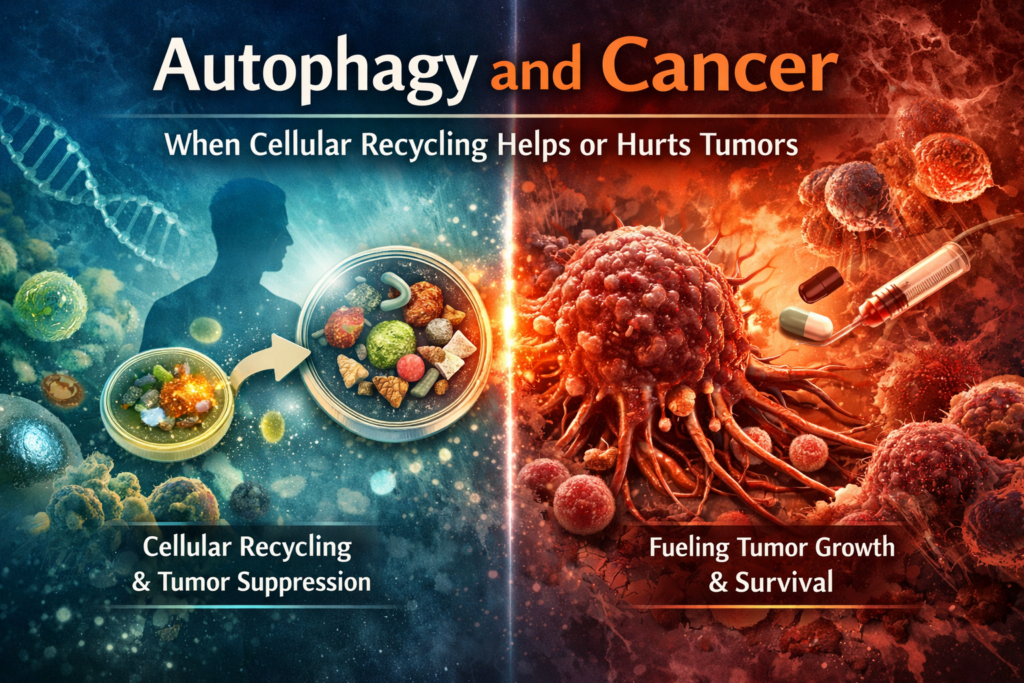
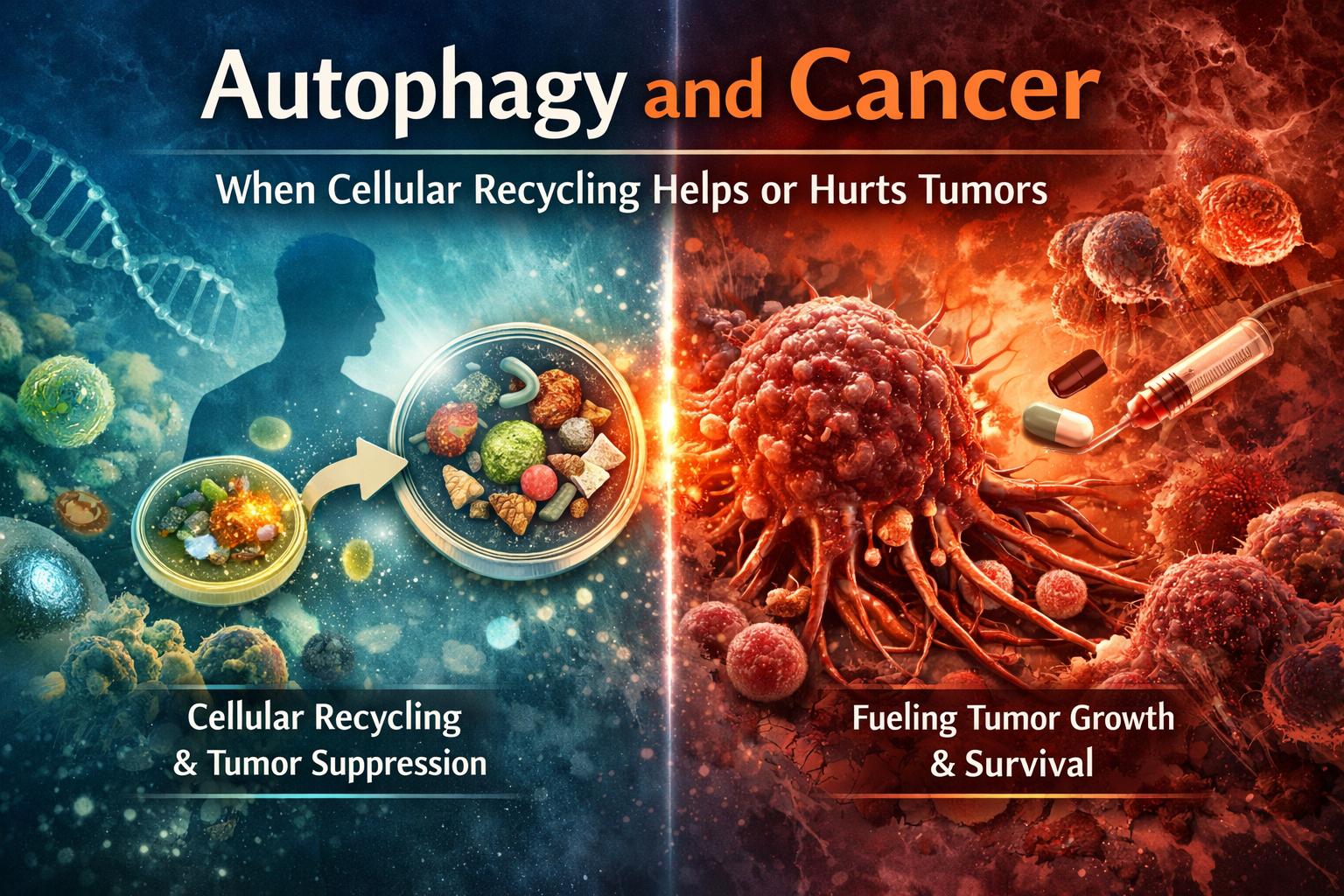
In cancer biology, however, autophagy plays a dual role. Sometimes it helps prevent cancer, and other times it helps cancer cells survive.
Understanding this balance has become an important area of research in modern oncology, especially in fields such as metabolic therapy, fasting, and cellular stress responses.
How Autophagy Works
Inside every cell are small membrane structures called autophagosomes. These structures act like garbage collectors.
The process typically follows several steps:
- Damage detection
The cell detects damaged proteins, organelles, or pathogens. - Isolation
A membrane structure forms around the damaged material. - Autophagosome formation
The membrane closes, trapping the material inside. - Fusion with lysosome
The autophagosome fuses with a lysosome, a compartment filled with digestive enzymes. - Breakdown and recycling
The contents are broken down and reused by the cell.
Through this system, cells can maintain energy balance and remove harmful structures.
Researchers often describe autophagy as “cellular housekeeping.”
Learn more about autophagy from the
National Cancer Institute:
https://www.cancer.gov/about-cancer/causes-prevention/research/autophagy
Autophagy as a Cancer Prevention Mechanism
In healthy tissues, autophagy often works as a tumor suppression mechanism.
Cells constantly experience stress from factors such as:
• oxidative damage
• inflammation
• metabolic stress
• environmental toxins
• DNA mutations
Autophagy helps remove damaged mitochondria and defective proteins before they accumulate.
If these damaged structures remain inside cells, they can increase genomic instability, which is a major driver of cancer.
Studies have shown that impaired autophagy can increase the risk of tumor formation.
For example, mutations in genes involved in autophagy regulation—such as Beclin-1—have been associated with certain cancers including breast cancer and ovarian cancer.
Research review:
https://www.ncbi.nlm.nih.gov/pmc/articles/PMC2832197/
Because of this protective role, autophagy is sometimes considered part of the body’s natural anti-cancer defense system.
When Autophagy Helps Cancer Cells Survive
While autophagy can suppress early tumor formation, cancer cells can also hijack the same mechanism to survive.
Tumors often grow in extremely harsh environments. Inside a tumor, cells may face:
• low oxygen (hypoxia)
• low glucose availability
• nutrient deprivation
• immune attack
• chemotherapy stress
Autophagy allows cancer cells to recycle internal components to generate energy.
This helps them survive conditions that would normally kill healthy cells.
For example, when nutrients are scarce, cancer cells can break down their own proteins and organelles to create fuel.
In this context, autophagy becomes a survival adaptation for tumors.
Scientific overview:
https://www.nature.com/articles/nrc.2015.7
This dual nature makes autophagy one of the most complex processes in cancer biology.
Autophagy and Cancer Treatment
Autophagy plays an important role in how cancer cells respond to treatment.
Many therapies—including chemotherapy, radiation, and targeted therapies—cause severe stress inside cancer cells.
This stress often triggers autophagy.
In some cases, this can help cancer cells survive treatment.
In other situations, excessive autophagy may lead to autophagic cell death, which destroys the cancer cell.
Because of this, scientists are exploring two opposite treatment strategies:
1. Blocking autophagy
Some drugs attempt to inhibit autophagy so cancer cells cannot survive treatment stress.
Examples include drugs that interfere with lysosomes.
2. Overstimulating autophagy
Other therapies try to push autophagy to extreme levels that become toxic to cancer cells.
The correct approach depends on the type of cancer and treatment stage.
Autophagy is now considered a major target in experimental oncology.
Research overview:
https://www.frontiersin.org/articles/10.3389/fonc.2020.01064/full
Autophagy and Fasting
One of the most powerful natural triggers of autophagy is fasting.
When the body experiences a shortage of nutrients, cells switch from growth mode to survival mode.
This activates several metabolic pathways, including:
• AMPK activation
• mTOR suppression
• increased cellular recycling
When mTOR signaling decreases, autophagy activity increases.
This shift allows cells to break down old components and generate energy.
Many researchers believe that fasting-induced autophagy may help protect healthy cells during metabolic stress.
The topic has gained attention in areas such as metabolic therapy and cancer research.
Scientific overview:
https://www.cell.com/cell-metabolism/fulltext/S1550-4131(18)30373-2
However, the relationship between fasting, autophagy, and cancer treatment is still being studied.
Spermidine and Autophagy
Another compound known to influence autophagy is spermidine.
Spermidine is a naturally occurring molecule found in many foods, including:
• wheat germ
• soybeans
• mushrooms
• aged cheese
• legumes
Spermidine has attracted scientific interest because it appears to stimulate autophagy through epigenetic regulation.
Researchers have found that spermidine may help promote cellular cleanup processes and mitochondrial health.
In laboratory models, spermidine supplementation has been linked to improved cellular stress resistance.
Some studies suggest it may influence aging pathways and metabolic regulation.
Research review:
https://www.nature.com/articles/nrm.2017.52
Although research is ongoing, spermidine is frequently discussed in the context of longevity, metabolic health, and cellular recycling.
Autophagy and Metabolic Therapy
Autophagy is closely connected to metabolic stress, which makes it highly relevant in metabolic cancer research.
Metabolic therapy approaches often focus on altering cellular energy pathways.
Examples include:
• fasting or fasting-mimicking diets
• ketogenic diets
• glucose restriction
• mitochondrial stress
These strategies may influence pathways such as:
• AMPK
• mTOR
• insulin signaling
• oxidative metabolism
Because these pathways regulate autophagy, metabolic interventions can strongly influence cellular recycling mechanisms.
Understanding this relationship is important for researchers studying tumor metabolism and stress responses.
For example, metabolic stress can sometimes make cancer cells more vulnerable to treatments that increase oxidative damage.
Learn more about tumor metabolism:
https://www.sciencedirect.com/science/article/pii/S0092867421002136
Autophagy and the Tumor Microenvironment
Autophagy does not only affect cancer cells themselves. It also influences the tumor microenvironment.
The tumor microenvironment includes:
• immune cells
• fibroblasts
• blood vessels
• signaling molecules
Autophagy in immune cells can affect how effectively the immune system recognizes tumors.
For example, dendritic cells use autophagy to process antigens and present them to T-cells.
This means autophagy may influence immune surveillance against cancer.
Research overview:
https://www.nature.com/articles/s41418-020-0522-2
Because of this, autophagy research is also relevant in the field of cancer immunology.
The Future of Autophagy Research
Autophagy research is rapidly expanding.
Scientists are investigating:
• drugs that block autophagy
• drugs that stimulate autophagy
• metabolic therapies that alter autophagy pathways
• interactions between autophagy and immune responses
Understanding when autophagy helps tumors—and when it harms them—remains one of the biggest challenges in oncology.
Future treatments may involve precisely controlling autophagy depending on the cancer type and treatment stage.
Many researchers believe that targeting autophagy could become an important part of personalized cancer therapy.
Key Takeaways
Autophagy is one of the body’s most important cellular survival systems.
Key points include:
• Autophagy is the body’s natural cellular recycling process.
• It helps remove damaged proteins and organelles.
• In early stages, autophagy can help prevent cancer.
• In established tumors, autophagy may help cancer cells survive stress.
• Fasting and metabolic stress can activate autophagy.
• Spermidine and other compounds may influence cellular recycling pathways.
• Scientists are studying how to manipulate autophagy to improve cancer treatments.
Understanding autophagy is critical for researchers exploring tumor metabolism, metabolic therapy, and cellular stress biology.
Learn More
Related guides on Helping4Cancer:
Reactive Oxygen Species and Cancer
https://helping4cancer.com/reactive-oxygen-species-cancer/
The Warburg Effect: Cancer Metabolism Explained
https://helping4cancer.com/warburg-effect-cancer-metabolism-2/
Table of Contents