What Is Oxidative Stress?
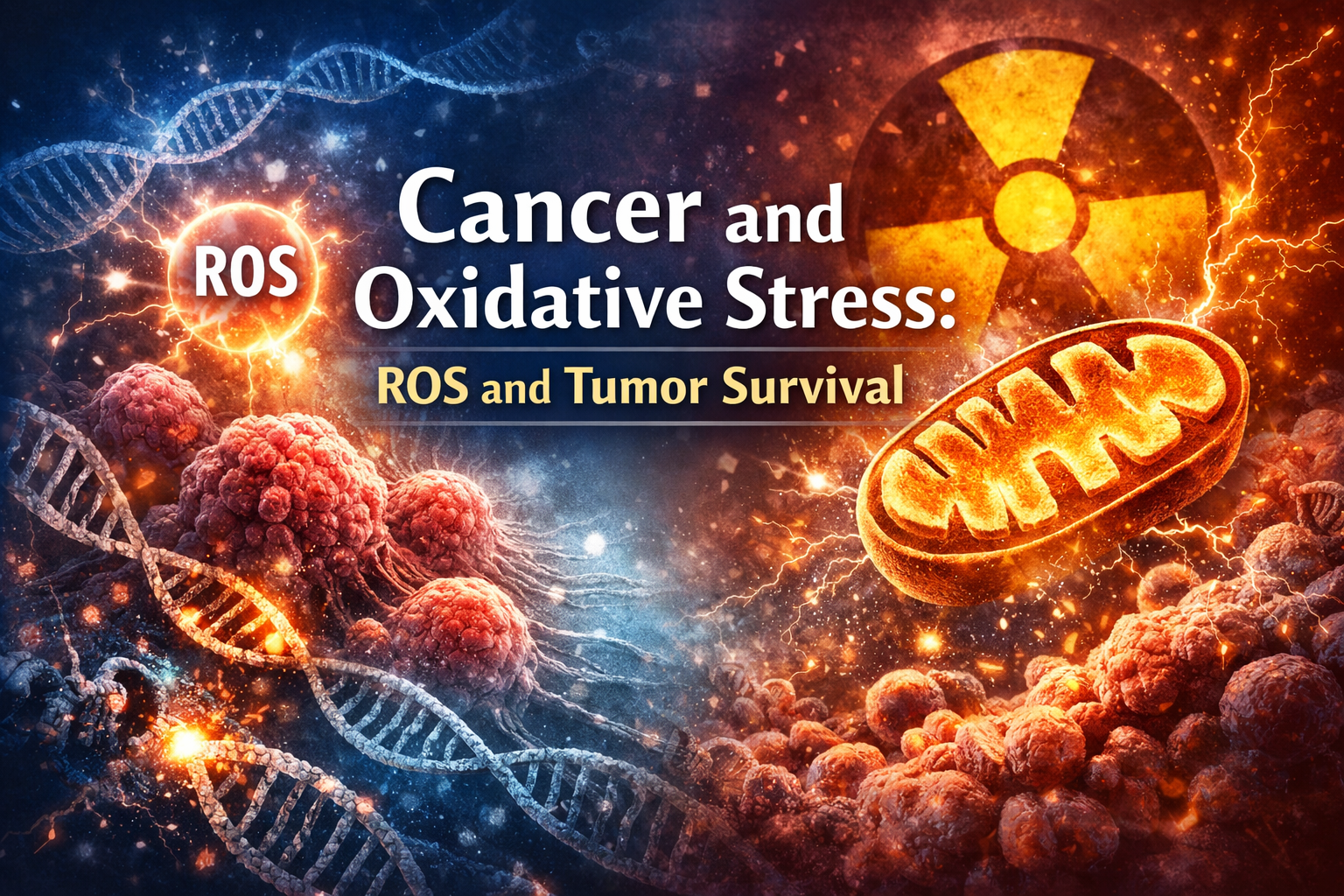
Oxidative stress is a biological condition where the production of reactive oxygen species (ROS) exceeds the body’s ability to neutralize them with antioxidants. ROS are highly reactive molecules derived from oxygen metabolism.
In normal cells, ROS play important roles in signaling, immune defense, and cellular adaptation. However, when ROS levels rise too high or are poorly controlled, they can damage DNA, proteins, and lipids.
Cancer exists in a constant state of oxidative imbalance. Tumor cells generate higher levels of ROS than normal cells, but they also develop systems to survive this stress.
This balance between ROS production and antioxidant defense is a central feature of cancer biology.
What Are Reactive Oxygen Species (ROS)?
Reactive oxygen species are chemically reactive molecules that contain oxygen. They are primarily produced inside the mitochondria during energy production.
Common types of ROS include:
- Superoxide (O2−)
- Hydrogen peroxide (H2O2)
- Hydroxyl radicals (•OH)
These molecules are unstable and react with nearby cellular structures, which can lead to damage or signaling changes.
In cancer, ROS are not just harmful byproducts. They actively drive tumor progression and adaptation.
How Cancer Cells Produce High Levels of ROS
Cancer cells generate elevated ROS due to their altered metabolism and rapid growth demands.
Key sources include:
Mitochondrial Dysfunction
Tumor mitochondria are often damaged or inefficient. This leads to electron leakage during energy production, forming superoxide and other ROS.
More on this process:
https://helping4cancer.com/cancer-and-mitochondria/
Increased Metabolic Activity
Cancer cells rely heavily on glycolysis and other metabolic pathways. These processes produce ROS as byproducts.
Related concept:
https://helping4cancer.com/tumor-metabolic-switch/
Oncogene Activation
Cancer-driving genes such as MYC and RAS increase metabolic flux and mitochondrial activity, both of which elevate ROS levels.
Inflammation in the Tumor Microenvironment
Chronic inflammation surrounding tumors leads to immune cells releasing ROS as part of their defense mechanisms.
This creates a highly oxidative environment that cancer cells must adapt to.
The Dual Role of ROS in Cancer
ROS have a paradoxical role in cancer. They can both promote tumor growth and destroy cancer cells.
ROS as a Growth Signal
At moderate levels, ROS act as signaling molecules that activate pathways involved in cell survival and proliferation.
These include:
- PI3K/Akt pathway
- NF-κB signaling
- MAPK pathway
These pathways are covered in detail here:
https://helping4cancer.com/tumor-signaling-pathways/
Low to moderate ROS levels help cancer cells:
- Proliferate faster
- Adapt to stress
- Resist apoptosis
- Activate angiogenesis
ROS as a Cell Killer
At high levels, ROS become toxic and trigger cell death.
Excess ROS can cause:
- DNA double-strand breaks
- Lipid peroxidation
- Protein dysfunction
- Mitochondrial collapse
When ROS exceed a certain threshold, cancer cells undergo apoptosis, necrosis, or ferroptosis.
This concept is critical for treatment strategies.
Oxidative Damage and DNA Mutations
ROS are one of the primary sources of DNA damage in cancer.
They cause:
- Base modifications (e.g., 8-oxoG)
- DNA strand breaks
- Chromosomal instability
Over time, this damage leads to mutations that drive cancer progression.
Ironically, while ROS contribute to cancer development, they also make cancer cells more vulnerable to further oxidative damage.
This vulnerability is a key therapeutic target.
External reference:
https://www.ncbi.nlm.nih.gov/pmc/articles/PMC3614697/
Cancer’s Antioxidant Defense Systems
To survive high ROS levels, cancer cells upregulate antioxidant systems.
These include:
Glutathione System
Glutathione is the primary intracellular antioxidant. It neutralizes ROS and protects cellular structures.
Cancer cells often increase glutathione production to maintain redox balance.
Superoxide Dismutase (SOD)
SOD converts superoxide into hydrogen peroxide, which is less reactive.
Catalase and Peroxidases
These enzymes break down hydrogen peroxide into water and oxygen.
NRF2 Pathway
NRF2 is a master regulator of antioxidant defense. When activated, it increases the expression of multiple detoxification and antioxidant genes.
These systems allow cancer cells to survive in an otherwise lethal oxidative environment.
The ROS Threshold Concept
Cancer cells operate near a critical ROS threshold.
- Too little ROS → insufficient signaling for growth
- Moderate ROS → optimal tumor survival and proliferation
- Excess ROS → cell death
This creates a therapeutic window.
If ROS levels can be pushed slightly higher, cancer cells may collapse while normal cells remain protected.
This concept is central to many modern and experimental cancer therapies.
How Radiation Therapy Uses ROS
Radiation therapy works primarily by generating ROS inside cancer cells.
High-energy radiation interacts with water molecules in cells to produce hydroxyl radicals, one of the most damaging types of ROS.
These radicals cause:
- DNA double-strand breaks
- Irreversible genetic damage
- Cell death
More details:
https://helping4cancer.com/radiation-therapy-kills-cancer-cells/
Because cancer cells already operate near their ROS limit, radiation pushes them beyond survival.
External reference:
https://www.cancer.gov/about-cancer/treatment/types/radiation-therapy
Chemotherapy and Oxidative Stress
Many chemotherapy drugs also rely on oxidative stress mechanisms.
They work by:
- Increasing ROS production
- Damaging mitochondrial function
- Inhibiting antioxidant defenses
Examples include:
- Doxorubicin
- Cisplatin
- Cyclophosphamide
These treatments exploit the fragile redox balance in cancer cells.
However, they can also affect normal cells, which leads to side effects.
Mitochondria and ROS Production
Mitochondria are the primary source of ROS in cancer cells.
During oxidative phosphorylation, electrons pass through the electron transport chain. When this process is inefficient, electrons leak and react with oxygen to form superoxide.
In cancer:
- Mitochondria are often dysfunctional
- ROS production is increased
- Energy metabolism is altered
This creates both a survival advantage and a vulnerability.
More on mitochondrial dysfunction:
https://helping4cancer.com/cancer-energy-crisis/
Oxidative Stress and the Tumor Microenvironment
The tumor microenvironment is highly oxidative.
It includes:
- Immune cells producing ROS
- Hypoxic regions with unstable metabolism
- Inflammatory signaling molecules
This environment promotes:
- Genetic instability
- Tumor progression
- Resistance to therapy
At the same time, it places constant stress on cancer cells, forcing them to adapt or die.
More on this ecosystem:
https://helping4cancer.com/tumor-microenvironment/
ROS and Apoptosis Resistance
Cancer cells often develop resistance to apoptosis despite high ROS levels.
They achieve this by:
- Upregulating BCL-2 and anti-apoptotic proteins
- Enhancing antioxidant defenses
- Repairing damaged DNA
This allows them to survive conditions that would normally kill healthy cells.
Related topic:
https://helping4cancer.com/apoptosis-resistance-cancer/
Oxidative Stress and Ferroptosis
Ferroptosis is a form of cell death driven by iron-dependent lipid peroxidation.
It is closely linked to oxidative stress.
Key features include:
- Accumulation of lipid ROS
- Iron-mediated reactions
- Membrane damage
Cancer cells that are resistant to apoptosis may still be vulnerable to ferroptosis.
This makes oxidative stress a powerful tool for targeting difficult tumors.
External reference:
https://www.nature.com/articles/nrc.2017.64
The Role of Antioxidants in Cancer
Antioxidants are often misunderstood in cancer biology.
They can:
- Protect normal cells from damage
- Reduce treatment side effects
- Support immune function
However, excessive antioxidant use at the wrong time may:
- Reduce ROS-mediated cancer cell death
- Interfere with chemotherapy or radiation
This creates a timing-dependent effect.
The balance between oxidative stress and antioxidant protection is critical.
Metabolic Therapy and ROS Targeting
Metabolic therapy strategies often aim to manipulate ROS levels.
These include:
Increasing ROS in Cancer Cells
- Fasting or caloric restriction
- Glucose restriction (keto diets)
- Certain metabolic drugs
These approaches stress cancer metabolism and increase oxidative pressure.
More on metabolic strategies:
https://helping4cancer.com/metabolic-therapy-cancer/
Targeting Mitochondrial Weakness
By disrupting mitochondrial function, therapies can increase ROS production beyond survivable levels.
Exploiting Redox Imbalance
Because cancer cells are already under oxidative stress, small increases in ROS can trigger collapse.
This is one of the most promising strategies in cancer treatment research.
External reference:
https://pubmed.ncbi.nlm.nih.gov/26694985/
Why Oxidative Stress Matters in Cancer
Oxidative stress is not just a side effect of cancer. It is a central driver of tumor behavior.
It influences:
- Mutation rates
- Tumor growth
- Treatment response
- Immune interactions
- Metastasis
Understanding oxidative stress helps explain why many therapies work and how they can be optimized.
Key Takeaways
- Cancer cells operate under high oxidative stress but adapt to survive it
- ROS act as both growth signals and lethal agents
- Treatments like radiation and chemotherapy exploit ROS to kill cancer cells
- Mitochondrial dysfunction is a major source of ROS in tumors
- Cancer cells rely on strong antioxidant systems to maintain balance
- Pushing ROS beyond a critical threshold can trigger tumor cell death
Oxidative stress represents one of the most important vulnerabilities in cancer biology. By understanding and targeting this balance, therapies can be designed to selectively damage cancer cells while sparing normal tissue.
Table of Contents