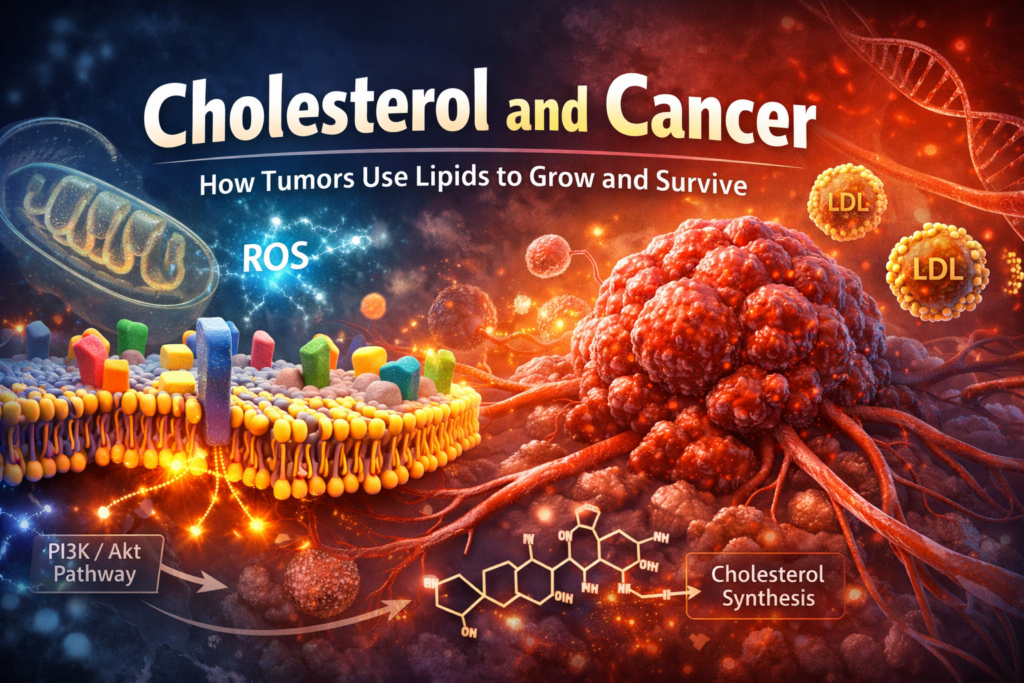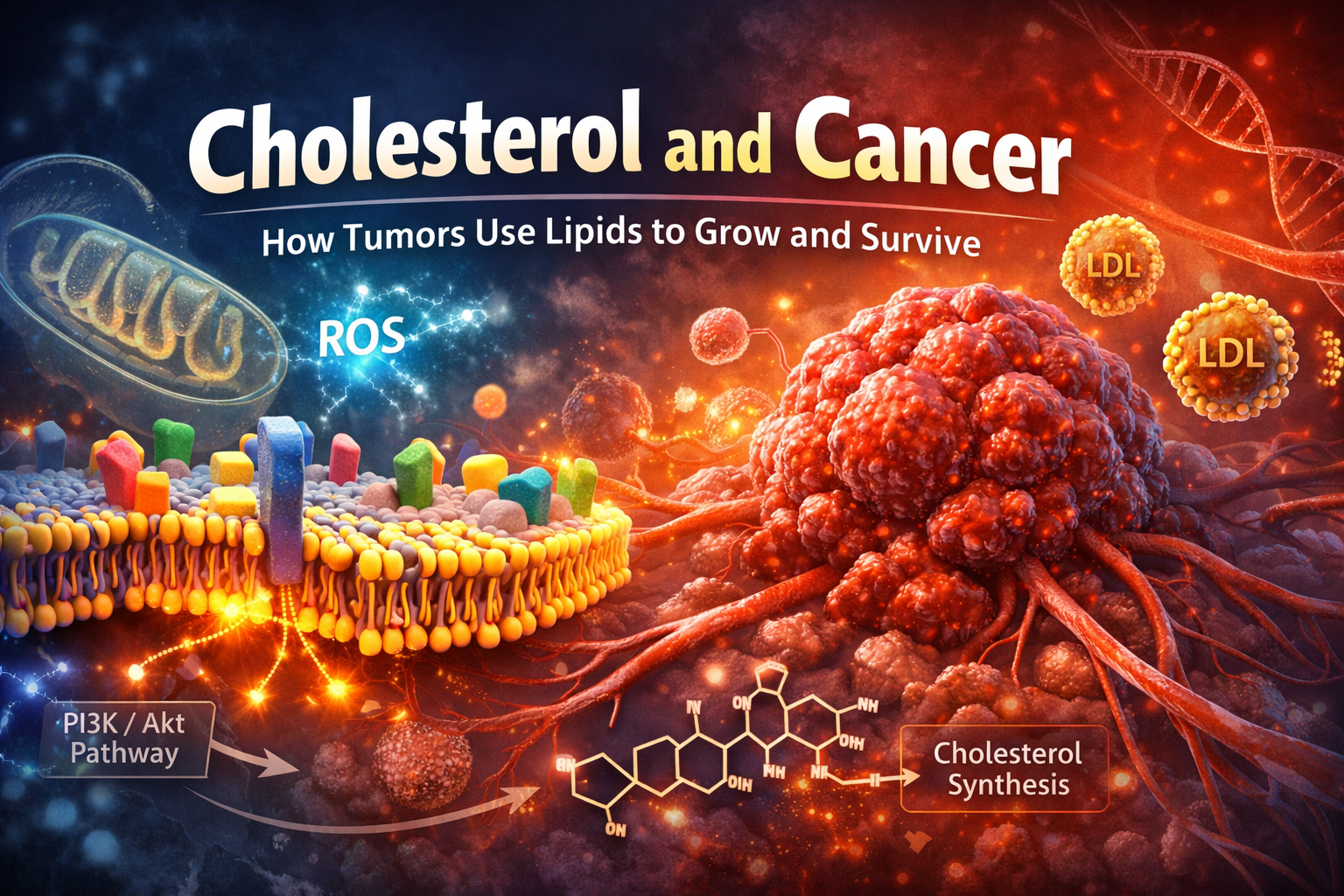
What Is Cholesterol and Why It Matters in Cancer
Cholesterol is a vital lipid molecule found in every cell in the body. It plays a central role in maintaining cell membrane integrity, supporting hormone production, and organizing signaling platforms. In normal physiology, cholesterol levels are tightly regulated.
In cancer, however, this balance is disrupted. Tumor cells reprogram cholesterol metabolism to support rapid growth, resist cell death, and enhance survival signaling. Instead of simply being a structural molecule, cholesterol becomes a powerful driver of cancer progression.
Cancer cells require large amounts of cholesterol because they divide quickly. Each new cell needs a fully formed membrane, and cholesterol provides the rigidity and structure required for that process. This makes cholesterol metabolism a key component of tumor biology.
For a broader understanding of how metabolism influences cancer, see:
https://helping4cancer.com/metabolic-therapy-cancer/
Cholesterol and Cell Membrane Structure
Cholesterol is a major component of the cell membrane. It regulates membrane fluidity and stability, ensuring proper function of proteins embedded within the membrane.
In cancer cells, membrane composition is altered to support growth and signaling. High cholesterol levels lead to more rigid and organized membranes, which enhances the ability of cancer cells to communicate and respond to growth signals.
Key roles of cholesterol in membranes include:
- Stabilizing membrane structure
- Supporting rapid cell division
- Organizing signaling molecules
- Protecting cells from environmental stress
Tumor cells often increase cholesterol uptake or production to maintain these advantages.
Lipid Rafts: Cholesterol-Rich Signaling Platforms
One of the most important roles of cholesterol in cancer is the formation of lipid rafts. These are specialized microdomains within the cell membrane that concentrate signaling proteins.
Lipid rafts act as platforms for critical cancer-driving pathways, including:
- PI3K/Akt signaling
- mTOR activation
- EGFR signaling
- MAPK pathways
By clustering these proteins together, cholesterol enhances signal strength and efficiency. This allows cancer cells to respond rapidly to growth signals and maintain continuous proliferation.
For a deeper breakdown of tumor signaling networks, visit:
https://helping4cancer.com/tumor-survival-network/
Cholesterol and Tumor Proliferation
Cancer cells must constantly divide to sustain tumor growth. Cholesterol supports this process in multiple ways.
First, it provides the structural material needed to build new cell membranes. Without sufficient cholesterol, cells cannot divide efficiently.
Second, cholesterol enhances signaling pathways that drive the cell cycle. These pathways include growth signals that push cells through critical checkpoints.
Third, cholesterol helps stabilize proteins involved in DNA replication and repair, ensuring that cancer cells can continue dividing even under stress.
This makes cholesterol metabolism directly linked to tumor proliferation.
For more on how cancer cells control division, see:
https://helping4cancer.com/cancer-cell-cycle/
Cholesterol and Mitochondrial Function
Cholesterol also plays a role inside the cell, particularly in mitochondria. Mitochondria are responsible for energy production and regulation of cell death.
In cancer cells, cholesterol accumulates in mitochondrial membranes. This alters mitochondrial function in several important ways:
- Reduces membrane permeability
- Prevents release of pro-apoptotic signals
- Stabilizes mitochondrial structure under stress
- Alters energy metabolism
By protecting mitochondria, cholesterol helps cancer cells resist apoptosis (programmed cell death). This allows tumor cells to survive treatments that would normally trigger cell death.
For more on mitochondrial involvement in cancer, visit:
https://helping4cancer.com/cancer-and-mitochondria/
Cholesterol and Apoptosis Resistance
One of the defining features of cancer is the ability to avoid apoptosis. Cholesterol contributes to this resistance by stabilizing cellular and mitochondrial membranes.
When cholesterol levels are high:
- Death receptors become less responsive
- Mitochondrial membranes resist breakdown
- Pro-apoptotic proteins are less effective
This creates a protective environment for cancer cells, allowing them to survive even under extreme stress, such as chemotherapy or radiation.
Cholesterol also supports anti-apoptotic signaling pathways, further reinforcing survival mechanisms.
To explore this concept further:
https://helping4cancer.com/apoptosis-resistance-cancer/
Cholesterol and Reactive Oxygen Species (ROS)
Reactive oxygen species (ROS) are highly reactive molecules that can damage cells. In cancer therapy, ROS is often used to push tumor cells into oxidative stress and death.
Cholesterol influences ROS in complex ways.
On one hand, cholesterol-rich membranes can protect cells from oxidative damage by stabilizing lipid structures. On the other hand, altered cholesterol metabolism can increase oxidative stress inside cancer cells.
Cancer cells walk a fine line:
- Too little ROS → survival and growth
- Too much ROS → cell death
Cholesterol helps regulate this balance, allowing cancer cells to tolerate higher levels of oxidative stress without dying.
For a full explanation of ROS in cancer:
https://helping4cancer.com/cancer-oxidative-stress/
Cholesterol Synthesis Pathways in Cancer
Cancer cells do not rely solely on dietary cholesterol. They often increase their own internal production through the mevalonate pathway.
This pathway is responsible for synthesizing cholesterol and other important molecules needed for cell growth.
Key features of this pathway in cancer include:
- Upregulation of HMG-CoA reductase
- Increased cholesterol synthesis
- Enhanced production of growth-related molecules
- Activation of survival signaling pathways
The mevalonate pathway is closely linked to cancer metabolism and represents a potential target for therapy.
Cholesterol Uptake and Transport in Tumors
In addition to producing cholesterol, cancer cells increase their ability to absorb it from the bloodstream.
They achieve this by:
- Upregulating LDL receptors
- Increasing cholesterol transport proteins
- Enhancing lipid storage mechanisms
This dual strategy—producing and importing cholesterol—ensures a constant supply for tumor growth.
High LDL receptor expression is commonly observed in aggressive tumors, highlighting the importance of cholesterol uptake in cancer progression.
Cholesterol and the Tumor Microenvironment
Cholesterol does not only affect cancer cells. It also plays a role in the tumor microenvironment, which includes immune cells, blood vessels, and surrounding tissues.
High cholesterol levels can suppress immune function by:
- Disrupting T cell activity
- Promoting immune exhaustion
- Enhancing tumor immune evasion
This creates a protective environment where cancer cells can grow without being attacked effectively by the immune system.
For more on immune suppression in cancer:
https://helping4cancer.com/immune-exhaustion-cancer/
Cholesterol and Angiogenesis
Tumors require a blood supply to grow. Cholesterol contributes to angiogenesis, the process of forming new blood vessels.
It supports angiogenesis by:
- Enhancing VEGF signaling
- Stabilizing endothelial cell membranes
- Promoting vascular growth pathways
This allows tumors to access nutrients and oxygen, further supporting their expansion.
Cholesterol and Cancer Treatment Resistance
One of the most important implications of cholesterol in cancer is its role in treatment resistance.
High cholesterol levels can:
- Reduce drug penetration into cells
- Stabilize survival pathways
- Protect mitochondria from damage
- Decrease sensitivity to chemotherapy
This makes tumors more difficult to treat and contributes to relapse.
Cholesterol-rich membranes can act as a barrier, limiting the effectiveness of certain therapies.
Therapeutic Strategies Targeting Cholesterol
Because cholesterol plays such a central role in cancer, targeting its metabolism has become an area of interest in research.
Potential strategies include:
- Inhibiting cholesterol synthesis
- Blocking cholesterol uptake
- Disrupting lipid rafts
- Targeting the mevalonate pathway
These approaches aim to weaken cancer cells by removing a key structural and signaling component.
Research suggests that disrupting cholesterol metabolism can impair tumor growth and increase sensitivity to treatment.
Cholesterol and Metabolic Reprogramming
Cancer cells undergo metabolic reprogramming to support survival. While much focus is placed on glucose metabolism, lipid metabolism—including cholesterol—is equally important.
Cholesterol integrates with other metabolic systems:
- Glycolysis (Warburg effect)
- Mitochondrial respiration
- Fatty acid synthesis
- Redox balance
This interconnected network allows cancer cells to adapt to changing conditions and maintain growth.
Understanding cholesterol metabolism provides a more complete picture of cancer biology.
Why Cholesterol Matters in Cancer Survival
Cholesterol is not just a structural molecule. It is a central player in cancer survival.
It supports:
- Rapid cell division
- Strong survival signaling
- Resistance to apoptosis
- Protection against oxidative stress
- Immune system evasion
Without cholesterol, many of the processes that allow cancer to grow and spread would be significantly weakened.
This makes cholesterol metabolism a critical area of study in cancer research.
Key Takeaways
Cholesterol plays a multifaceted role in cancer biology. It is essential for membrane structure, signaling, metabolism, and survival.
Key points include:
- Cancer cells increase cholesterol production and uptake
- Cholesterol supports lipid rafts and signaling pathways
- It protects mitochondria and prevents apoptosis
- It helps regulate oxidative stress
- It contributes to treatment resistance
Targeting cholesterol metabolism offers a promising approach to disrupting tumor growth and improving treatment outcomes.
External References
National Cancer Institute – Lipid Metabolism and Cancer
https://www.cancer.gov
PubMed – Cholesterol Metabolism in Cancer
https://pubmed.ncbi.nlm.nih.gov
Nature Reviews Cancer – Lipid Metabolism and Tumor Growth
https://www.nature.com
NIH – Role of Cholesterol in Cell Signaling
https://www.nih.gov
ScienceDirect – Cholesterol and Cancer Progression
https://www.sciencedirect.com
Table of Contents