What Is DNA Mismatch Repair?
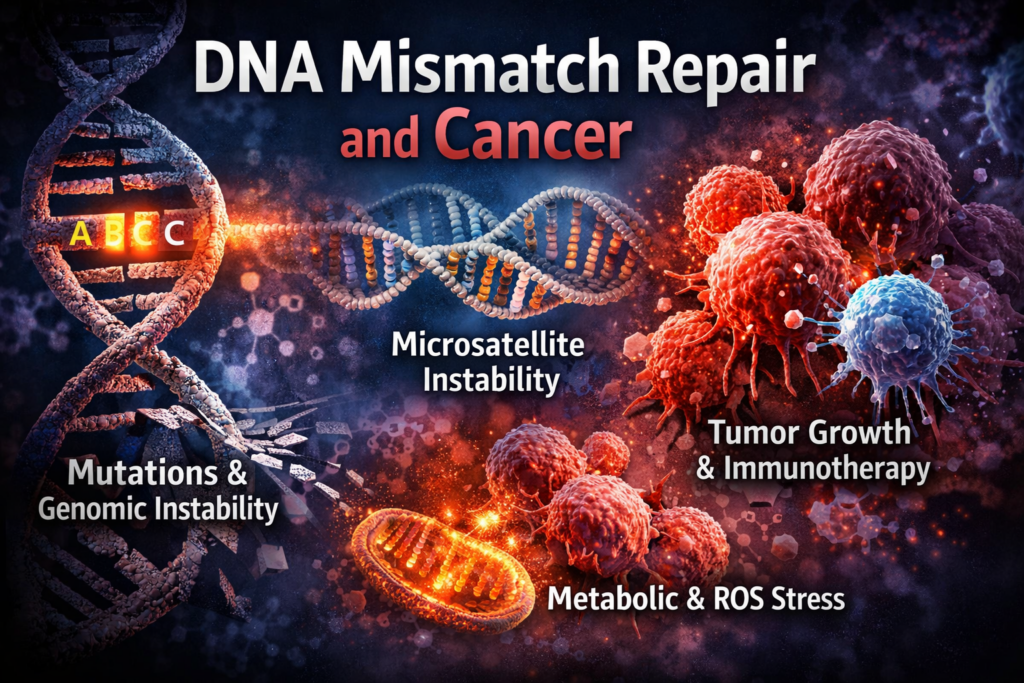
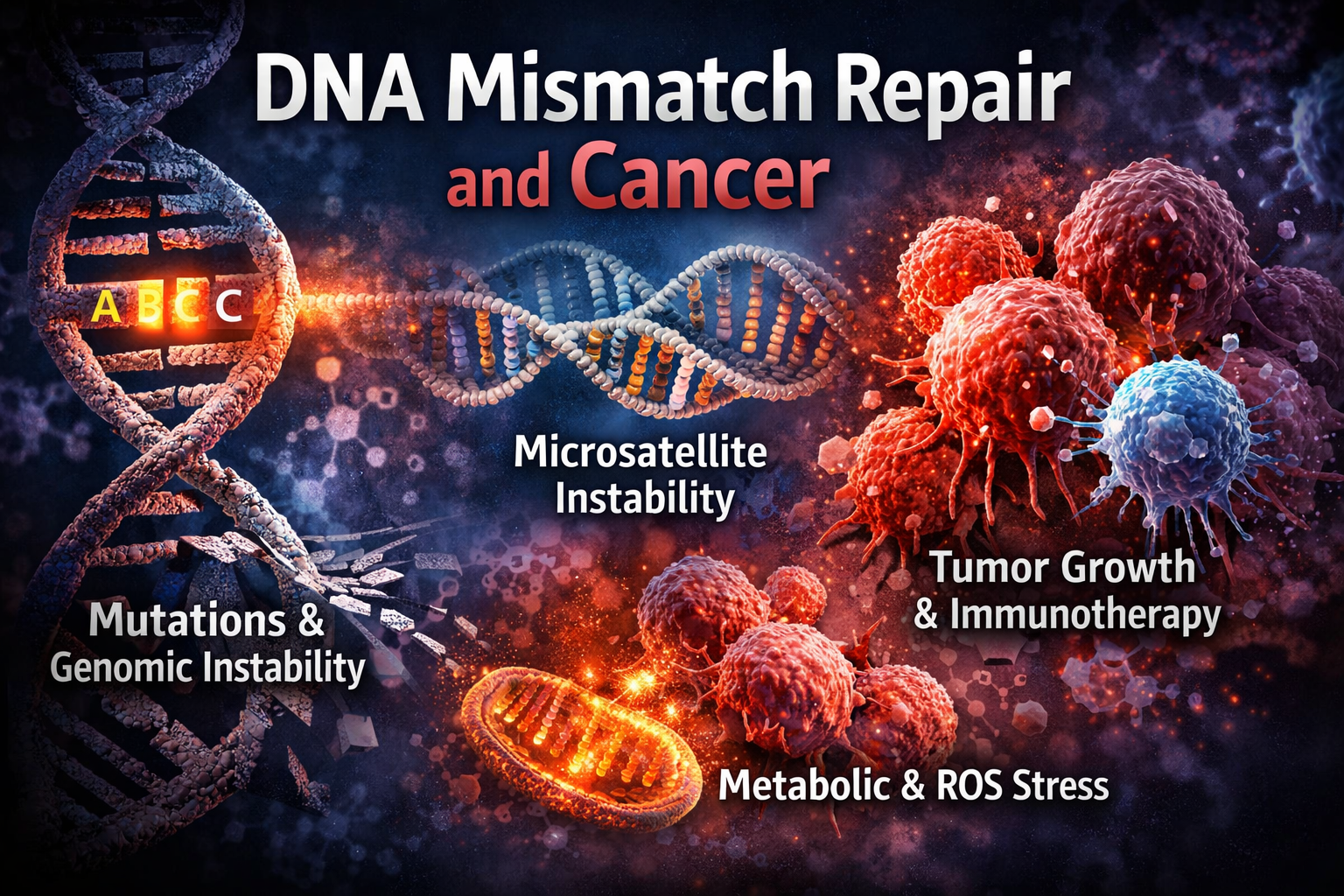
DNA mismatch repair (MMR) is a critical cellular system responsible for correcting errors that occur during DNA replication.
Every time a cell divides, billions of DNA bases must be copied accurately. Despite high fidelity, small mistakes still happen, including:
- Incorrect base pairings (A paired with C instead of T)
- Insertions or deletions of DNA bases
- Repetitive sequence slippage
MMR acts as a proofreading mechanism that scans newly synthesized DNA, identifies mismatches, and repairs them before they become permanent mutations.
Without this system, mutation rates increase dramatically, creating the genetic instability that fuels cancer development.
How DNA Mismatch Repair Works
The MMR system relies on a coordinated group of proteins that detect and correct replication errors.
Key MMR Proteins
The main proteins involved include:
- MLH1
- MSH2
- MSH6
- PMS2
These proteins function in a step-by-step repair process:
Step-by-Step Repair Mechanism
- Mismatch Detection
- MSH2 and MSH6 recognize incorrect base pairings
- Recruitment of Repair Complex
- MLH1 and PMS2 form a complex that initiates repair
- Excision of Error Segment
- The faulty DNA section is removed
- DNA Resynthesis
- DNA polymerase fills in the correct sequence
- Ligation
- DNA ligase seals the repaired strand
This process ensures genomic stability and prevents mutation accumulation.
What Happens When Mismatch Repair Fails?
When MMR is defective, replication errors are no longer corrected.
This leads to:
- Rapid accumulation of mutations
- Increased genetic instability
- Activation of oncogenes
- Inactivation of tumor suppressor genes
This condition is known as MMR deficiency (dMMR).
Consequences of MMR Failure
- Mutation rates increase up to 100–1000x
- DNA errors become permanently embedded
- Tumors evolve faster and become more aggressive
Over time, this creates a cellular environment where cancer can develop and thrive.
Microsatellite Instability: A Hallmark of MMR Deficiency
One of the most important outcomes of MMR failure is:
Microsatellite instability (MSI)
What Are Microsatellites?
Microsatellites are short, repetitive DNA sequences scattered throughout the genome.
Examples:
- CACACACA
- TATATATA
These regions are especially prone to replication errors.
How MSI Develops
When MMR is defective:
- Errors in microsatellites are not repaired
- Repeats expand or contract
- Genetic instability increases
This leads to MSI-high (MSI-H) tumors, which are strongly associated with certain cancers.
Cancers Associated with MMR Deficiency
MMR defects are strongly linked to multiple cancer types, especially those with high mutation burdens.
Common MMR-Related Cancers
- Colorectal cancer
- Endometrial cancer
- Gastric cancer
- Ovarian cancer
- Pancreatic cancer
A major hereditary condition linked to MMR failure is:
Lynch syndrome
Lynch Syndrome
Lynch syndrome is caused by inherited mutations in MMR genes.
Characteristics include:
- Early-onset colorectal cancer
- High risk of multiple cancers
- Strong association with MSI
This condition highlights how critical MMR is in preventing cancer.
MMR Deficiency and Tumor Mutation Burden
MMR-deficient tumors exhibit a very high:
- Mutation load
- Genetic diversity
- Neoantigen production
Why This Matters
High mutation burden creates abnormal proteins (neoantigens) that:
- Can trigger immune recognition
- Make tumors more visible to immune cells
This creates a paradox:
- MMR failure promotes cancer
- But also makes tumors more immunogenic
Mismatch Repair and the Immune System
MMR deficiency plays a unique role in tumor-immune interactions.
Increased Immune Visibility
MSI-high tumors produce:
- Abnormal proteins
- Mutated peptides
- Strong immune signals
This activates:
- T cells
- NK cells
These immune cells can recognize and attack tumor cells more effectively.
Immune Evasion Still Occurs
Despite high immunogenicity, tumors adapt by:
- Upregulating PD-L1
- Suppressing immune signaling
- Creating an immunosuppressive microenvironment
This balance between detection and evasion is central to cancer survival.
MMR Deficiency and Immunotherapy
MMR status is one of the most important predictors of response to immunotherapy.
Why MSI-High Tumors Respond Better
Tumors with MMR deficiency:
- Have more mutations
- Produce more neoantigens
- Are easier for immune cells to detect
This makes them highly responsive to:
- Immune checkpoint inhibitors
Clinical Impact
MSI-high tumors are often treated with:
- PD-1 inhibitors
- PD-L1 inhibitors
This is one of the first examples of genetic-based cancer therapy selection.
Mismatch Repair and Tumor Evolution
MMR deficiency accelerates tumor evolution through rapid mutation accumulation.
Effects on Tumor Biology
- Faster adaptation to therapies
- Increased drug resistance
- Greater heterogeneity
This makes treatment more complex, as tumors can quickly evolve survival strategies.
Metabolic Implications of MMR Deficiency
MMR failure does not only affect genetics—it also impacts tumor metabolism.
Increased Metabolic Stress
High mutation rates lead to:
- Protein misfolding
- Cellular stress
- Increased energy demand
This forces cancer cells to rely heavily on:
- Glycolysis (Warburg effect)
- Altered mitochondrial function
Link to Oxidative Stress
MMR-deficient cells often experience elevated:
Reactive oxygen species (ROS)
This creates:
- DNA damage
- Lipid peroxidation
- Mitochondrial dysfunction
Cancer cells must adapt by increasing antioxidant defenses to survive.
MMR, ROS, and Cancer Vulnerability
The combination of MMR deficiency and oxidative stress creates a unique vulnerability.
Why This Matters
- High mutation rates weaken genomic stability
- Elevated ROS pushes cells toward damage thresholds
- Mitochondrial dysfunction reduces resilience
This creates a “tipping point” where cancer cells are:
- More fragile
- More susceptible to stress-based therapies
Therapeutic Implications
Understanding MMR deficiency opens multiple treatment strategies.
1. Immunotherapy Targeting
- MSI-high tumors respond well to checkpoint inhibitors
- Immune activation is enhanced due to mutation load
2. Exploiting Genetic Instability
- Targeting DNA repair weaknesses
- Inducing lethal mutation accumulation
3. ROS-Based Strategies
- Increasing oxidative stress beyond survivable levels
- Targeting mitochondrial dysfunction
4. Synthetic Lethality
- Blocking alternative DNA repair pathways
- Forcing cancer cells into catastrophic failure
MMR and Chemotherapy Sensitivity
MMR status influences how tumors respond to chemotherapy.
MMR-Deficient Tumors
- May resist certain chemotherapies
- Show altered DNA damage responses
MMR-Proficient Tumors
- More responsive to DNA-damaging agents
- Better repair capacity but less mutation burden
This distinction is important for treatment planning.
Why DNA Mismatch Repair Matters in Cancer
DNA mismatch repair sits at the center of cancer biology because it directly controls mutation rates.
Key Takeaways
- MMR prevents mutation accumulation
- Failure leads to genomic instability
- MSI is a hallmark of MMR deficiency
- MMR status predicts immunotherapy response
- MMR-deficient tumors are both dangerous and vulnerable
This makes MMR one of the most important systems in understanding cancer progression and treatment.
Internal Links (Helping4Cancer)
Cancer and the Immune System
https://helping4cancer.com/cancer-immune-system/
Cancer and Oxidative Stress
https://helping4cancer.com/cancer-oxidative-stress/
Cancer and Mitochondria
https://helping4cancer.com/cancer-and-mitochondria/
Tumor Survival Network
https://helping4cancer.com/tumor-survival-network/
External References
National Cancer Institute – DNA Repair and Cancer
https://www.cancer.gov/about-cancer/causes-prevention/genetics/dna-repair-fact-sheet
PubMed – Mismatch Repair Deficiency and Cancer
https://pubmed.ncbi.nlm.nih.gov/
Nature Reviews Cancer – Microsatellite Instability
https://www.nature.com/subjects/microsatellite-instability
NIH – Lynch Syndrome Overview
https://www.ncbi.nlm.nih.gov/
Final Perspective
DNA mismatch repair is more than a proofreading system—it is a gatekeeper of genomic integrity.
When it fails, cancer gains a powerful advantage through rapid mutation and adaptation. At the same time, this instability creates weaknesses that modern therapies can exploit.
Understanding MMR bridges genetics, metabolism, and immunology—making it a central pillar in both cancer biology and treatment strategy.
Table of Contents