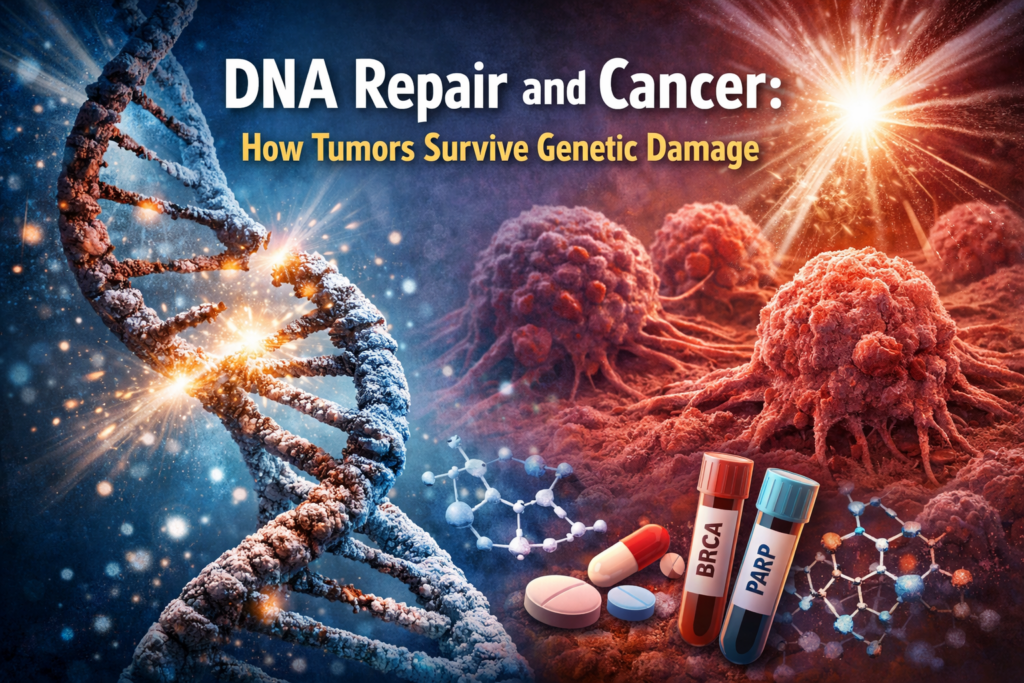
DNA Repair and Cancer Introduction
Every cell in the human body constantly faces damage to its DNA. DNA carries the instructions that control how cells grow, divide, and function. When DNA becomes damaged, cells normally repair it quickly using specialized repair systems.
These repair mechanisms are essential for maintaining healthy tissues and preventing disease.
However, cancer complicates this process. Many tumors develop because DNA damage accumulates faster than the body can repair it. At the same time, cancer cells often adapt by hijacking DNA repair pathways, allowing them to survive despite heavy genetic instability.
Understanding DNA repair has become one of the most important areas of modern cancer research. Scientists now know that certain tumors depend heavily on specific repair mechanisms, which has led to the development of targeted treatments such as PARP inhibitors.
This guide explains:
- how DNA repair works
- why repair failures cause cancer
- the role of BRCA genes and PARP enzymes
- how modern therapies target DNA repair pathways
Why DNA Damage Happens
DNA damage occurs constantly in every cell of the body.
Sources of damage include:
Normal cellular metabolism
Energy production inside mitochondria creates reactive molecules that can damage DNA.
Radiation exposure
Radiation from medical treatments or the environment can break DNA strands.
Chemical exposure
Tobacco smoke, pollutants, and toxins can mutate DNA.
Replication errors
Every time a cell divides, billions of DNA letters must be copied. Mistakes sometimes occur.
Because of these risks, the body has evolved multiple DNA repair pathways to maintain genetic stability.
If these systems fail, mutations accumulate and cancer may develop.
Learn more about mutation-driven cancer growth from the National Cancer Institute:
https://www.cancer.gov/about-cancer/causes-prevention/genetics
The Major DNA Repair Pathways
Cells contain several specialized repair systems designed to fix different types of DNA damage.
These systems work like a team of molecular mechanics that constantly inspect and repair genetic material.
1. Base Excision Repair (BER)
Base excision repair fixes small DNA damage such as oxidized or chemically altered bases.
This pathway removes the damaged base and replaces it with the correct one.
BER is particularly important for repairing damage caused by reactive oxygen species (ROS) produced during metabolism.
Related topic:
Reactive Oxygen Species and Cancer
https://helping4cancer.com/reactive-oxygen-species-cancer/
2. Nucleotide Excision Repair (NER)
Nucleotide excision repair removes bulky DNA damage such as that caused by ultraviolet light.
The repair process cuts out a short section of damaged DNA and replaces it with new DNA.
This pathway helps prevent skin cancers caused by UV radiation.
People with rare genetic disorders affecting NER, such as xeroderma pigmentosum, have extremely high skin cancer risk.
More information:
https://www.genome.gov/genetics-glossary/DNA-Repair
3. Mismatch Repair (MMR)
Mismatch repair corrects mistakes made during DNA replication.
If this pathway fails, mutation rates increase dramatically.
Defects in mismatch repair are responsible for microsatellite instability (MSI), a condition found in certain colon, stomach, and endometrial cancers.
MSI tumors often respond well to immunotherapy because they produce many abnormal proteins that the immune system can recognize.
4. Double-Strand Break Repair
Double-strand breaks are among the most dangerous types of DNA damage.
Cells repair these breaks using two main pathways:
Homologous Recombination (HR)
This is the most accurate repair method.
It uses a backup copy of DNA as a template to fix the break precisely.
Genes involved in homologous recombination include:
- BRCA1
- BRCA2
- RAD51
Mutations in these genes greatly increase cancer risk.
Non-Homologous End Joining (NHEJ)
This is a faster but less accurate repair process.
Instead of using a template, the cell simply reconnects the broken DNA ends.
Because NHEJ can introduce small errors, it sometimes contributes to cancer-causing mutations.
BRCA Genes and Cancer
Two of the most well-known DNA repair genes are BRCA1 and BRCA2.
These genes help repair double-strand DNA breaks using homologous recombination.
When BRCA genes function properly, they prevent mutations from accumulating.
But when they are mutated, DNA damage builds up rapidly.
BRCA mutations significantly increase the risk of several cancers, including:
- breast cancer
- ovarian cancer
- prostate cancer
- pancreatic cancer
According to the National Cancer Institute, individuals with BRCA1 or BRCA2 mutations may have up to a 70% lifetime risk of breast cancer.
Learn more:
https://www.cancer.gov/about-cancer/causes-prevention/genetics/brca-fact-sheet
PARP: A Critical DNA Repair Enzyme
Another important DNA repair protein is PARP, which stands for poly (ADP-ribose) polymerase.
PARP enzymes help repair single-strand DNA breaks.
When PARP detects damage, it recruits repair proteins to fix the DNA.
This process helps cells survive everyday DNA stress.
However, cancer cells often rely heavily on PARP activity to survive.
This discovery led to the development of a new class of cancer drugs called PARP inhibitors.
PARP Inhibitors: Targeting Cancer’s Repair System
PARP inhibitors block the PARP enzyme.
When PARP is inhibited, single-strand DNA breaks accumulate.
During cell division, these breaks can turn into double-strand breaks, which are much more dangerous.
Normal cells can repair these breaks using homologous recombination.
But cancer cells with BRCA mutations cannot repair them effectively.
As a result, the cancer cells die.
This concept is called synthetic lethality.
Healthy cells survive, but cancer cells collapse under the genetic damage.
Several PARP inhibitors are now approved for treating cancers with BRCA mutations.
Examples include:
- Olaparib
- Niraparib
- Rucaparib
- Talazoparib
More information from the American Cancer Society:
https://www.cancer.org/cancer/managing-cancer/treatment-types/targeted-therapy/parp-inhibitors.html
DNA Repair and Cancer Therapy
Many cancer treatments work by damaging DNA.
The goal is to overwhelm cancer cells with genetic damage so they cannot survive.
Examples include:
Chemotherapy
Certain chemotherapy drugs cause DNA damage that cancer cells cannot repair.
Examples include platinum-based drugs such as:
- cisplatin
- carboplatin
- oxaliplatin
These drugs create DNA crosslinks that block replication.
Radiation Therapy
Radiation works by generating DNA double-strand breaks.
If enough DNA damage occurs, the cancer cell cannot survive.
However, tumors with strong DNA repair systems can sometimes resist radiation.
This is one reason researchers are studying drugs that block repair pathways.
Learn more about radiation and oxidative damage:
https://helping4cancer.com/reactive-oxygen-species-cancer/
Why Some Tumors Become Treatment Resistant
Cancer cells are highly adaptable.
Over time, tumors may develop resistance to treatments that damage DNA.
Common resistance mechanisms include:
- activating backup DNA repair pathways
- increasing PARP activity
- restoring BRCA function
- reducing drug penetration
Because of this, combination therapies are often used.
These strategies attempt to overwhelm cancer cells with multiple forms of stress.
DNA Repair and Cancer Risk
Inherited mutations in DNA repair genes increase cancer risk because cells cannot fix genetic damage properly.
Examples include:
| Gene | Cancer Risk |
|---|---|
| BRCA1 | Breast, ovarian |
| BRCA2 | Breast, prostate, pancreatic |
| MLH1 | Colon cancer |
| MSH2 | Lynch syndrome cancers |
| ATM | Breast and pancreatic cancer |
Genetic testing can identify individuals with these mutations and help guide early screening or preventive strategies.
Learn more from the National Institutes of Health:
https://www.genome.gov/genetics-glossary/BRCA1-and-BRCA2
Future Directions in DNA Repair Research
Scientists are actively exploring new ways to exploit DNA repair weaknesses in tumors.
Promising areas of research include:
DNA repair inhibitors
New drugs are being developed to block additional repair pathways beyond PARP.
Combination therapies
Combining PARP inhibitors with chemotherapy or immunotherapy may increase effectiveness.
Precision oncology
Genetic sequencing allows doctors to identify DNA repair defects in individual tumors.
This enables more personalized treatment strategies.
Synthetic lethality research
Scientists are searching for additional genetic weaknesses similar to the BRCA-PARP relationship.
These discoveries could open the door to many new targeted cancer therapies.
Conclusion
DNA repair systems are essential for maintaining healthy cells.
They protect the genome from constant damage caused by normal metabolism, environmental exposure, and replication errors.
However, cancer cells often manipulate these repair pathways to survive genetic instability.
Mutations in genes such as BRCA1 and BRCA2 can dramatically increase cancer risk, while enzymes like PARP help tumors repair damage caused by treatments.
Modern oncology has begun exploiting these weaknesses.
Drugs that target DNA repair pathways, particularly PARP inhibitors, represent a major breakthrough in precision cancer therapy.
As scientists continue studying how tumors repair genetic damage, new treatments may emerge that make cancer cells increasingly vulnerable while protecting healthy tissue.
Understanding DNA repair is therefore not only critical for understanding cancer biology—it is also central to the future of cancer treatment.
Table of Contents