What Is IGF-1?
IGF-1 stands for Insulin-Like Growth Factor-1. It is a hormone that plays a major role in growth, cell repair, and metabolism.
The body produces IGF-1 mainly in the liver after stimulation from growth hormone (GH) released by the pituitary gland. Once released into the bloodstream, IGF-1 travels through the body and signals cells to grow, divide, and survive.
In healthy conditions, this system helps with:
- Childhood growth
- Tissue repair
- Muscle development
- Bone density
- Metabolic regulation
However, because IGF-1 strongly stimulates cell growth and survival, scientists have long studied its role in cancer development and tumor growth.
Many cancers use the IGF-1 signaling system to support their growth and resist cell death.
The IGF-1 Signaling Pathway
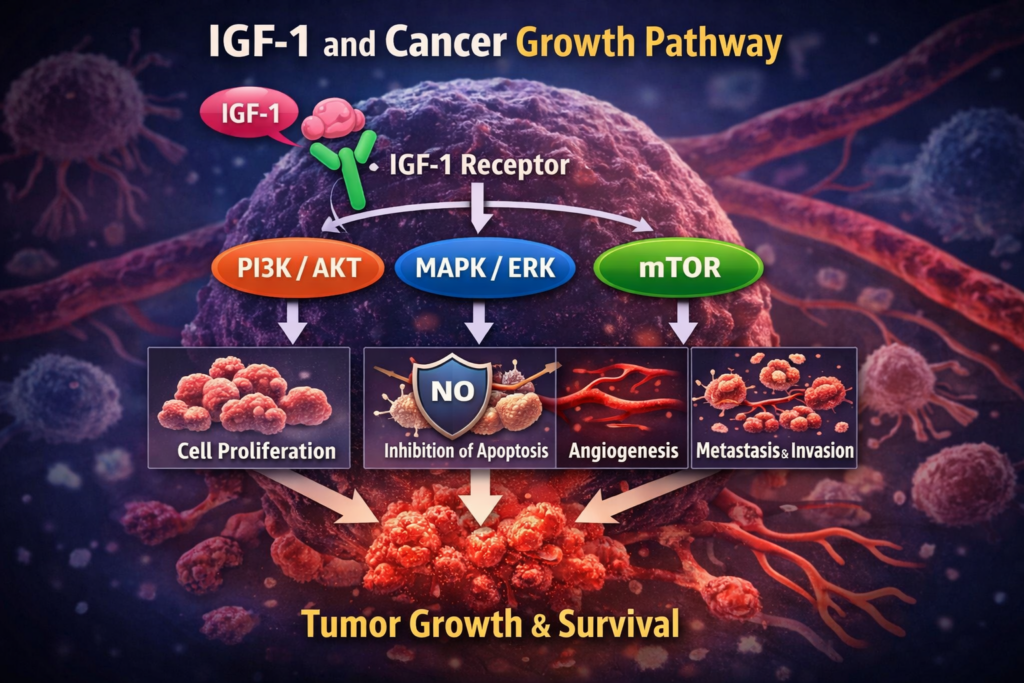
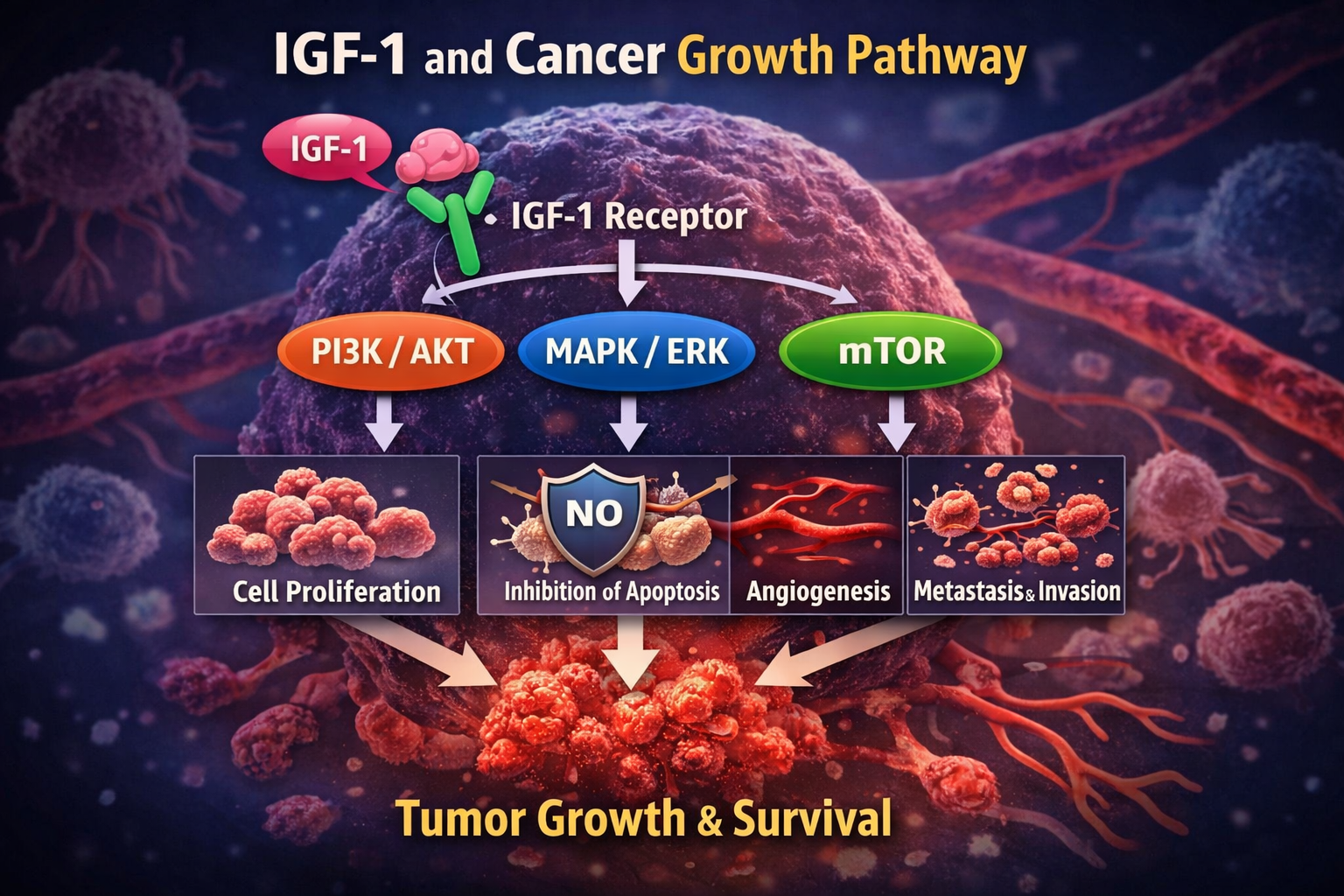
IGF-1 works by binding to a protein on cell surfaces called the IGF-1 receptor (IGF-1R).
When IGF-1 attaches to this receptor, it activates a series of signals inside the cell. These signals tell the cell to:
- Grow
- Divide
- Avoid programmed cell death
- Produce energy
- Repair damage
Several important cancer-related pathways are activated by IGF-1 signaling, including:
- PI3K / AKT pathway
- MAPK / ERK pathway
- mTOR signaling
These pathways are known to regulate cell growth, metabolism, and survival. When they become overactive, cells may divide uncontrollably, which is a hallmark of cancer.
Because of this, the IGF-1 pathway is often considered a growth accelerator for tumors.
How IGF-1 May Contribute to Cancer
Researchers have identified several ways IGF-1 can support cancer development.
1. Stimulating Cell Proliferation
One of the most important functions of IGF-1 is stimulating cell division.
Cancer cells take advantage of this signal. By activating IGF-1 receptors, tumor cells can increase their rate of replication.
Studies show IGF signaling promotes tumor cell proliferation, migration, and invasion, which can lead to cancer progression and spread.
2. Blocking Apoptosis (Cell Death)
Healthy cells have built-in safety mechanisms that trigger apoptosis, a process where damaged cells self-destruct.
Cancer cells often disable these safety systems.
IGF-1 signaling helps cells avoid apoptosis, allowing abnormal cells to survive longer than they should.
This survival signal allows cancer cells to accumulate mutations and continue growing.
3. Supporting Tumor Growth
Tumors require constant growth signals to expand.
IGF-1 acts as a powerful growth factor, encouraging cells to multiply and supporting tumor expansion.
Research shows abnormal IGF signaling is linked to several cancers, including:
- Colon cancer
- Prostate cancer
- Breast cancer
- Pancreatic cancer
- Melanoma
Because of this, IGF-1 signaling is considered one of the key growth drivers in oncology research.
4. Promoting Angiogenesis
Tumors need a blood supply to survive.
IGF-1 can stimulate angiogenesis, the formation of new blood vessels that feed tumors with oxygen and nutrients.
This allows tumors to grow larger and become more aggressive.
5. Helping Cancer Spread (Metastasis)
Cancer becomes more dangerous when it spreads to other organs.
IGF-1 signaling can increase the ability of cancer cells to:
- Move
- Invade nearby tissues
- Travel through blood vessels
These processes are essential for metastasis, which is responsible for most cancer deaths.
IGF-1 and Cancer Risk
Scientists have also studied whether higher IGF-1 levels increase cancer risk.
Large population studies have found that people with higher blood levels of IGF-1 may have an increased risk of certain cancers.
Research suggests associations between elevated IGF-1 levels and cancers such as:
- Breast cancer
- Prostate cancer
- Colorectal cancer
- Lung cancer
One large study also found higher IGF-1 levels were linked with increased risk of breast and prostate cancers.
However, scientists emphasize that this relationship is complex.
High IGF-1 does not necessarily cause cancer directly. Instead, it may create conditions that make tumor growth easier if cancer cells are already present.
IGF-1 and the Tumor Microenvironment
Cancer does not grow in isolation.
Tumors exist within a complex environment of immune cells, blood vessels, and signaling molecules.
IGF-1 can influence this environment by:
- Changing immune responses
- Supporting tumor survival
- Increasing resistance to therapy
Studies suggest IGF-1 signaling may help tumors escape immune detection, making them harder for the immune system to eliminate.
This is one reason researchers are investigating IGF-1 as a target for cancer treatment.
IGF-1 and Treatment Resistance
Another important role of the IGF pathway is its contribution to therapy resistance.
Cancer treatments such as chemotherapy and radiation aim to damage tumor cells and trigger cell death.
However, IGF-1 signaling can activate survival pathways that help cancer cells recover from treatment damage.
Researchers have found that the IGF pathway may contribute to:
- Chemotherapy resistance
- Hormone therapy resistance
- Radiation resistance
Because of this, blocking IGF-1 signaling is an area of active drug development.
Targeting IGF-1 in Cancer Therapy
Scientists have developed several strategies to block the IGF-1 pathway.
These include:
IGF-1 Receptor Inhibitors
Drugs designed to block the IGF-1 receptor (IGF-1R) prevent growth signals from reaching cancer cells.
Monoclonal Antibodies
These antibodies attach to IGF-1 receptors and stop the hormone from activating tumor growth signals.
Combination Therapies
Researchers are also studying treatments that combine:
- IGF-1 pathway inhibitors
- Chemotherapy
- Targeted cancer drugs
- Immunotherapy
The goal is to weaken cancer cells’ survival signals and make treatments more effective.
IGF-1 and Lifestyle Factors
Several lifestyle factors influence IGF-1 levels in the body.
These include:
Diet
High protein intake and high calorie consumption may increase IGF-1 levels.
Obesity
Obesity is linked to increased activity of insulin and IGF signaling, which may contribute to cancer development.
Physical Activity
Exercise can influence hormone balance and metabolic pathways connected to IGF-1.
Age
IGF-1 levels naturally peak during adolescence and decline with age.
Understanding how these factors influence IGF-1 is an active area of research in cancer prevention.
Why IGF-1 Matters in Cancer Research
The IGF-1 system sits at the intersection of several major biological systems:
- Growth hormone signaling
- Insulin metabolism
- Nutrient sensing
- Cellular growth pathways
Because of this central role, IGF-1 interacts with many of the pathways known to drive cancer, including:
- mTOR
- PI3K / AKT
- RAS / MAPK
These pathways regulate cell survival, metabolism, and growth, making them major targets for modern cancer research.
Scientists believe that understanding the IGF-1 system could lead to:
- Better cancer prevention strategies
- More precise targeted therapies
- Improved understanding of tumor biology
Key Takeaways
IGF-1 is a powerful growth hormone that helps regulate cell growth, repair, and metabolism.
While essential for normal health, abnormal IGF-1 signaling may contribute to cancer by:
- Stimulating tumor growth
- Preventing cancer cell death
- Supporting metastasis
- Increasing treatment resistance
Higher circulating IGF-1 levels have been associated with increased risk for several cancers, although the relationship is complex and influenced by many factors.
Because of its central role in cell growth and survival, the IGF-1 pathway remains an important focus in modern cancer research and drug development.
References
- National Cancer Institute – Cancer Biology
https://www.cancer.gov/ - Insulin-like growth factors in cancer biology
https://www.ncbi.nlm.nih.gov/pmc/articles/PMC4383470/ - IGF-1 receptor signaling in cancer
https://www.nature.com/articles/nrc.2017.109 - IGF-1 levels and cancer risk study
https://www.sciencedirect.com/science/article/abs/pii/S1470204502007313 - American Cancer Society – How Cancer Grows
https://www.cancer.org/
Table of Contents