People Also Ask About Obesity and Colon Cancer
Many people researching colorectal cancer are asking:
- Does obesity increase colon cancer risk?
- Why does belly fat increase cancer risk?
- What is visceral fat?
- How does obesity affect inflammation?
- Can obesity cause insulin resistance?
- What is metabolic syndrome?
- How does obesity affect the microbiome?
- Does obesity weaken the immune system?
- Can weight loss reduce colon cancer risk?
- How does obesity affect younger adults and colon cancer?
- What is the tumor microenvironment?
- How does fatty liver disease affect colon cancer risk?
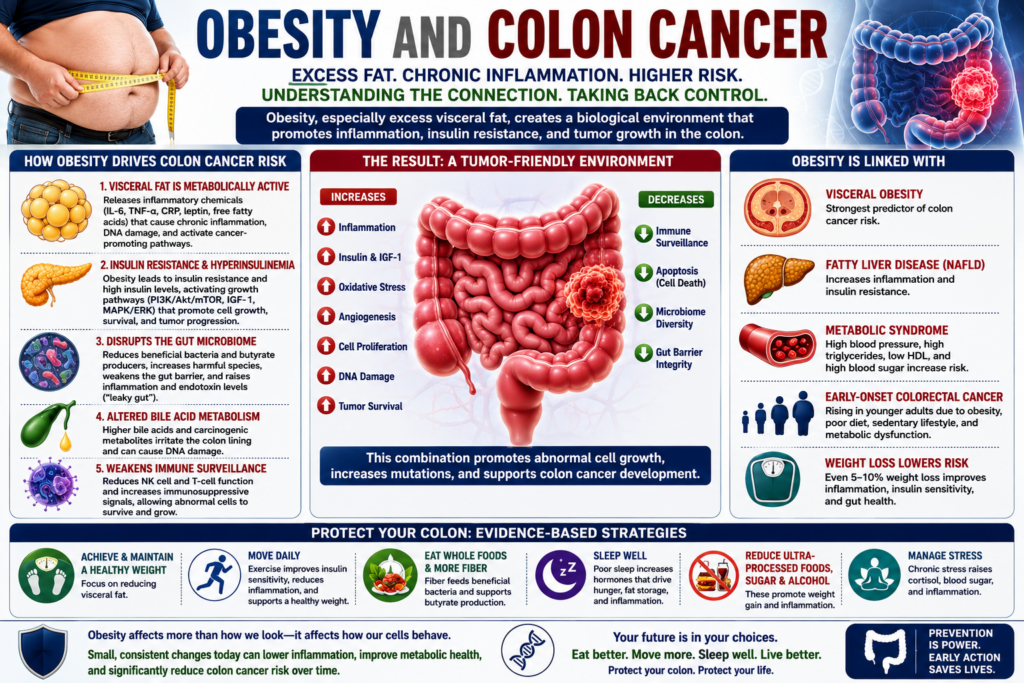
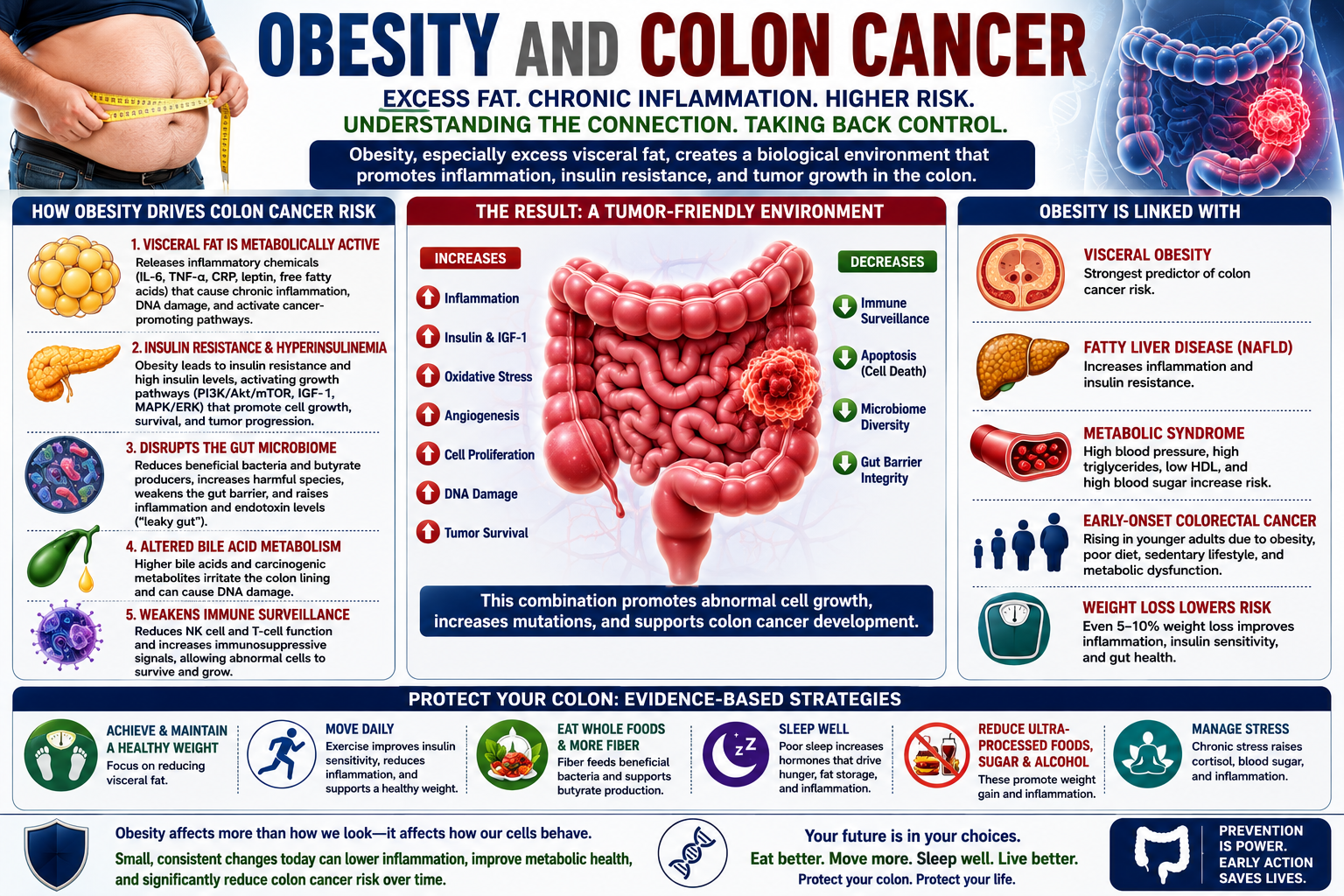
Researchers now consider obesity one of the strongest lifestyle-related colorectal cancer risk factors because it affects inflammation, metabolism, insulin signaling, gut health, immune function, and the tumor microenvironment all at the same time.
Obesity and Colon Cancer
Obesity is one of the strongest and most consistent lifestyle-related risk factors for colorectal cancer.
It is not simply about body size or appearance.
The real issue is the biological environment excess fat creates inside the body.
Obesity affects:
- Inflammation
- Insulin resistance
- Hormones
- The gut microbiome
- Immune function
- Metabolism
- The tumor microenvironment
These systems interact together over many years and may help create conditions where cancer develops more easily.
Not All Fat Is the Same
Researchers pay special attention to visceral fat.
Visceral fat is the fat stored around internal organs inside the abdomen.
This type of fat is highly metabolically active and strongly linked with colon cancer risk.
Visceral fat behaves almost like an inflammatory organ.
It releases inflammatory compounds directly into the bloodstream.
Visceral Fat and Chronic Inflammation
Visceral fat produces inflammatory molecules such as:
- IL-6
- TNF-α
- CRP
- Leptin
- Free fatty acids
These substances may contribute to:
- Chronic inflammation
- DNA damage
- Oxidative stress
- Immune dysfunction
- Abnormal cell signaling
Researchers increasingly believe chronic low-grade inflammation is one of the biggest long-term drivers of colorectal cancer.
Obesity and Insulin Resistance
Obesity and insulin resistance are tightly connected.
As body fat increases, cells may become less responsive to insulin.
This forces the pancreas to release more insulin to compensate.
Chronically elevated insulin levels are called hyperinsulinemia.
High insulin and IGF-1 signaling may activate powerful growth pathways such as:
- PI3K/Akt/mTOR
- MAPK/ERK
These pathways promote:
- Cell growth
- Cell survival
- Angiogenesis
- Tumor progression
- Resistance to apoptosis
This is one of the strongest biological links between obesity and colorectal cancer.
Obesity and the Gut Microbiome
Obesity is also associated with major microbiome changes.
Research shows obesity often correlates with:
- Lower microbial diversity
- Lower butyrate-producing bacteria
- More inflammatory bacteria
- Increased gut permeability
- Higher endotoxin levels
These changes may weaken the colon barrier and increase inflammation inside the digestive tract.
Researchers now heavily study obesity-related dysbiosis as part of colorectal cancer biology.
The Gut Barrier and “Leaky Gut”
The gut barrier protects the colon from harmful bacteria, toxins, and inflammatory compounds.
Obesity may weaken this barrier.
When the barrier becomes more permeable, bacterial toxins such as LPS (lipopolysaccharide) may leak into the bloodstream.
This may worsen:
- Inflammation
- Insulin resistance
- Immune dysfunction
- Metabolic syndrome
This cycle may place additional stress on the colon over time.
Butyrate-Producing Bacteria Decline
One important finding in obesity research is the reduction of butyrate-producing bacteria.
Butyrate is a short-chain fatty acid produced when gut bacteria ferment fiber and resistant starch.
Butyrate helps:
- Fuel healthy colon cells
- Support mucus production
- Strengthen gut barrier integrity
- Reduce inflammation
- Promote apoptosis of abnormal cells
Lower butyrate levels are consistently linked with poorer colon health and higher colorectal cancer risk.
Obesity and Bile Acids
People with obesity often have altered bile acid metabolism.
This may increase:
- Secondary bile acids
- Colon irritation
- Oxidative stress
- DNA damage
Some secondary bile acids are believed to have carcinogenic properties inside the colon.
Researchers increasingly study bile acid metabolism as another connection between obesity and colon cancer.
Obesity Weakens Immune Surveillance
A healthy immune system constantly monitors and destroys abnormal cells.
Obesity may weaken this process.
Research shows obesity may reduce:
- Natural killer (NK) cell activity
- T-cell function
- Immune surveillance efficiency
At the same time, obesity increases inflammatory and immunosuppressive signaling.
This may allow abnormal cells to survive longer and evade immune destruction.
Obesity and the Tumor Microenvironment
The tumor microenvironment includes:
- Immune cells
- Blood vessels
- Inflammatory molecules
- Fat tissue
- Fibroblasts
- Gut bacteria
- Oxygen levels
Obesity changes this entire environment.
It may increase:
- Inflammation
- Angiogenesis
- Oxidative stress
- Growth signaling
- Hypoxia
- Tumor survival pathways
while decreasing:
- Immune surveillance
- Gut barrier integrity
- Microbiome diversity
Researchers increasingly believe obesity helps create a more tumor-friendly environment throughout the body.
Obesity and Early-Onset Colon Cancer
One of the most alarming modern trends is the rise of colorectal cancer in adults under 50.
Researchers believe obesity and metabolic syndrome are major contributors.
Younger generations are exposed earlier in life to:
- Ultra-processed foods
- High sugar intake
- Sedentary lifestyles
- Poor sleep
- Constant snacking
- Low fiber diets
- Early insulin resistance
This may explain why metabolic dysfunction and colon cancer are appearing at younger ages than before.
Fatty Liver Disease and Colon Cancer
Obesity strongly increases the risk of non-alcoholic fatty liver disease (NAFLD).
Fatty liver disease is closely tied to:
- Insulin resistance
- Chronic inflammation
- Metabolic syndrome
- Oxidative stress
Researchers increasingly associate fatty liver disease with higher colorectal cancer risk.
Weight Loss and Colon Cancer Risk
The encouraging news is that even modest weight loss may improve many cancer-related pathways.
Weight loss may help:
- Lower inflammation
- Improve insulin sensitivity
- Reduce visceral fat
- Improve microbiome diversity
- Improve gut barrier integrity
- Lower oxidative stress
- Improve metabolic flexibility
Even a 5–10% reduction in body weight may significantly improve metabolic health markers.
Exercise and Obesity Reduction
Physical activity is one of the most powerful ways to reduce visceral fat and improve metabolic health.
Exercise may help improve:
- Insulin sensitivity
- Inflammation
- Blood sugar control
- Body composition
- Gut motility
- Immune function
Regular movement is consistently associated with lower colorectal cancer risk.
The Bigger Picture
Obesity increases colon cancer risk because it creates a high-insulin, high-inflammation, metabolically overloaded internal environment.
This environment may:
- Damage DNA
- Disrupt the microbiome
- Activate growth pathways
- Increase oxidative stress
- Weaken immune defenses
- Promote tumor survival
Researchers now view obesity as both a metabolic disease and an inflammatory disease strongly connected to colorectal cancer biology.
Final Thoughts
Obesity is one of the strongest long-term risk factors associated with colorectal cancer because it affects nearly every major cancer-related system in the body.
Visceral fat, chronic inflammation, insulin resistance, microbiome disruption, hyperinsulinemia, fatty liver disease, and metabolic dysfunction may all work together to create a biological environment that supports tumor growth over time.
The good news is that improving metabolic health can reverse many of these pathways.
Even modest improvements in:
- Body weight
- Exercise
- Fiber intake
- Sleep
- Blood sugar control
- Gut health
- Insulin sensitivity
may significantly improve long-term colon health and lower colorectal cancer risk.
Internal Links
- Colon Cancer Reduction: Metabolic Health, Gut Health, and Lifestyle Factors
- Insulin Resistance and Colon Cancer
- Metabolic Syndrome and Colon Cancer
- The Gut Microbiome and Colon Health
- Constant Eating and Metabolic Overload
- Lifestyle Factors That May Help Reduce Colon Cancer Risk
- Cancer Is More Complicated Than Glucose Alone
- Hypoxia and HIF-1α in Cancer
External Authority Sources
- NIH / PubMed Central: Obesity and Colorectal Cancer
- NIH / PubMed Central: Visceral Obesity and Colorectal Cancer Risk
- NIH / PubMed Central: Obesity, Inflammation, and Cancer Pathways
- National Cancer Institute: Obesity and Cancer
- American Cancer Society: Body Weight and Colorectal Cancer Risk
Medical Disclaimer
This article is for educational and informational purposes only and is not medical advice. It does not diagnose, treat, cure, or prevent any disease. Always speak with a qualified healthcare professional about obesity, metabolic health, colon cancer risk, digestive symptoms, weight loss, screening, or treatment decisions.