People Also Ask About Hypoxia and HIF-1α
Many people researching colon cancer are asking:
- What is hypoxia in cancer?
- What is HIF-1α?
- How does low oxygen affect tumors?
- Why are hypoxic tumors more aggressive?
- What is angiogenesis?
- How does VEGF help tumors grow?
- How does hypoxia affect the immune system?
- What is the Warburg effect?
- Why do tumors produce lactate?
- How does hypoxia increase metastasis?
- Does obesity increase HIF-1α?
- How does inflammation affect HIF-1α?
- Why are hypoxic tumors harder to treat?
- How does hypoxia affect colon cancer?
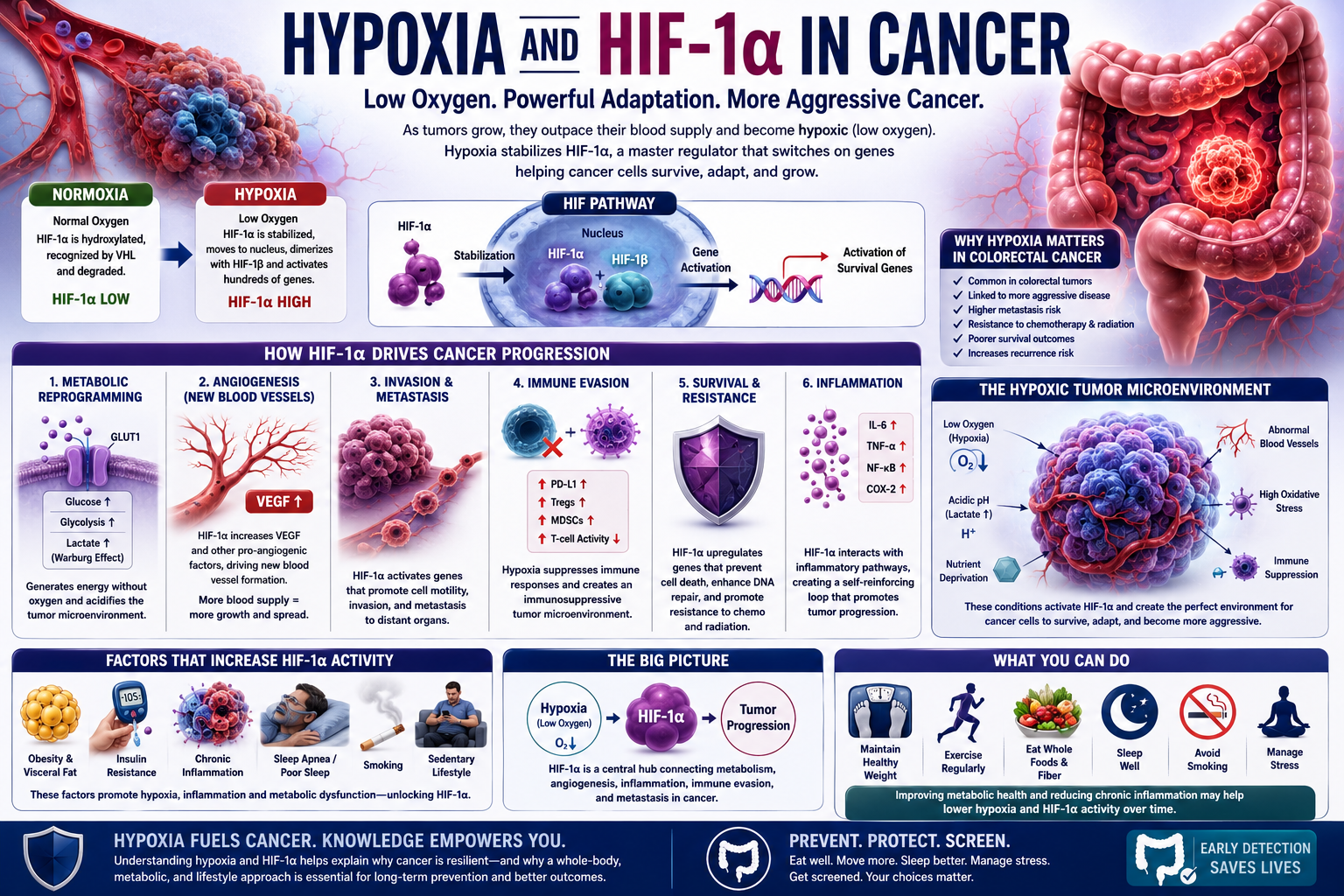
Researchers now consider hypoxia and HIF-1α some of the most important survival systems in colorectal cancer biology because they connect metabolism, angiogenesis, inflammation, immune evasion, and tumor aggressiveness.
Hypoxia and HIF-1α in Cancer
As tumors grow, they often outgrow their blood supply.
This creates areas of low oxygen called hypoxia.
Hypoxia is not just a side effect of cancer growth.
It is one of the major biological forces that helps tumors survive, spread, and resist treatment.
The master regulator of this low-oxygen response is a protein called:
HIF-1α (Hypoxia-Inducible Factor-1 alpha)
HIF-1α acts like a survival switch that helps cancer cells adapt to harsh environments.
Researchers now believe HIF-1α connects many major cancer systems together, including:
- Metabolism
- Angiogenesis
- Immune evasion
- Inflammation
- Tumor aggressiveness
- Metastasis
- Treatment resistance
What Is Hypoxia?
Hypoxia simply means low oxygen.
Tumors often become hypoxic because:
- They grow faster than blood vessels can form
- Their blood supply becomes chaotic
- Cancer cells consume oxygen rapidly
Normal healthy cells struggle in low oxygen environments.
Cancer cells adapt.
This adaptation is one reason aggressive tumors become difficult to treat.
What Is HIF-1α?
HIF-1α is a transcription factor.
That means it controls which genes turn on or off.
Under normal oxygen conditions:
- HIF-1α is quickly destroyed
- Levels stay low
Under low oxygen conditions:
- HIF-1α stabilizes
- Moves into the cell nucleus
- Activates hundreds of survival genes
This allows cancer cells to survive conditions that would normally kill healthy cells.
How HIF-1α Helps Cancer Survive
HIF-1α activates multiple pathways that help tumors become more aggressive.
Increased Glucose Uptake
HIF-1α increases glucose transporters such as GLUT1.
This helps cancer cells pull in more glucose for energy production.
Increased Glycolysis
HIF-1α pushes cancer cells toward glycolysis — the Warburg effect.
This allows tumors to produce energy even when oxygen is low.
Angiogenesis (New Blood Vessel Growth)
HIF-1α strongly activates VEGF.
VEGF helps tumors build new blood vessels.
More blood vessels mean:
- More nutrients
- More oxygen
- Faster growth
- Greater metastatic potential
This is one reason anti-VEGF cancer drugs exist.
Metastasis and Invasion
HIF-1α activates genes that help tumors:
- Invade nearby tissue
- Migrate
- Spread to distant organs
Hypoxic tumors are often more metastatic.
Survival Under Stress
HIF-1α helps tumors resist:
- Cell death
- Oxidative stress
- Nutrient deprivation
- Chemotherapy stress
This is one reason hypoxic tumors are often treatment resistant.
Hypoxia and the Warburg Effect
One major role of HIF-1α is metabolic reprogramming.
HIF-1α increases:
- Glycolysis
- Lactate production
- Glucose uptake
while reducing:
- Normal mitochondrial energy production
This creates an acidic tumor environment rich in lactate.
Why Lactate Matters
High lactate levels may:
- Damage surrounding tissue
- Promote invasion
- Suppress immune cells
- Increase inflammation
- Support metastasis
Researchers now believe lactate is not simply waste.
It acts like a signaling molecule that helps tumors survive.
Hypoxia and Angiogenesis
Tumors cannot grow large without blood supply.
HIF-1α strongly activates VEGF (Vascular Endothelial Growth Factor).
VEGF tells the body to grow new blood vessels around tumors.
These blood vessels:
- Deliver nutrients
- Deliver oxygen
- Support rapid growth
- Create pathways for metastasis
However, tumor blood vessels are often abnormal and disorganized.
This creates even more hypoxia inside tumors, which further activates HIF-1α.
This creates a vicious cycle.
Hypoxia and Immune Evasion
Hypoxic tumors suppress the immune system.
HIF-1α may:
- Reduce T-cell activity
- Increase PD-L1 expression
- Increase regulatory T-cells (Tregs)
- Attract immunosuppressive cells
- Create acidic environments that weaken immune cells
This allows tumors to hide from immune attack more effectively.
Researchers now believe hypoxia is a major reason many tumors evade immune destruction.
Hypoxia and Inflammation
Hypoxia and inflammation feed each other.
HIF-1α activates inflammatory pathways including:
- NF-κB
- IL-6
- TNF-α
- COX-2
Inflammation then stabilizes HIF-1α even further.
This creates a self-reinforcing loop that may accelerate tumor progression.
Hypoxia in Colorectal Cancer
Colorectal tumors often contain large hypoxic regions because:
- They grow rapidly
- Blood supply becomes irregular
- The colon naturally has lower oxygen levels
Higher HIF-1α activity in colorectal cancer is associated with:
- More aggressive tumors
- Increased metastasis
- Poorer survival
- Increased angiogenesis
- Greater glycolysis
- Treatment resistance
Researchers now consider hypoxia one of the central drivers of aggressive colorectal cancer behavior.
Lifestyle Factors That May Increase HIF-1α Activity
Several modern lifestyle factors may indirectly increase hypoxia signaling.
Obesity
Visceral fat itself becomes hypoxic.
Obesity may increase:
- HIF-1α activation
- Inflammation
- Insulin resistance
Insulin Resistance
High insulin and IGF-1 signaling interact with HIF-1α pathways.
Chronic Inflammation
Inflammation stabilizes HIF-1α even when oxygen levels are normal.
Poor Sleep and Sleep Apnea
Sleep apnea causes repeated low-oxygen episodes.
Researchers now study whether chronic intermittent hypoxia increases cancer risk.
Smoking
Smoking reduces oxygen delivery while increasing oxidative stress and inflammation.
Sedentary Lifestyle
Poor metabolic fitness and reduced circulation may worsen metabolic dysfunction and inflammation.
Why HIF-1α Matters So Much
HIF-1α connects many major cancer systems together.
It helps tumors:
- Survive low oxygen
- Rewire metabolism
- Build blood vessels
- Spread
- Suppress immunity
- Increase inflammation
- Resist treatment
This is one reason cancer is far more complicated than glucose alone.
Cancer behaves like an adaptive ecosystem that changes based on its environment.
The Bigger Picture
Researchers increasingly believe colorectal cancer develops through the interaction of:
- Metabolism
- Inflammation
- Immune dysfunction
- Hypoxia
- Microbiome disruption
- Obesity
- Insulin resistance
- Tumor microenvironment changes
Hypoxia and HIF-1α sit near the center of many of these systems.
This is why improving:
- Metabolic health
- Insulin sensitivity
- Body composition
- Inflammation
- Exercise
- Sleep
- Gut health
may help reduce the conditions that activate hypoxia pathways over time.
Final Thoughts
Hypoxia and HIF-1α are some of the most important survival systems in cancer biology.
Low oxygen environments activate HIF-1α, which helps tumors survive, grow, spread, evade the immune system, and resist treatment.
Researchers now heavily study hypoxia because it connects:
- Angiogenesis
- Inflammation
- Metabolic adaptation
- Immune evasion
- Tumor aggressiveness
- Metastasis
into one powerful cancer survival network.
This is why modern colon cancer research increasingly focuses on the entire tumor environment rather than glucose alone.
Internal Links
- Insulin Resistance and Colon Cancer
- Obesity and Colon Cancer
- The Gut Microbiome and Colon Health
- Constant Eating and Metabolic Overload
- Lifestyle Factors That May Help Reduce Colon Cancer Risk
External Authority Sources
- NIH / PubMed Central: HIF‑1α and Colorectal Cancer
- NIH / PubMed Central: Hypoxia and Tumor Metabolism
- NIH / PubMed Central: VEGF and Angiogenesis in Cancer
- Nature Reviews Cancer: Hypoxia and Cancer Progression
- National Cancer Institute: Tumor Hypoxia and Cancer Research
Medical Disclaimer
This article is for educational and informational purposes only and is not medical advice. It does not diagnose, treat, cure, or prevent any disease. Always speak with a qualified healthcare professional about cancer risk, symptoms, screening, or treatment decisions.