What Are Oncogenes and Tumor Suppressor Genes?
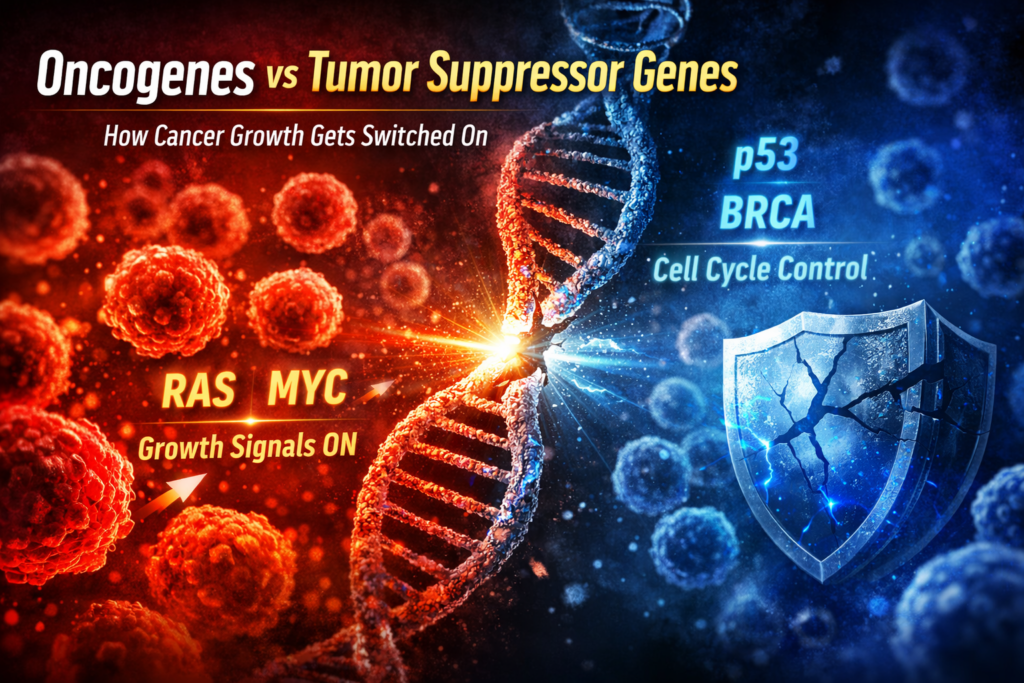
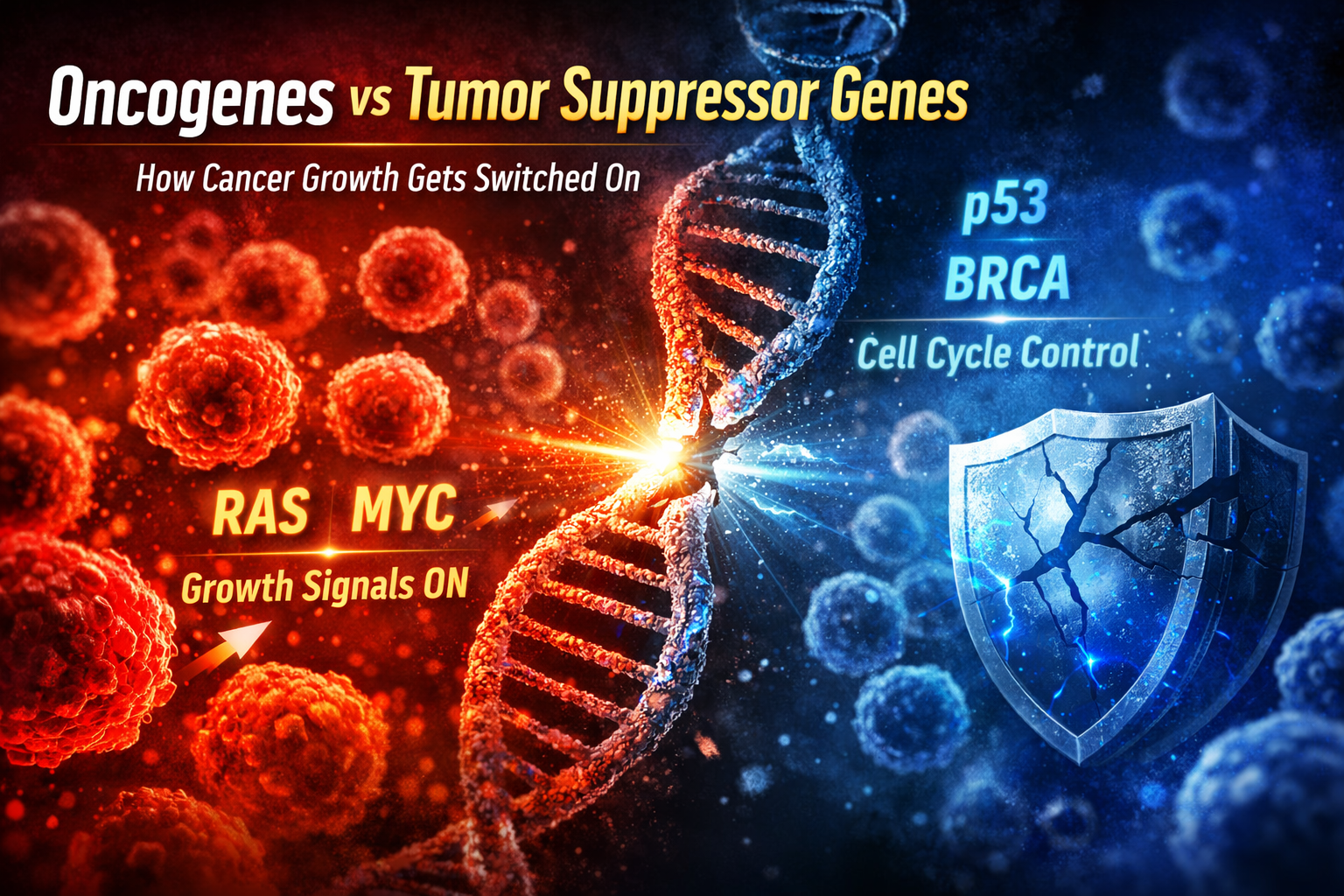
Cancer begins when the normal balance of cell growth and cell death is disrupted. This balance is tightly controlled by two major categories of genes:
- Oncogenes (growth-promoting genes)
- Tumor suppressor genes (growth-inhibiting and protective genes)
In healthy cells, these systems work together to regulate when cells divide, repair damage, or die. When oncogenes become overactive and tumor suppressor genes are lost or disabled, cells begin to grow uncontrollably.
This imbalance is one of the most fundamental drivers of cancer biology.
The Normal Role of Proto-Oncogenes
Proto-oncogenes are normal genes found in every cell. Their job is to promote controlled cell growth and division when needed.
They are activated during:
- Tissue repair
- Development
- Immune responses
- Cellular regeneration
These genes produce proteins that:
- Signal cells to divide
- Activate growth pathways such as PI3K/Akt and MAPK
- Regulate metabolism to support cell function
In normal conditions, proto-oncogenes are tightly regulated. They turn on only when needed and shut off once the task is complete.
How Proto-Oncogenes Become Oncogenes
An oncogene is a mutated or overactive version of a proto-oncogene.
This transformation can occur through:
- Gene mutations
- Gene amplification (too many copies)
- Chromosomal rearrangements
- Viral activation
Once activated, oncogenes behave like a stuck accelerator pedal. They continuously signal the cell to grow and divide, even when it should not.
Common examples include:
- RAS mutations (constant growth signaling)
- MYC amplification (increased cell proliferation)
- HER2 overexpression (enhanced receptor signaling)
These changes lead to persistent activation of pathways such as:
- PI3K/Akt (survival and metabolism)
- MAPK/ERK (proliferation)
- mTOR (protein synthesis and growth)
What Are Tumor Suppressor Genes?
Tumor suppressor genes act as the brakes of the cell.
Their primary roles include:
- Slowing or stopping cell division
- Repairing DNA damage
- Triggering apoptosis (programmed cell death)
- Maintaining genomic stability
These genes ensure that damaged or abnormal cells do not continue dividing.
Key Tumor Suppressor Genes in Cancer
Several tumor suppressor genes play critical roles in preventing cancer:
- TP53 (p53): Known as the “guardian of the genome,” it detects DNA damage and either repairs it or initiates cell death
- RB1: Controls progression through the cell cycle
- BRCA1 and BRCA2: Involved in DNA repair through homologous recombination
- PTEN: Regulates the PI3K/Akt pathway and prevents excessive growth signaling
Loss or mutation of these genes removes critical safeguards, allowing abnormal cells to survive and accumulate further mutations.
The Two-Hit Hypothesis
Tumor suppressor genes typically require two “hits” (mutations) to lose function completely.
- First hit: One copy of the gene is damaged
- Second hit: The remaining functional copy is lost or inactivated
This is known as the two-hit hypothesis and explains why tumor suppressor loss is often gradual.
In contrast, oncogenes usually require only one activating mutation to drive cancer growth.
How These Genes Affect the Cell Cycle
The cell cycle is tightly controlled by signals from both oncogenes and tumor suppressor genes.
Oncogenes push the cycle forward by:
- Activating cyclins and CDKs
- Promoting DNA replication
- Enhancing metabolic activity
Tumor suppressor genes slow or stop the cycle by:
- Blocking progression at checkpoints (G1/S, G2/M)
- Repairing DNA damage before division
- Triggering apoptosis if damage is too severe
When this system breaks down, cells bypass checkpoints and divide uncontrollably.
Metabolic Effects of Oncogenes
Oncogenes do more than stimulate growth. They also reprogram cellular metabolism.
Key changes include:
- Increased glucose uptake (Warburg effect)
- Enhanced glycolysis even in the presence of oxygen
- Increased lipid and nucleotide synthesis
- Activation of mTOR for protein production
These metabolic changes allow cancer cells to generate the energy and building blocks needed for rapid growth.
For more on cancer metabolism, see:
https://helping4cancer.com/lipid-metabolism-cancer/
https://helping4cancer.com/nucleotide-synthesis-cancer/
Tumor Suppressors and DNA Repair
Tumor suppressor genes play a central role in maintaining DNA integrity.
They:
- Detect DNA damage
- Pause the cell cycle
- Activate repair mechanisms
- Initiate apoptosis if repair fails
Loss of tumor suppressors leads to:
- Genomic instability
- Accumulation of mutations
- Increased cancer aggressiveness
Learn more:
https://helping4cancer.com/genomic-instability-cancer/
https://helping4cancer.com/dna-mismatch-repair-cancer/
Apoptosis and Survival Signaling
Apoptosis is the process of programmed cell death.
Oncogenes often suppress apoptosis by:
- Activating survival pathways (PI3K/Akt)
- Increasing anti-apoptotic proteins (Bcl-2)
Tumor suppressors promote apoptosis by:
- Activating pro-apoptotic signals
- Detecting irreparable damage
- Eliminating defective cells
When apoptosis is blocked, damaged cells continue to survive and multiply.
Interaction With ROS and Mitochondria
Reactive oxygen species (ROS) play a dual role in cancer.
Oncogenes:
- Increase metabolic activity, generating more ROS
- Adapt to oxidative stress by enhancing antioxidant systems
Tumor suppressors:
- Respond to oxidative damage
- Trigger repair or cell death
Mitochondria are central to this balance. They regulate:
- Energy production
- ROS levels
- Apoptosis signaling
Disruption of this system contributes to cancer survival.
Why This Matters for Cancer Growth
The combination of:
- Activated oncogenes
- Inactivated tumor suppressor genes
creates a perfect environment for cancer progression.
This leads to:
- Uncontrolled cell division
- Resistance to cell death
- Increased mutation rates
- Metabolic reprogramming
- Enhanced ability to invade and metastasize
This is the foundation of nearly all cancers.
Implications for Treatment
Understanding these gene systems is critical for modern cancer treatment.
Targeted therapies aim to:
- Block oncogene signaling (e.g., HER2 inhibitors, EGFR inhibitors)
- Restore tumor suppressor pathways where possible
- Exploit weaknesses in cancer metabolism
- Increase oxidative stress beyond survivable levels
Some strategies focus on:
- Inhibiting PI3K/Akt/mTOR pathways
- Targeting DNA repair weaknesses (e.g., PARP inhibitors in BRCA mutations)
- Enhancing immune detection of abnormal cells
The Role of Personalized Cancer Therapy
Different cancers have different genetic profiles.
For example:
- Some cancers are driven primarily by oncogene activation
- Others are dominated by tumor suppressor loss
Genetic testing allows for:
- Identification of specific mutations
- Selection of targeted therapies
- More precise treatment strategies
This is the foundation of precision oncology.
External Research and Sources
National Cancer Institute – https://www.cancer.gov
PubMed – https://pubmed.ncbi.nlm.nih.gov
Nature Reviews Cancer – https://www.nature.com/nrc/
NIH Genetics Home Reference – https://ghr.nlm.nih.gov
Final Summary
Oncogenes and tumor suppressor genes control the balance between growth and protection in every cell.
- Oncogenes act as accelerators that drive cell growth
- Tumor suppressor genes act as brakes that prevent damage and uncontrolled division
Cancer develops when:
- Growth signals are permanently switched on
- Protective mechanisms are lost
This imbalance leads to uncontrolled growth, metabolic changes, and resistance to cell death.
Understanding this core concept provides a foundation for:
- Cancer biology
- Treatment strategies
- Targeted therapies
- Metabolic approaches to cancer support
It is one of the most important principles in understanding how cancer begins and how it progresses.
Table of Contents