What Is Telomerase and Why It Matters in Cancer
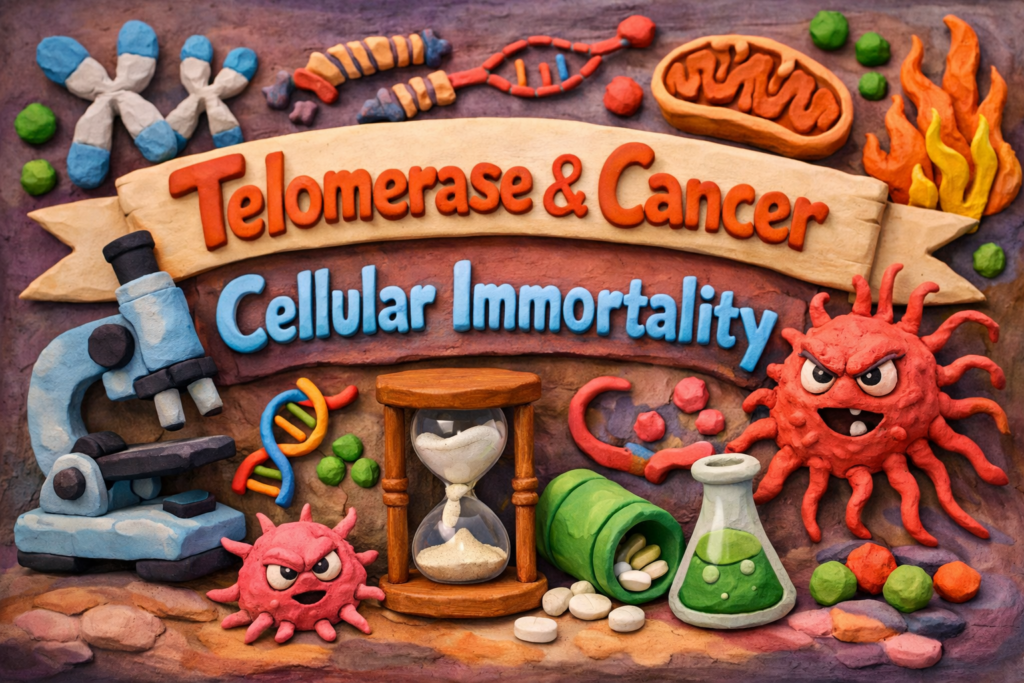
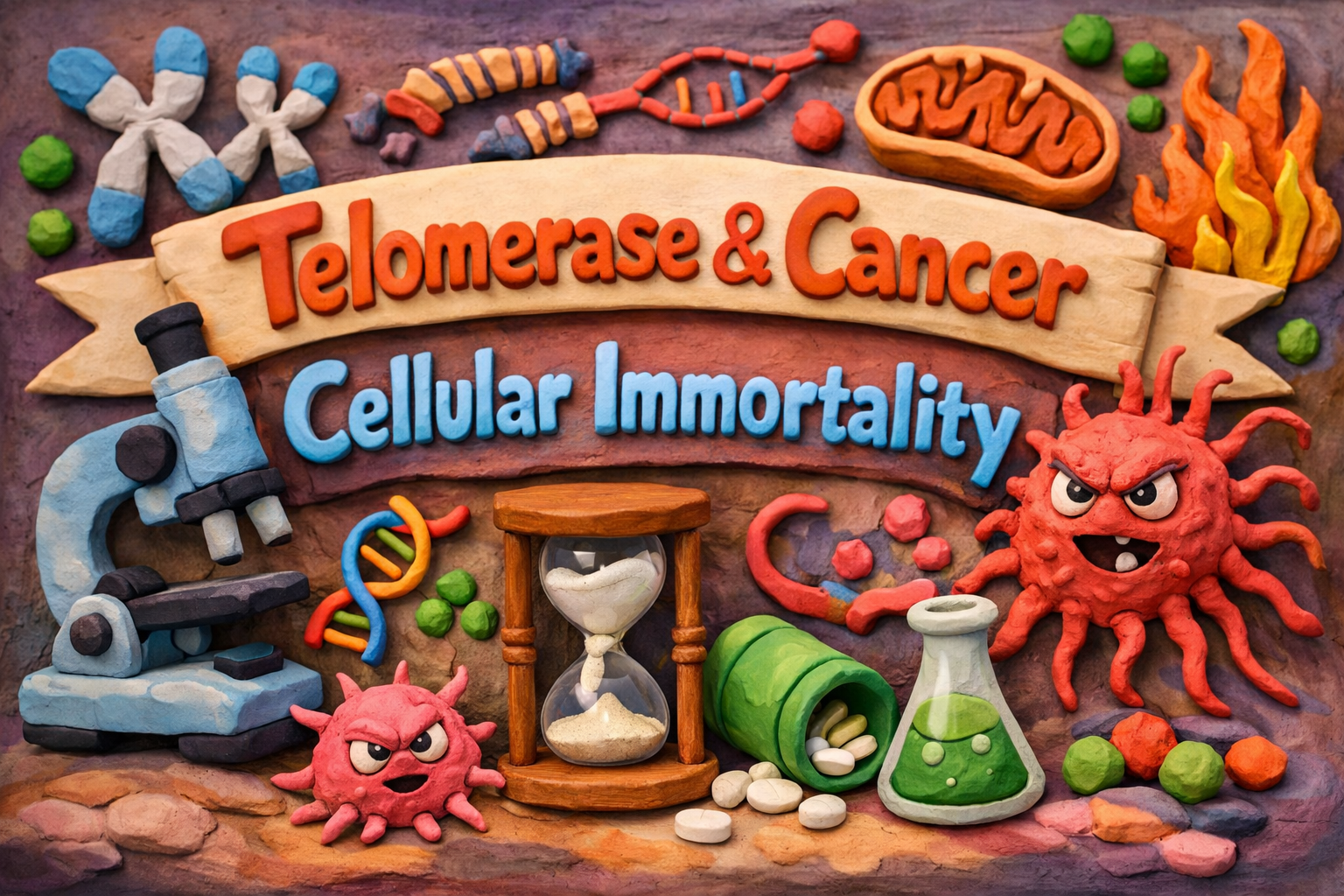
Telomerase is an enzyme that allows cells to maintain the protective ends of their chromosomes, known as telomeres. In normal human cells, telomeres shorten with each division, eventually leading to cellular aging and death.
Cancer cells bypass this natural limit by reactivating telomerase. This allows them to divide indefinitely, making telomerase one of the key drivers of cancer immortality.
This process is considered a hallmark of cancer because it enables long-term tumor survival, continuous growth, and resistance to stress.
Understanding Telomeres: The Cellular Clock
Telomeres are repetitive DNA sequences located at the ends of chromosomes. They act as protective caps that prevent genetic damage during replication.
Each time a cell divides, telomeres shorten slightly. When they become too short, the cell enters senescence or undergoes apoptosis.
Key Functions of Telomeres
- Protect chromosome integrity
- Prevent DNA damage signals
- Control the number of times a cell can divide
- Maintain genomic stability
Without telomeres, chromosomes would degrade or fuse, leading to cell death or malfunction.
How Telomerase Works
Telomerase restores telomere length by adding DNA repeats to chromosome ends. It contains two main components:
- hTERT (human telomerase reverse transcriptase), the catalytic protein
- TERC (telomerase RNA component), which provides the template
In most adult cells, telomerase is inactive. However, in cancer cells, hTERT becomes reactivated, enabling continuous telomere repair.
Result of Telomerase Activation
- Cells bypass senescence
- Unlimited replication becomes possible
- DNA damage checkpoints are weakened
- Tumors gain long-term survival capacity
This shift transforms normal cells into continuously dividing cancer cells.
Telomerase Activation in Cancer
Approximately 85–90% of cancers reactivate telomerase. This makes it one of the most consistent biological features across tumor types.
Telomerase activation can occur through several mechanisms:
Genetic and Epigenetic Changes
- hTERT promoter mutations increase expression
- Epigenetic modifications enhance transcription
- Oncogene signaling (MYC, RAS) upregulates telomerase
- Loss of tumor suppressors like p53 removes inhibition
These changes allow cancer cells to maintain telomeres even under stress conditions.
Telomerase and Replicative Immortality
Replicative immortality is the ability of cancer cells to divide without limit. Telomerase is the central mechanism enabling this process.
Why Immortality Matters for Tumors
- Sustains continuous tumor growth
- Allows accumulation of mutations
- Supports metastasis and recurrence
- Enables resistance to therapy
Without telomerase, cancer cells would eventually stop dividing. With it, they can survive indefinitely.
Telomerase and Cancer Metabolism
Telomerase does more than maintain telomeres. It also plays a role in cancer metabolism and mitochondrial function.
Metabolic Roles of Telomerase
- Enhances glycolysis (Warburg effect)
- Supports mitochondrial efficiency
- Reduces oxidative stress damage
- Promotes ATP production
Telomerase helps cancer cells adapt to hostile environments, including low oxygen and nutrient deprivation.
Telomerase and Reactive Oxygen Species (ROS)
Reactive oxygen species (ROS) are a double-edged sword in cancer. High ROS can kill cancer cells, but moderate levels promote survival.
Telomerase helps regulate ROS levels, protecting cancer cells from oxidative damage.
How Telomerase Interacts with ROS
- Stabilizes mitochondrial membranes
- Reduces excessive oxidative stress
- Prevents DNA damage from ROS
- Supports survival under metabolic stress
This makes telomerase particularly important in environments where ROS levels fluctuate, such as during chemotherapy.
Telomerase and DNA Repair Pathways
Telomerase also interacts with DNA repair systems, allowing cancer cells to survive genomic instability.
Key Effects
- Protects chromosome ends from being recognized as DNA breaks
- Reduces activation of DNA damage checkpoints
- Supports repair mechanisms that allow survival despite mutations
This contributes to genomic instability, a key feature of aggressive cancers.
Alternative Lengthening of Telomeres (ALT)
Not all cancers rely on telomerase. Some use an alternative mechanism called ALT (Alternative Lengthening of Telomeres).
Characteristics of ALT
- Uses recombination-based DNA repair
- Found in a minority of cancers
- Associated with high genomic instability
However, most cancers still depend on telomerase, making it a primary target for research.
Why Telomerase Is a Critical Cancer Target
Because telomerase is active in most cancers but inactive in normal cells, it represents an attractive therapeutic target.
Potential Benefits of Targeting Telomerase
- Limits tumor growth
- Forces cancer cells into senescence
- Increases sensitivity to treatment
- Disrupts long-term survival mechanisms
Targeting telomerase could weaken one of the most fundamental advantages cancer cells possess.
Telomerase and Treatment Resistance
Cancer cells with active telomerase are often more resistant to therapy.
Mechanisms of Resistance
- Enhanced DNA repair
- Reduced apoptosis
- Protection from oxidative damage
- Ability to recover after treatment
This is particularly important in chemotherapy, where ROS and DNA damage are used to kill cancer cells.
Telomerase in Cancer Stem Cells
Cancer stem cells are a small population of cells responsible for tumor recurrence and metastasis. These cells often have high telomerase activity.
Why This Matters
- Enables long-term survival of cancer stem cells
- Supports resistance to therapy
- Drives tumor regrowth after treatment
Targeting telomerase may help eliminate these highly resilient cells.
Telomerase and the Tumor Microenvironment
Telomerase also influences how cancer cells interact with their environment.
Effects on the Microenvironment
- Promotes angiogenesis
- Supports immune evasion
- Enhances inflammatory signaling
- Facilitates metastasis
This makes telomerase a central player not just in cell survival, but in overall tumor behavior.
Telomerase and Immune Evasion
Cancer cells use telomerase to help avoid detection by the immune system.
Mechanisms
- Alters antigen presentation
- Reduces immune cell recognition
- Supports suppressive tumor environments
This allows tumors to grow without being effectively targeted by NK cells and T cells.
Telomerase and Key Cancer Pathways
Telomerase interacts with multiple cancer survival pathways:
Major Pathways Involved
- PI3K/Akt pathway enhances hTERT activity
- MYC directly increases telomerase expression
- p53 loss removes suppression of telomerase
- WNT signaling promotes telomerase activation
These pathways work together to reinforce cancer cell survival and immortality.
Why Telomerase Matters in a Metabolic Cancer Strategy
From a metabolic perspective, telomerase supports cancer survival in several ways:
- Enables continuous replication despite stress
- Protects against ROS-induced damage
- Supports mitochondrial function
- Enhances adaptability to nutrient deprivation
This makes telomerase a central component of how cancer cells survive under pressure.
Clinical and Research Insights
Telomerase has been extensively studied in cancer research. Key findings include:
- High telomerase activity correlates with poor prognosis
- Telomerase expression is found in most tumor types
- Targeting telomerase shows promise in experimental therapies
External Research Sources
- https://www.ncbi.nlm.nih.gov/pmc/articles/PMC3370421/
- https://pubmed.ncbi.nlm.nih.gov/20376149/
- https://www.nature.com/articles/nrc2497
- https://www.cancer.gov/about-cancer/causes-prevention/genetics/telomeres-fact-sheet
These sources provide deeper insights into telomerase biology and its role in cancer progression.
Internal Resources for Further Learning
To better understand how telomerase fits into broader cancer biology, explore:
- https://helping4cancer.com/p53-cancer/
- https://helping4cancer.com/pi3k-akt-cancer/
- https://helping4cancer.com/genomic-instability-cancer/
- https://helping4cancer.com/cell-cycle-checkpoints-cancer/
These guides explain the interconnected pathways that support cancer survival.
Conclusion: Telomerase as a Foundation of Cancer Survival
Telomerase is one of the most important mechanisms that allows cancer cells to become immortal. By maintaining telomeres, it removes the natural limits on cell division.
Beyond replication, telomerase supports metabolism, protects against oxidative stress, and enhances resistance to treatment. It interacts with key survival pathways and helps cancer cells adapt to hostile environments.
Understanding telomerase provides insight into how cancer persists, evolves, and resists therapy. It also highlights a critical vulnerability that may be targeted in future treatments.
Table of Contents