Introduction: Why the Tumor Microenvironment Matters
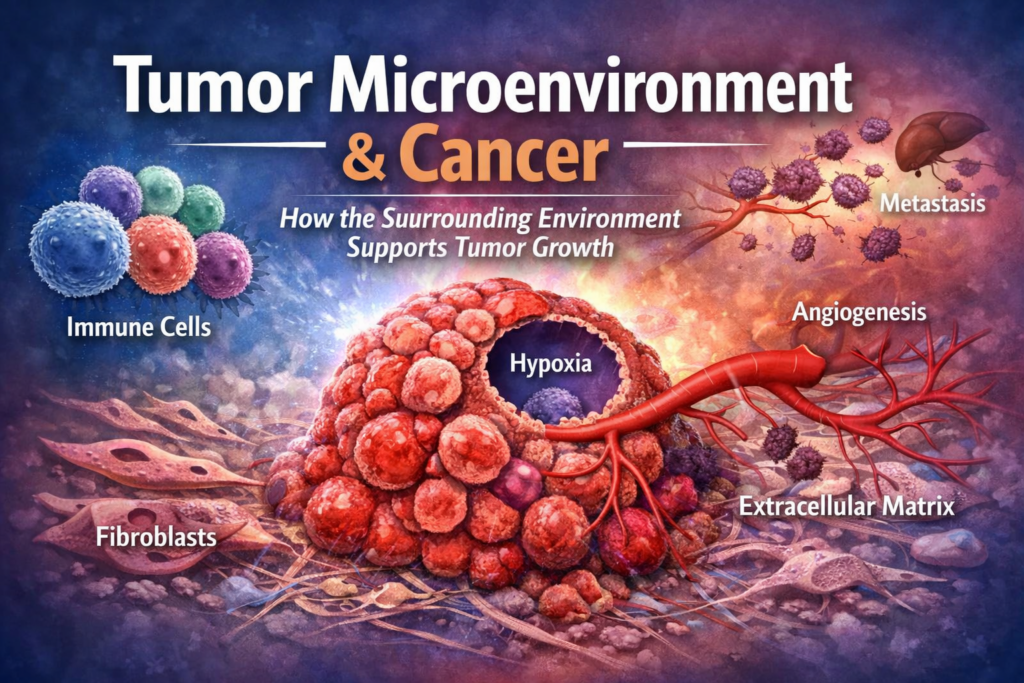
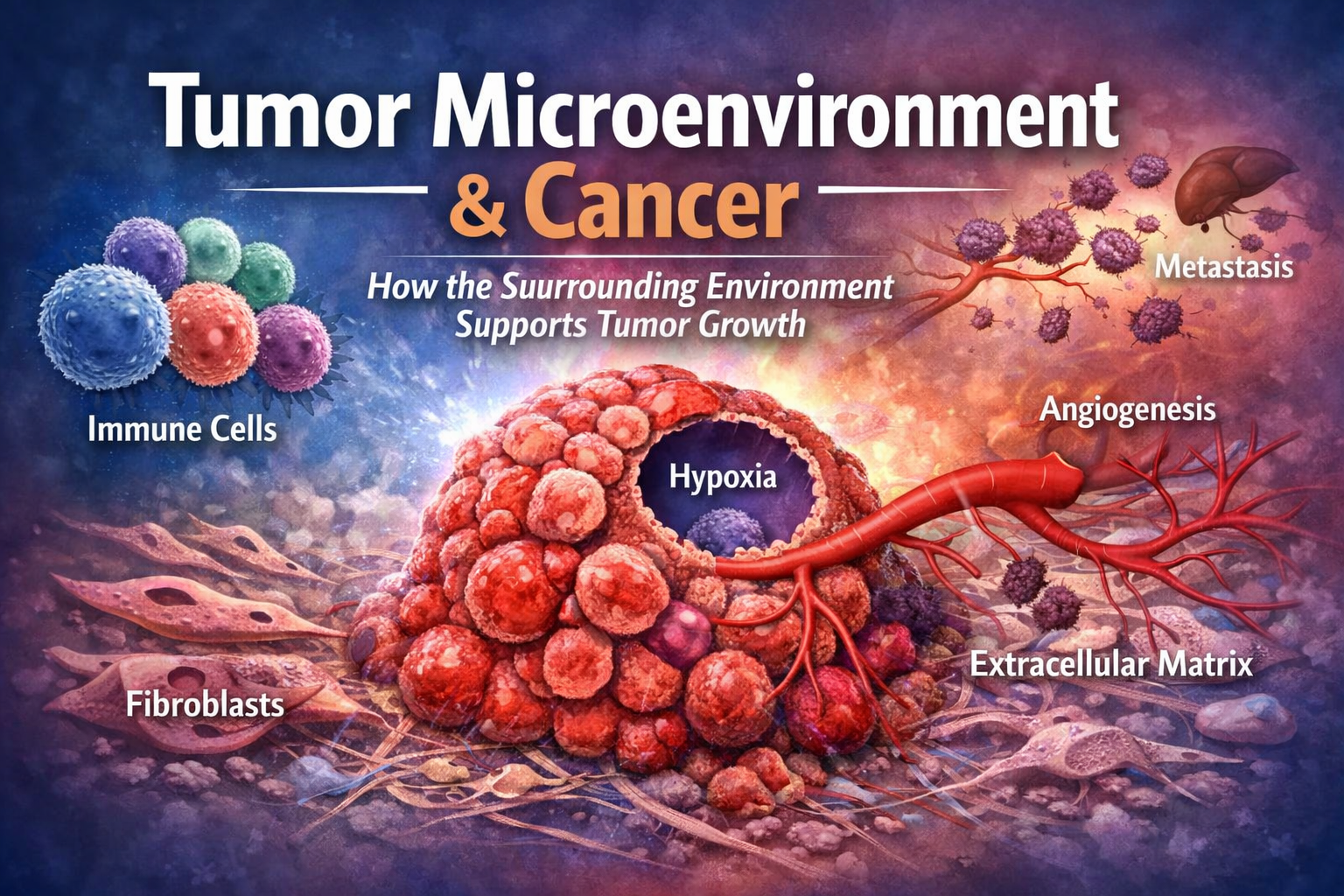
Cancer is not just a mass of abnormal cells growing uncontrollably. Modern research shows that tumors behave more like complex ecosystems. Surrounding every tumor is a network of supportive cells, blood vessels, immune cells, signaling molecules, and structural components. This environment is known as the tumor microenvironment (TME), which plays a crucial role in understanding the relationship between the tumor microenvironment and cancer.
The tumor microenvironment plays a critical role in cancer development, progression, immune evasion, and treatment resistance. In many cases, cancer cannot grow or spread effectively without support from the surrounding microenvironment, making the study of the tumor microenvironment and cancer essential.
Scientists now recognize that targeting the tumor microenvironment may be just as important as targeting cancer cells themselves.
Understanding how the tumor microenvironment works helps researchers develop new therapies that disrupt cancer’s support system.
Recognizing the impact of the tumor microenvironment and cancer can lead to advancements in therapeutic strategies.
This guide explains what the tumor microenvironment is, how it helps cancer survive, and why it has become one of the most important topics in modern oncology.
What Is the Tumor Microenvironment?
The tumor microenvironment (TME) refers to the area surrounding a tumor and the non-cancerous components that interact with cancer cells.
Instead of existing alone, cancer cells live inside a community of other cells and biological structures that influence how the tumor behaves.
These components include:
- Immune cells
- Fibroblasts
- Blood vessels
- Signaling molecules
- Structural proteins
- Oxygen levels
- Nutrients and metabolic waste
Together, these elements create a complex biological environment that can either slow down or accelerate cancer growth.
In many cancers, the tumor microenvironment becomes hijacked by the tumor, transforming it into a system that actively supports cancer survival.
External reference:
https://www.cancer.gov/research/areas/treatment/tumor-microenvironment
Key Components of the Tumor Microenvironment
Cancer-Associated Fibroblasts (CAFs)
Fibroblasts are cells responsible for producing connective tissue and repairing damaged tissue.
Inside tumors, these cells often transform into cancer-associated fibroblasts (CAFs).
CAFs help tumors by:
- Producing structural scaffolding for tumor growth
- Secreting growth signals
- Promoting tumor invasion
- Helping tumors resist therapy
These fibroblasts essentially act as construction workers for cancer, building a supportive environment that allows tumors to expand.
External reference:
https://www.nature.com/articles/nrc.2017.102
Immune Cells in the Tumor Microenvironment
The immune system normally identifies and destroys abnormal cells. However, tumors can manipulate immune cells in the surrounding environment.
Several immune cells can appear inside tumors, including:
- T cells
- Macrophages
- Dendritic cells
- Natural killer cells
In a healthy response, these cells attack cancer. But tumors can convert them into immunosuppressive cells that protect the tumor instead.
One example is tumor-associated macrophages (TAMs). These cells release growth factors, suppress immune attack, and promote tumor progression.
External reference:
https://www.ncbi.nlm.nih.gov/pmc/articles/PMC7053967/
Blood Vessels and Angiogenesis
Tumors require a steady supply of oxygen and nutrients to grow.
To obtain these resources, tumors stimulate the formation of new blood vessels through a process called angiogenesis.
Angiogenesis allows tumors to:
- Receive oxygen and glucose
- Remove metabolic waste
- Grow beyond small sizes
- Spread to distant organs
The tumor microenvironment often contains abnormal blood vessels that are poorly structured but highly effective at feeding the tumor.
Blocking angiogenesis has become a major strategy in cancer treatment.
External reference:
https://www.cancer.gov/about-cancer/treatment/types/immunotherapy/angiogenesis-inhibitors
Extracellular Matrix (ECM)
The extracellular matrix is a network of proteins and fibers that provides structural support to tissues.
Inside the tumor microenvironment, the ECM becomes altered.
Changes in the ECM can:
- Increase tumor stiffness
- Help cancer cells migrate
- Support metastasis
- Protect tumors from drugs
Cancer cells often remodel the extracellular matrix to create pathways for invasion into surrounding tissues.
External reference:
https://www.ncbi.nlm.nih.gov/pmc/articles/PMC6033734/
How the Tumor Microenvironment Helps Cancer Survive
Cancer cells rely heavily on their surrounding environment for survival. The tumor microenvironment provides several key advantages that help tumors grow and resist treatment.
Immune Suppression
One of the most dangerous features of the tumor microenvironment is its ability to suppress immune responses.
Tumors release signaling molecules that deactivate immune cells or recruit regulatory cells that block immune attacks.
This allows cancer cells to hide from the immune system.
Many modern immunotherapy drugs work by reversing this suppression.
External reference:
https://www.cancer.gov/about-cancer/treatment/types/immunotherapy
Metabolic Support
Tumors often reprogram metabolism in the surrounding environment.
Cancer cells consume large amounts of glucose and produce lactic acid. This acidic environment weakens nearby immune cells and supports tumor survival.
The tumor microenvironment also helps cancer access nutrients through altered blood flow and metabolic signaling.
These metabolic adaptations allow tumors to survive in harsh conditions such as low oxygen levels.
Protection from Treatment
The tumor microenvironment can make cancer treatments less effective.
Physical barriers created by the extracellular matrix can prevent drugs from reaching cancer cells.
Additionally, supportive cells release survival signals that help tumors resist chemotherapy and radiation.
Because of this, modern cancer research focuses on therapies that target both cancer cells and the microenvironment.
Hypoxia: Low Oxygen Inside Tumors
Many tumors contain regions with extremely low oxygen levels. This condition is called hypoxia.
Hypoxia occurs because tumor blood vessels are often poorly organized and inefficient.
Low oxygen levels activate special proteins called hypoxia-inducible factors (HIFs).
HIF proteins trigger genes that help cancer cells survive, including genes that promote:
- Angiogenesis
- Metabolism changes
- Cell survival
- Metastasis
Hypoxia also contributes to treatment resistance.
External reference:
https://www.nature.com/articles/nrc3181
The Tumor Microenvironment and Metastasis
Metastasis is the process by which cancer spreads to distant organs.
The tumor microenvironment plays a major role in this process.
Supportive cells release signals that allow cancer cells to:
- Break away from the primary tumor
- Invade nearby tissues
- Enter the bloodstream
- Survive circulation
- Colonize new organs
The microenvironment essentially prepares cancer cells for travel and survival in distant locations.
Understanding this process is critical for preventing cancer spread.
External reference:
https://www.ncbi.nlm.nih.gov/pmc/articles/PMC5790543/
Targeting the Tumor Microenvironment in Cancer Treatment
Because the tumor microenvironment supports cancer survival, many new therapies aim to disrupt it.
Several strategies are currently used in modern oncology.
Immunotherapy
Immunotherapy drugs help the immune system recognize and attack cancer.
Checkpoint inhibitors, such as PD-1 and CTLA-4 inhibitors, work by reversing immune suppression inside the tumor microenvironment.
These therapies have transformed treatment for cancers like melanoma and lung cancer.
External reference:
https://www.cancer.gov/about-cancer/treatment/types/immunotherapy/checkpoint-inhibitors
Anti-Angiogenesis Therapy
Anti-angiogenesis drugs block the formation of new blood vessels that feed tumors.
By cutting off the tumor’s nutrient supply, these therapies slow cancer growth.
Examples include drugs that target the VEGF pathway.
External reference:
https://www.cancer.gov/about-cancer/treatment/types/angiogenesis-inhibitors
Metabolic Targeting
Some treatments focus on the metabolic changes inside the tumor microenvironment.
These approaches attempt to disrupt cancer’s ability to obtain energy and nutrients.
Researchers are studying drugs that interfere with glucose metabolism, mitochondrial function, and lactate production.
Why the Tumor Microenvironment Is a Major Focus of Cancer Research
The tumor microenvironment has become one of the most important areas of cancer research.
Instead of viewing cancer as a disease of abnormal cells alone, scientists now see it as a disease of cellular ecosystems.
Targeting the tumor microenvironment may allow doctors to:
- Improve immunotherapy success
- Prevent metastasis
- Increase chemotherapy effectiveness
- Reduce treatment resistance
Future cancer treatments will likely combine traditional therapies with approaches that disrupt the tumor microenvironment.
Frequently Asked Questions
What is the tumor microenvironment?
The tumor microenvironment is the collection of cells, blood vessels, immune cells, signaling molecules, and structural components that surround and interact with a tumor.
Why is the tumor microenvironment important in cancer?
It plays a major role in cancer growth, immune evasion, metastasis, and treatment resistance.
Can cancer grow without a tumor microenvironment?
Most tumors rely heavily on their surrounding environment for nutrients, signaling, and immune suppression. Without this support system, many cancers struggle to survive.
Are treatments targeting the tumor microenvironment available?
Yes. Modern therapies such as immunotherapy and anti-angiogenesis drugs specifically target the tumor microenvironment.
Key Takeaways
The tumor microenvironment is a complex ecosystem that surrounds and supports cancer cells.
It includes immune cells, fibroblasts, blood vessels, and structural proteins that interact with tumors in powerful ways.
This environment helps cancer grow, evade the immune system, and resist treatment.
Because of its importance, many new cancer therapies aim to disrupt the tumor microenvironment rather than targeting cancer cells alone.
Understanding the tumor microenvironment is essential for developing the next generation of cancer treatments.
Sources and References
National Cancer Institute – Tumor Microenvironment
https://www.cancer.gov/research/areas/treatment/tumor-microenvironment
Nature Reviews Cancer – The Tumor Microenvironment
https://www.nature.com/articles/nrc.2017.102
National Cancer Institute – Immunotherapy
https://www.cancer.gov/about-cancer/treatment/types/immunotherapy
Nature Reviews Cancer – Hypoxia and Cancer
https://www.nature.com/articles/nrc3181
NIH – Tumor Associated Macrophages
https://www.ncbi.nlm.nih.gov/pmc/articles/PMC7053967/
NIH – Extracellular Matrix and Cancer
https://www.ncbi.nlm.nih.gov/pmc/articles/PMC6033734/
NIH – Metastasis and Tumor Microenvironment
https://www.ncbi.nlm.nih.gov/pmc/articles/PMC5790543/
Table of Contents