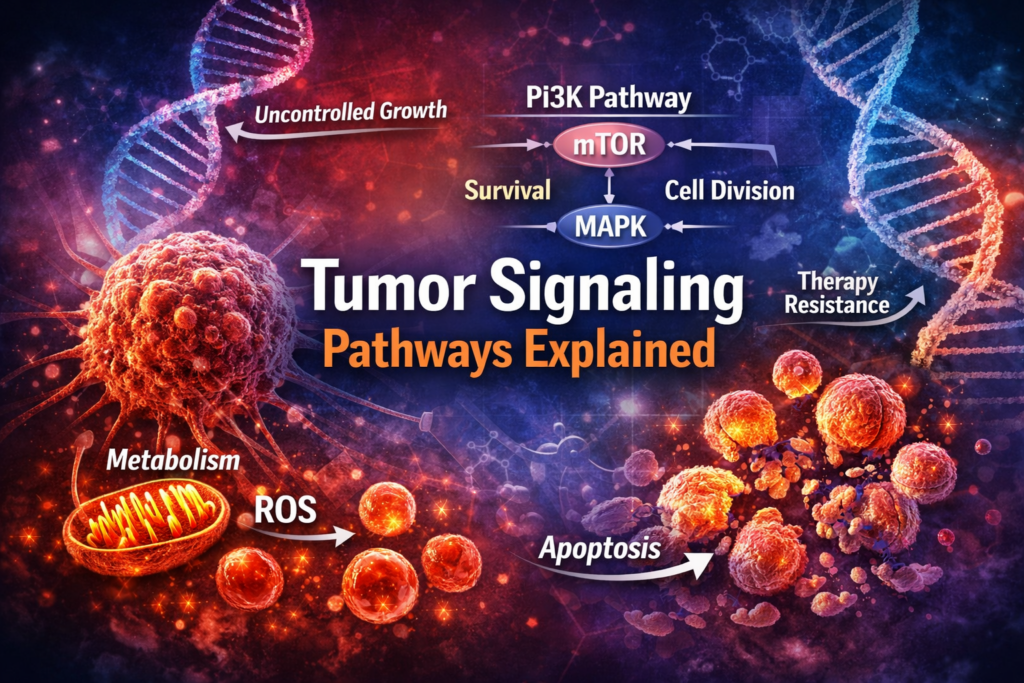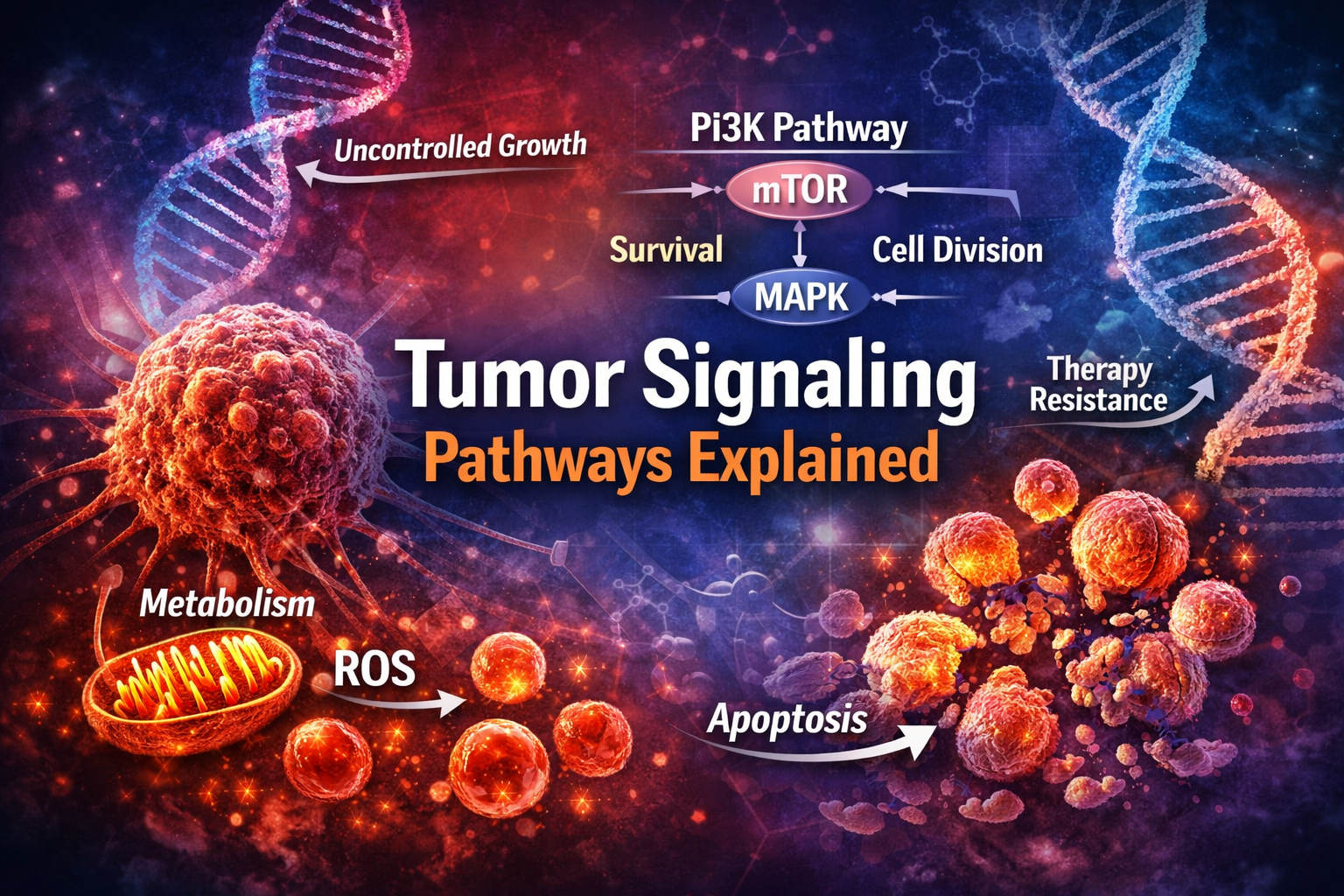
What Are Tumor Signaling Pathways?
Tumor signaling pathways are the internal communication systems that control how cancer cells grow, divide, survive, and spread. These pathways are made up of proteins that pass signals from the outside of a cell to the nucleus, telling the cell what to do.
In healthy cells, signaling pathways are tightly controlled. They respond to growth factors, nutrients, and environmental conditions. Once a task is complete, the signal shuts off.
In cancer cells, these pathways become permanently activated. This allows tumors to:
- Grow without limits
- Ignore normal stop signals
- Resist cell death (apoptosis)
- Adapt to stress and treatment
These abnormal signals are one of the core drivers of cancer progression and are considered a central feature of tumor biology.
For a broader overview of how tumors protect themselves, see:
https://helping4cancer.com/tumor-survival-network/
Why Tumor Signaling Pathways Matter
Cancer is not just uncontrolled growth—it is a coordinated system of survival signals. Tumor signaling pathways allow cancer cells to:
- Sense nutrients like glucose and amino acids
- Activate energy production systems
- Repair damage caused by treatments
- Suppress immune responses
These pathways connect directly to metabolism, mitochondrial function, and reactive oxygen species (ROS).
When signaling pathways are overactive, tumors gain a major survival advantage. This is why many modern cancer therapies aim to block these signals.
Research from the National Cancer Institute shows that targeting signaling pathways can significantly slow tumor growth:
https://www.cancer.gov/research/areas/treatment/targeted-therapies
The PI3K Pathway: The Master Growth Switch
The PI3K (phosphoinositide 3-kinase) pathway is one of the most important signaling pathways in cancer. It acts as a central hub that controls growth, metabolism, and survival.
How PI3K Works
When growth signals bind to a cell, PI3K becomes activated and triggers a cascade of events:
- Activates AKT (a key survival protein)
- Increases glucose uptake
- Promotes protein synthesis
- Blocks apoptosis
This pathway essentially tells the cell: survive, grow, and keep dividing.
Why PI3K Is Dangerous in Cancer
In many cancers, the PI3K pathway is permanently turned on due to mutations. This leads to:
- Constant cell growth
- Resistance to chemotherapy
- Increased tumor metabolism
PI3K also connects directly to insulin signaling, linking cancer growth to metabolic health.
For deeper insight into metabolic drivers, see:
https://helping4cancer.com/insulin-and-cancer/
A detailed scientific overview is available from PubMed:
https://pubmed.ncbi.nlm.nih.gov/26627007/
mTOR Pathway: The Cellular Growth Engine
mTOR (mechanistic target of rapamycin) is a downstream component of the PI3K pathway and acts as a master regulator of cell growth and metabolism.
What mTOR Does
mTOR controls whether a cell builds or conserves energy. When activated, it:
- Increases protein synthesis
- Promotes cell growth and division
- Enhances nutrient utilization
- Inhibits autophagy (cellular cleanup process)
This makes mTOR one of the most important pathways for tumor expansion.
mTOR and Cancer Metabolism
Cancer cells rely heavily on mTOR to support rapid growth. It helps tumors:
- Convert glucose into energy quickly
- Build new cellular structures
- Adapt to nutrient-rich environments
When mTOR is overactive, cancer cells grow aggressively and resist stress.
This pathway is closely tied to metabolic therapies like fasting and ketogenic diets, which aim to reduce mTOR activation.
Learn more here:
https://helping4cancer.com/metabolic-therapy-for-cancer/
Scientific reference from Nature:
https://www.nature.com/articles/nrc.2017.90
MAPK Pathway: The Proliferation Signal
The MAPK (mitogen-activated protein kinase) pathway controls cell division and replication. It is often activated by growth factors and external signals.
How MAPK Works
MAPK signaling follows a cascade:
- RAS activation
- RAF activation
- MEK activation
- ERK activation
This chain ultimately tells the nucleus to begin cell division.
MAPK in Cancer
Mutations in RAS or RAF genes can cause the MAPK pathway to remain constantly active. This leads to:
- Rapid tumor growth
- Increased cell division
- Resistance to therapy
MAPK is especially important in cancers like melanoma, colorectal cancer, and lung cancer.
A detailed breakdown can be found here:
https://www.ncbi.nlm.nih.gov/books/NBK26890/
How These Pathways Work Together
Tumor signaling pathways do not operate in isolation. They form a highly connected network.
Key Interactions
- PI3K activates mTOR to drive growth
- MAPK promotes cell division alongside PI3K
- Both pathways enhance survival and resistance
This redundancy is one reason cancer is so difficult to treat. If one pathway is blocked, another can compensate.
This interconnected system is often referred to as the tumor survival network.
Learn more:
https://helping4cancer.com/cancer-drug-resistance/
Connection to Cancer Metabolism
Tumor signaling pathways are tightly linked to metabolism. They control how cancer cells use energy and nutrients.
Key Metabolic Effects
- Increased glucose uptake (Warburg effect)
- Enhanced glycolysis
- Altered mitochondrial function
- Increased ROS tolerance
These changes allow cancer cells to survive in harsh environments, including low oxygen and limited nutrients.
For a full metabolic breakdown, see:
https://helping4cancer.com/cancer-and-mitochondria/
Reactive Oxygen Species (ROS) and Signaling
Reactive oxygen species (ROS) play a dual role in cancer.
- Low levels of ROS activate signaling pathways
- High levels of ROS cause cell death
Tumor signaling pathways help cancer cells manage ROS levels. They:
- Activate antioxidant defenses
- Repair oxidative damage
- Prevent apoptosis
This balance allows tumors to grow while avoiding destruction.
Targeting this balance is a key strategy in many cancer treatments.
How Tumors Use Signaling to Avoid Death
Cancer cells use signaling pathways to block apoptosis, the natural process of programmed cell death.
Mechanisms of Survival
- Activation of AKT (anti-apoptotic signaling)
- Increased BCL-2 protein expression
- Suppression of p53 tumor suppressor
These changes allow cancer cells to survive even when damaged by chemotherapy or radiation.
For more detail:
https://helping4cancer.com/apoptosis-resistance-cancer/
Targeting Tumor Signaling Pathways in Treatment
Modern cancer therapies increasingly focus on blocking signaling pathways.
Types of Targeted Therapies
- PI3K inhibitors
- mTOR inhibitors (e.g., rapamycin-based drugs)
- MAPK pathway inhibitors (MEK inhibitors)
These therapies aim to:
- Slow tumor growth
- Increase sensitivity to treatment
- Disrupt cancer metabolism
However, tumors often develop resistance by activating alternative pathways.
This is why combination therapies are becoming more common.
A review from the NIH explains this approach:
https://www.ncbi.nlm.nih.gov/pmc/articles/PMC6391628/
Why This Matters for Cancer Progression
Tumor signaling pathways are not just part of cancer—they are the control system behind it.
They determine:
- How fast a tumor grows
- How it responds to treatment
- Whether it spreads or remains localized
Understanding these pathways provides insight into why cancer behaves the way it does.
It also explains why targeting metabolism, immune response, and signaling together may offer better outcomes.
Key Takeaways
- Tumor signaling pathways control cancer growth, survival, and metabolism
- The PI3K, mTOR, and MAPK pathways are central drivers of tumor behavior
- These pathways are often permanently activated in cancer
- They are tightly linked to metabolism and ROS regulation
- Targeting signaling pathways is a major focus of modern cancer therapy
By understanding these systems, it becomes easier to see how cancer operates—and how it may be disrupted.
Table of Contents