Introduction
Cancer is not just a disease of uncontrolled growth—it is a highly adaptive system designed to survive under extreme conditions. Tumors develop complex internal communication systems known as the tumor survival network, which allows cancer cells to resist treatment, avoid cell death, and continue growing even in hostile environments.
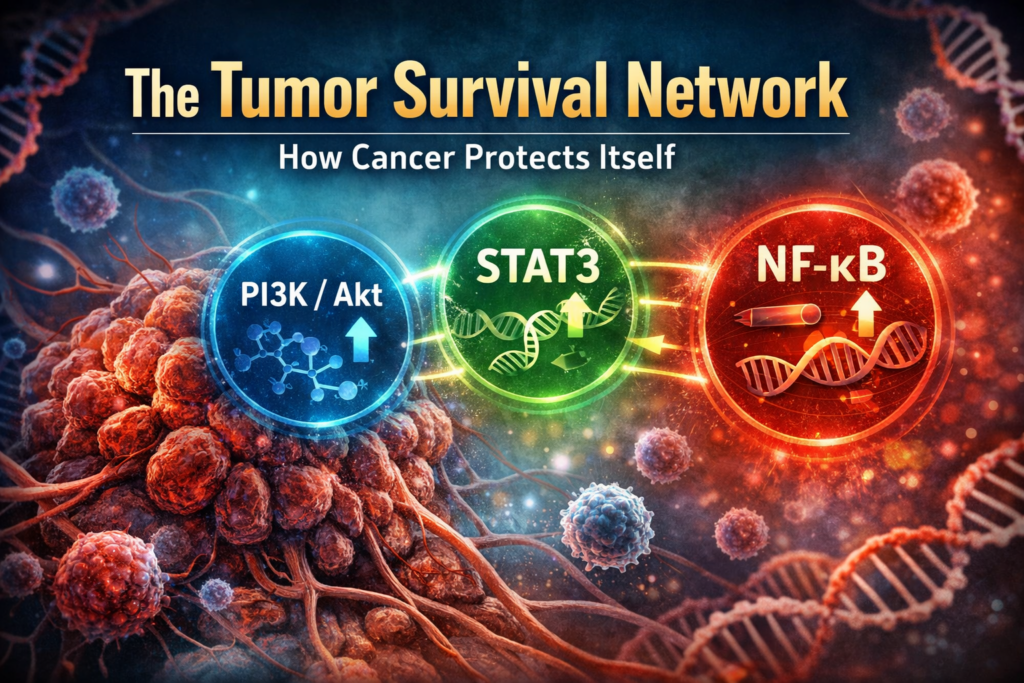
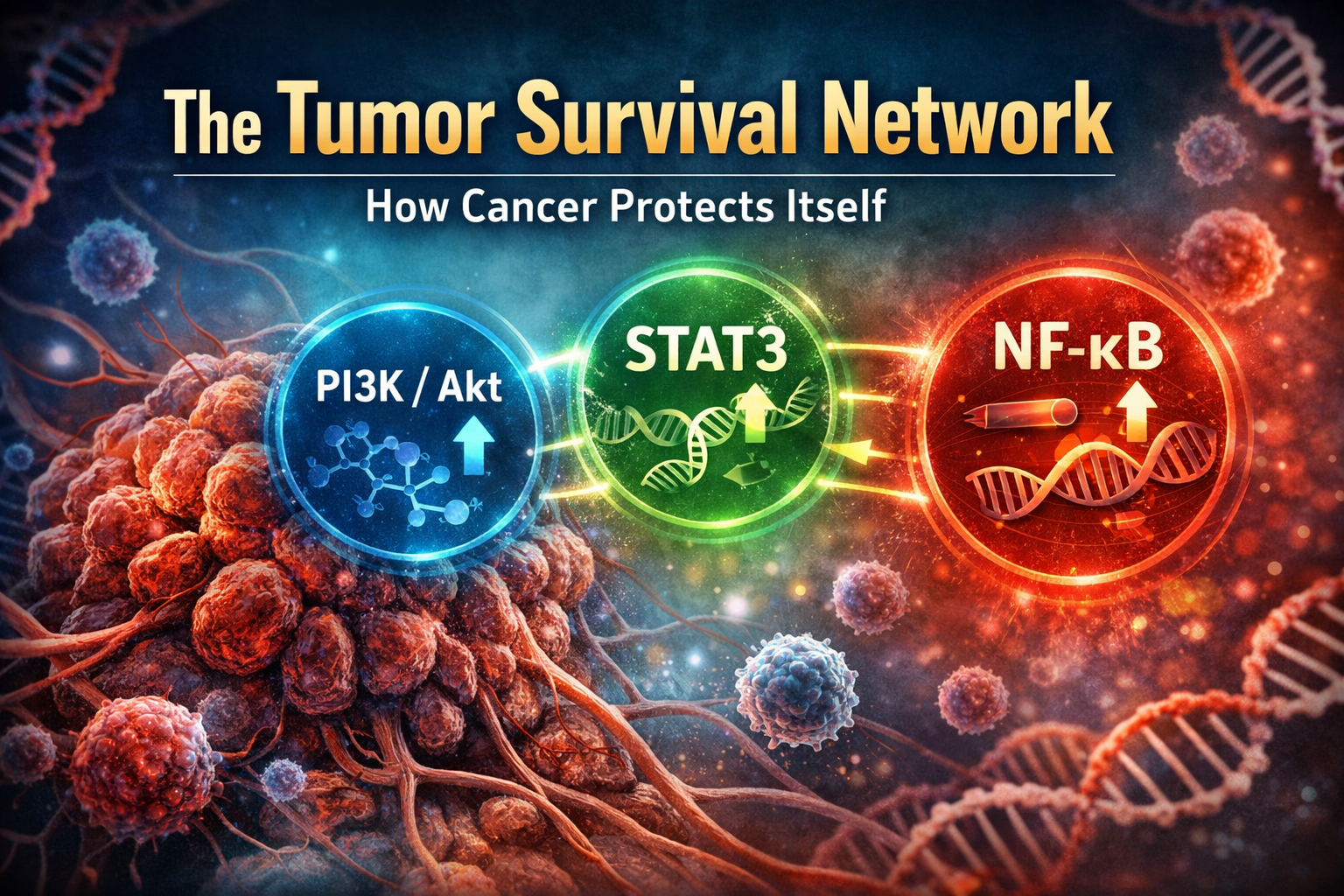
This network is made up of interconnected signaling pathways that control cell survival, metabolism, inflammation, and immune evasion. Among the most important of these pathways are PI3K/Akt, STAT3, and NF-κB, which act as central regulators of tumor resilience.
Understanding how the tumor survival network functions is critical for developing strategies that disrupt cancer at its core.
What Is the Tumor Survival Network?
The tumor survival network refers to a group of signaling pathways that work together to keep cancer cells alive. These pathways respond to stress signals such as chemotherapy, radiation, oxidative damage, and immune attack.
Instead of dying, cancer cells activate these pathways to:
- Repair damage
- Avoid apoptosis (programmed cell death)
- Adapt to low oxygen (hypoxia)
- Resist immune destruction
- Continue dividing
Unlike normal cells, which follow strict regulatory controls, cancer cells hijack these pathways and keep them permanently activated.
Why Cancer Cells Depend on Survival Pathways
Cancer cells exist in a hostile environment. They face:
- Limited oxygen supply
- Nutrient shortages
- Immune system attacks
- Exposure to therapies
To survive, tumors rely heavily on survival signaling. These pathways act like emergency systems, allowing cancer cells to rapidly respond to stress and recover.
This is one of the main reasons why cancer can be difficult to treat. Even when therapies damage tumor cells, the survival network helps them repair and persist.
The PI3K/Akt Pathway: The Master Survival Switch
What Is PI3K/Akt?
The PI3K/Akt pathway is one of the most important survival pathways in cancer. It regulates cell growth, metabolism, and resistance to apoptosis.
How It Works
When activated, PI3K triggers a cascade that activates Akt, a protein that promotes survival by:
- Blocking apoptosis signals
- Increasing glucose metabolism
- Supporting protein synthesis
- Enhancing cell growth
Why It Matters in Cancer
Many cancers have mutations that keep PI3K/Akt permanently active. This allows tumor cells to:
- Grow rapidly
- Resist chemotherapy
- Survive under metabolic stress
PI3K/Akt is often considered the central “survival engine” of cancer cells.
STAT3: The Growth and Immune Suppression Signal
What Is STAT3?
STAT3 is a transcription factor that controls genes involved in cell growth and immune suppression.
How It Works
When activated, STAT3 moves into the nucleus and turns on genes that:
- Promote tumor growth
- Prevent apoptosis
- Suppress immune responses
Role in Tumor Survival
STAT3 allows tumors to create a protective environment by:
- Reducing immune cell activity
- Promoting inflammation that benefits cancer
- Supporting angiogenesis (blood vessel growth)
This makes STAT3 a key player in both survival and immune evasion.
NF-κB: The Inflammation and Survival Pathway
What Is NF-κB?
NF-κB is a protein complex that controls inflammation and cell survival. It is normally activated during immune responses.
How It Works
In cancer, NF-κB becomes chronically active and:
- Promotes inflammatory signaling
- Prevents apoptosis
- Increases production of survival proteins
Why It Matters
Chronic NF-κB activation helps tumors:
- Survive under stress
- Resist chemotherapy and radiation
- Maintain a pro-tumor inflammatory environment
Inflammation driven by NF-κB is one of the hallmarks of cancer progression.
How These Pathways Work Together
The tumor survival network is not made of isolated pathways. Instead, PI3K/Akt, STAT3, and NF-κB interact and reinforce each other.
For example:
- PI3K/Akt can activate NF-κB
- NF-κB can increase STAT3 signaling
- STAT3 can enhance survival gene expression
This cross-talk creates redundancy, meaning that even if one pathway is blocked, others can compensate.
This is why combination therapies are often needed to effectively disrupt tumor survival.
Survival Pathways and Treatment Resistance
One of the biggest challenges in cancer therapy is resistance. Even when treatments initially work, tumors often adapt.
Survival pathways contribute to resistance by:
- Repairing DNA damage caused by radiation
- Blocking apoptosis triggered by chemotherapy
- Increasing drug efflux (pushing drugs out of cells)
- Enhancing antioxidant defenses
This allows cancer cells to survive treatments that would normally kill healthy cells.
The Role of the Tumor Microenvironment
The tumor survival network extends beyond cancer cells themselves. It also includes the surrounding tumor microenvironment.
This environment contains:
- Immune cells
- Fibroblasts
- Blood vessels
- Signaling molecules
These components release signals that activate survival pathways in cancer cells.
For example:
- Inflammatory cytokines activate NF-κB and STAT3
- Growth factors stimulate PI3K/Akt
- Hypoxia triggers adaptive survival responses
This creates a supportive ecosystem that protects tumors from destruction.
Targeting the Tumor Survival Network
Modern cancer therapies increasingly focus on disrupting survival pathways.
Targeted Therapies
Some drugs are designed to block specific pathways:
- PI3K inhibitors
- Akt inhibitors
- STAT3 inhibitors (in development)
- NF-κB modulators
Combination Approaches
Because of pathway redundancy, combining treatments is often more effective.
For example:
- Chemotherapy + pathway inhibitors
- Radiation + metabolic therapies
- Immunotherapy + survival pathway targeting
Metabolic Stress Strategies
Some approaches aim to overwhelm cancer cells by increasing stress:
- Raising reactive oxygen species (ROS)
- Limiting glucose availability
- Disrupting mitochondrial function
These strategies can weaken the tumor survival network and make cancer cells more vulnerable.
Why This Matters for Patients
Understanding the tumor survival network explains why cancer can be persistent and difficult to eliminate.
It also highlights why:
- Single treatments may not be enough
- Combination strategies are often necessary
- Timing and sequencing of therapies matter
By targeting survival pathways, it may be possible to reduce resistance and improve treatment outcomes.
Internal Pillar Links
- Cancer Metabolism Explained: https://helping4cancer.com/tumor-metabolism-vs-normal-cells/
- Apoptosis Resistance in Cancer: https://helping4cancer.com/apoptosis-resistance-cancer/
- Tumor Immune Cloaking: https://helping4cancer.com/tumor-immune-cloaking/
- Cancer Drug Resistance: https://helping4cancer.com/cancer-drug-resistance/
- Tumor Angiogenesis Explained: https://helping4cancer.com/tumor-angiogenesis-explained/
External References
- Hanahan D, Weinberg RA. Hallmarks of Cancer: The Next Generation. Cell.
- National Cancer Institute – Cancer Signaling Pathways
- Nature Reviews Cancer – PI3K/Akt signaling in cancer
- Cancer Research Journal – STAT3 and tumor progression
- Journal of Immunology – NF-κB in cancer inflammation
Conclusion
The tumor survival network is one of the most important concepts in modern cancer biology. It explains how cancer cells resist treatment, adapt to stress, and continue growing despite therapy.
Key pathways such as PI3K/Akt, STAT3, and NF-κB form a powerful system that protects tumors from destruction. Their ability to interact and compensate for one another makes cancer highly resilient.
Targeting this network represents a critical strategy in the fight against cancer. By disrupting survival signaling, therapies can weaken tumor defenses and improve the chances of successful treatment.
Table of Contents