What This Page Explains
This page explains:
- What turkey tail mushroom is
- How it affects dormant cancer cells
- How it activates the immune system
- Where it may help
- Where it has limits
- How it fits into a complete strategy
What Is Turkey Tail Mushroom?
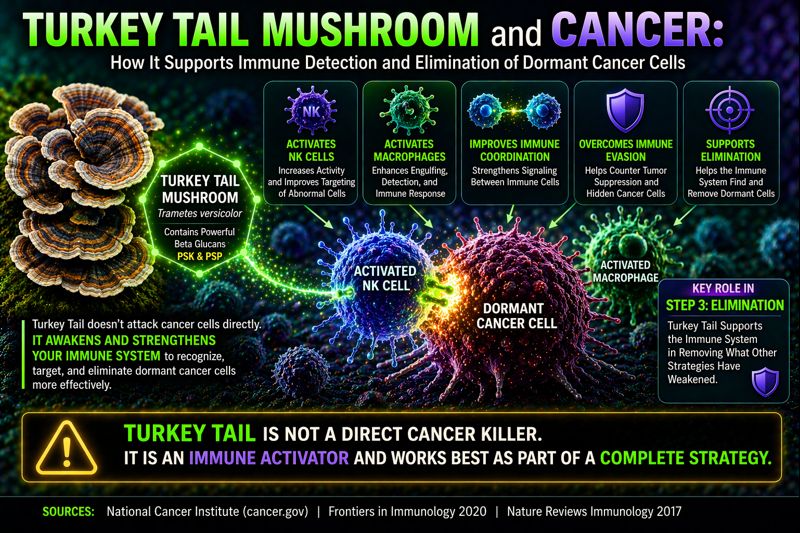
Turkey tail is a medicinal mushroom known scientifically as Trametes versicolor.
Key Compounds
- PSK (polysaccharide-K)
- PSP (polysaccharide-peptide)
These are forms of beta glucans.
Simple Explanation
- It does not attack cancer directly
- It activates the immune system
- It improves immune coordination
Why Turkey Tail Matters in Cancer
Dormant cancer cells survive by staying hidden.
Turkey tail helps:
- Increase immune awareness
- Improve detection
- Support elimination
Where This Fits in the System
Start here:
Turkey tail primarily affects:
- Immune activation
- NK cells
- Macrophages
- Immune coordination
How Turkey Tail Affects Dormant Cancer Cells
Dormant cells are difficult to eliminate because they:
- Are not dividing
- Are less visible
- Avoid immune detection
Turkey tail helps reverse this.
1. NK Cell Activation
NK cells destroy abnormal cells.
What Turkey Tail Does
- Increases NK cell activity
- Improves targeting ability
- Enhances detection
Result
Dormant cancer cells are more likely to be recognized and attacked.
2. Macrophage Activation
Macrophages detect and remove abnormal cells.
What Turkey Tail Does
- Activates macrophages
- Improves engulfing and response
- Enhances immune signaling
Result
Better removal of cancer cells.
3. Immune System Coordination
The immune system must work together.
What Turkey Tail Does
- Improves communication between immune cells
- Enhances coordination
- Strengthens overall response
Result
More effective immune activity.
4. Overcoming Immune Evasion
Cancer suppresses immune response.
What Turkey Tail Does
- Helps counter immune suppression
- Improves immune visibility
Result
Dormant cells become less hidden.
Where Turkey Tail Can Help
Turkey tail may help when:
- Supporting immune detection
- Enhancing NK cell function
- Improving immune coordination
- Assisting elimination phase
Where Turkey Tail Has Limits (Critical Section)
Turkey tail is not a direct cancer disruptor.
It Does NOT:
- Disrupt metabolism
- Interfere with autophagy
- Directly damage cancer cells
Important
If cancer cells are not:
- Weakened
- Destabilized
- Exposed
The immune system may still struggle.
Immune Activation Alone Is Not Enough
If used alone:
- Cancer cells may remain hidden
- Survival systems remain active
Strategic Role of Turkey Tail
Turkey tail is best understood as:
- An immune activator
- A coordination enhancer
- A support tool for elimination
How It Fits Into a Complete Strategy
From the system:
Step 1: Destabilize Dormancy
Turkey tail does NOT do this
Step 2: Remove Survival Systems
Turkey tail does NOT do this
Step 3: Eliminate Cells
Turkey tail supports this
Why Turkey Tail Is Important
Even weakened cancer cells must be removed.
The immune system performs this function.
Why Turkey Tail Alone Is Not Enough
Turkey tail can:
- Activate immune cells
- Improve detection
But it does NOT:
- Kill cancer cells directly
- Replace metabolic targeting
- Replace treatment
Key Takeaways
- Turkey tail activates immune function
- It improves NK cell and macrophage activity
- It enhances detection of dormant cancer cells
- It supports elimination phase
- It must be combined with other strategies
- It is not a standalone solution
External References
National Cancer Institute
https://www.cancer.gov/about-cancer/understanding/what-is-cancer
Frontiers in Immunology
https://www.frontiersin.org/articles/10.3389/fimmu.2020.00001/full
Nature Reviews Immunology
https://www.nature.com/articles/nri.2017.15
Continue Learning
Main system:
Related pages:
https://helping4cancer.com/beta-glucan-cancer/
https://helping4cancer.com/nk-t-cell-cancer/
https://helping4cancer.com/cancer-immune-evasion/
Disclaimer
This content is for educational purposes only and is not medical advice.