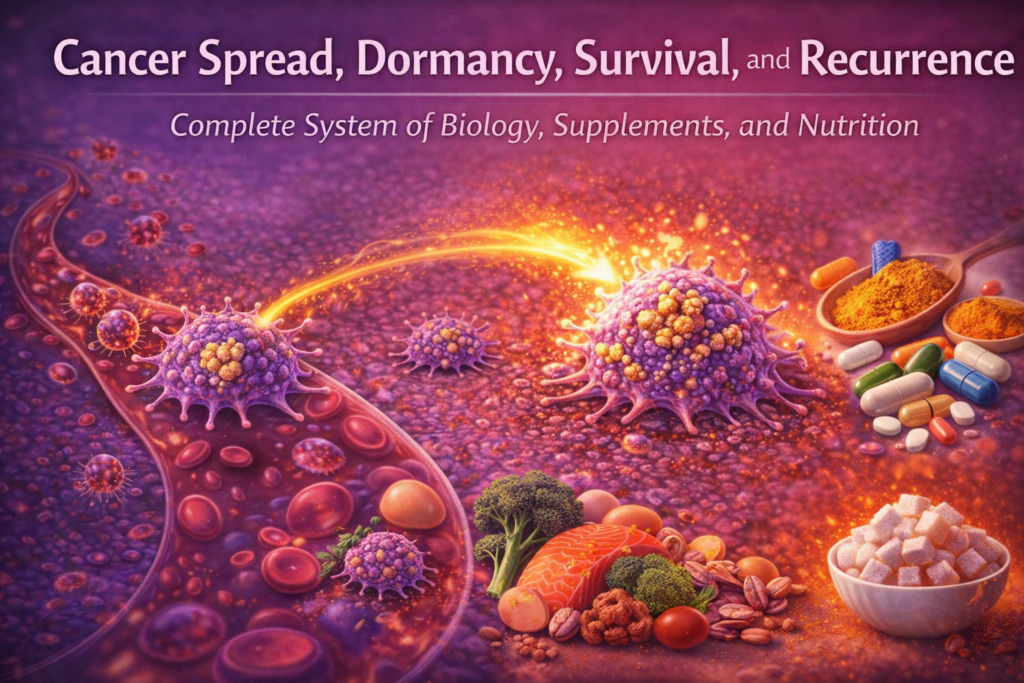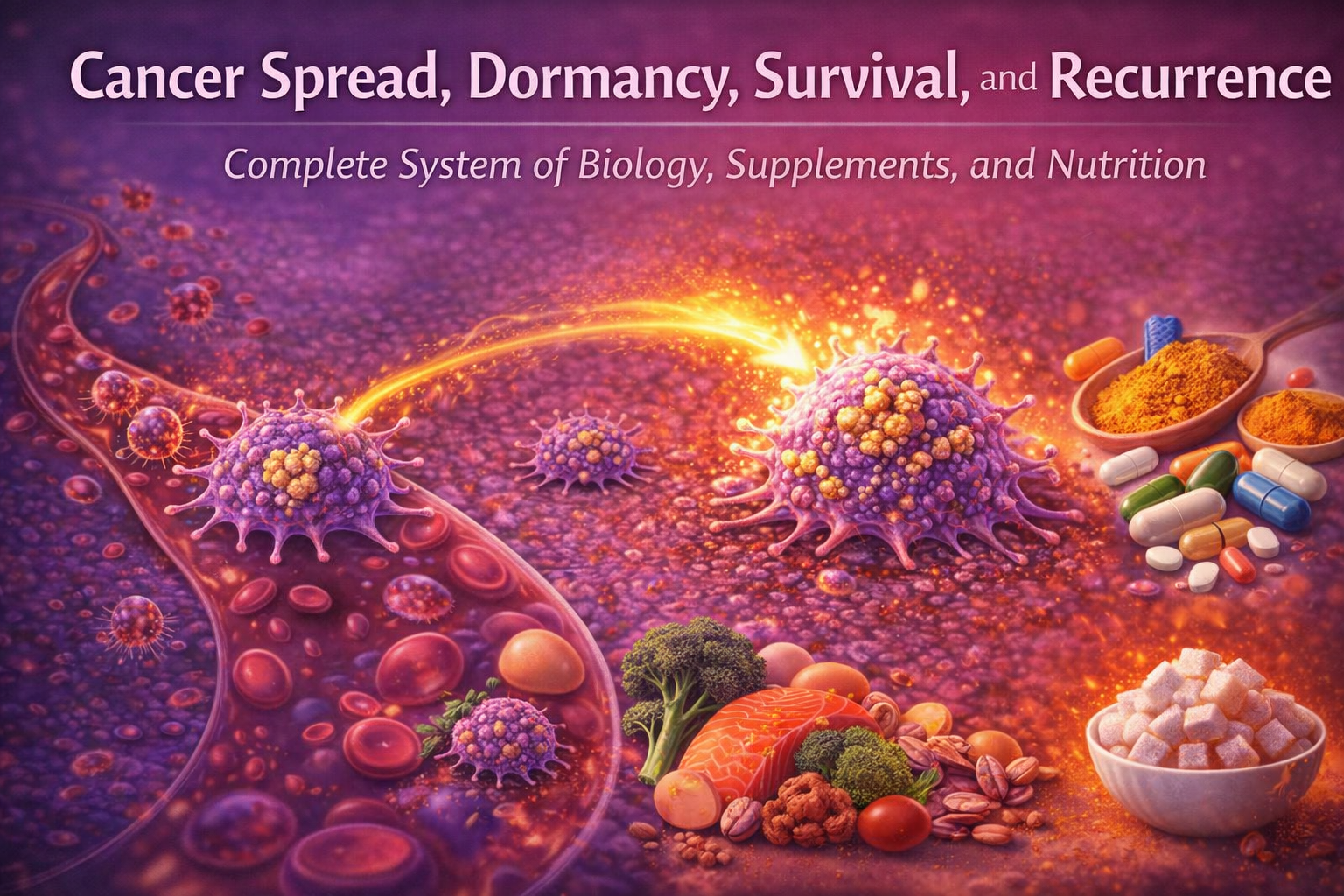
What This Page Is
This page is the complete system of how cancer behaves and survives.
It brings together four major parts of the bigger picture:
- Biology — how cancer spreads and behaves inside the body
- Survival systems — how cancer cells stay alive under stress
- Supplements — how research has studied ways these systems may be disrupted
- Nutrition — how fuel availability and environment may influence survival conditions
This page is designed to function as the main learning hub.
It is not only about tumor growth.
It is about:
- spread
- survival
- hidden cells
- dormancy
- adaptation
- recurrence
Research points to a central truth: cancer is dangerous not only because it can grow, but because it can survive pressure, adapt, and return later. Dormancy and stress adaptation are major parts of that story.
Start With the Full System
The Complete System, Simplified
Cancer spreads
Cancer survives
Cancer hides
Cancer becomes dormant
Cancer adapts
Cancer reactivates
That is the larger pattern.
Many explanations focus only on visible growth. But research shows that growth is only one stage. Before visible recurrence, cancer cells may need to survive detachment, immune pressure, low nutrients, low oxygen, and treatment stress. Some then enter a dormant state and remain viable until conditions shift in their favor.
This is why recurrence matters so much.
A cancer cell does not always need to keep growing to stay dangerous.
Sometimes it only needs to stay alive long enough.
The Core Biology System
1. Cancer Spread
Cancer spread is the first major part of the system. A tumor cell has to leave the primary tumor, enter circulation, survive in the bloodstream, and then leave the blood vessel to enter distant tissue.
Internal Links
Circulating Tumor Cells
https://helping4cancer.com/circulating-tumor-cell/
Explains what circulating tumor cells are and why they matter in spread.
Bloodstream Survival
https://helping4cancer.com/cancer-bloodstream-survival/
Explains how cancer cells survive shear stress, immune attack, and loss of normal attachment while traveling through the blood.
Extravasation
https://helping4cancer.com/cancer-extravasation/
Explains how cancer cells leave the bloodstream and enter new tissue.
Why This Matters
Research suggests that metastasis is a stepwise process, and each step acts like a filter. Many cells fail. The cells that survive tend to be the ones with the strongest adaptive traits. That means spread is also a process of selection. It favors cells that can tolerate stress, immune attack, and hostile environments.
External Reading
National Cancer Institute — Tumor Biology and Microenvironment Research
A broad NCI overview of how tumor cells and host tissue interact during growth and immune evasion.
2. Immune System and Evasion
After cancer spreads, the immune system becomes one of the main forces shaping what happens next.
Internal Links
NK and T Cell Basics
https://helping4cancer.com/nk-t-cell-cancer/
Explains the main immune cells involved in anti-cancer surveillance.
Immune Evasion
https://helping4cancer.com/cancer-immune-evasion/
Explains how cancer hides from or suppresses immune attack.
Why This Matters
Research shows that tumors use multiple layers of immune escape. These include reduced antigen visibility, checkpoint signaling, recruitment of regulatory T cells, myeloid-derived suppressor cells, and tumor-associated macrophages, along with metabolic changes that weaken effective immune killing. Dormant and slow-cycling cells may be especially difficult to eliminate because they can sit quietly in protected niches while producing fewer obvious danger signals.
External Reading
A review of cancer immune escape mechanisms and drug resistance.
A review on targeting the tumor immune microenvironment in cancer therapy.
3. Dormancy and Hidden Cells
Not every cancer cell that reaches new tissue starts growing right away.
Some cells hide.
Some survive without dividing.
Some become dormant.
Internal Links
Disseminated Tumor Cells
https://helping4cancer.com/disseminated-tumor-cell/
Explains what hidden cancer cells are after they leave the bloodstream and settle in tissue.
Cancer Dormancy
https://helping4cancer.com/cancer-dormancy/
Explains how cancer can stay alive in a quiet, non-growing state.
Why This Matters
Research points to a major idea: dormancy is not passive inactivity. It is an active survival state. Dormant cells can preserve viability through stress signaling, autophagy, metabolic adaptation, niche support, and immune escape. This helps explain how recurrence can happen long after visible disease seems controlled.
External Reading
A review on cancer dormancy and the tumor microenvironment.
A review focused on dormancy and hypoxic interplay.
4. Control Systems
Dormant and stress-adapted cancer cells do not survive by accident. Research shows they rely on control systems that help decide whether to grow, pause, recycle, or adapt.
Internal Links
p38 and ERK Cancer Control
https://helping4cancer.com/p38-erk-cancer/
Explains how the p38 vs ERK balance affects dormancy and growth.
Autophagy and Cancer Survival
https://helping4cancer.com/autophagy-cancer-survival/
Explains how cancer cells recycle internal parts to survive stress.
Cancer Metabolic Evasion
https://helping4cancer.com/cancer-metabolic-evasion/
Explains how cancer switches fuels and adapts metabolism.
Autophagy
Autophagy is the cell’s internal recycling system. In healthy biology, it clears damaged mitochondria, protein aggregates, and other worn-out components. In established tumors, the literature shows that autophagy often shifts toward a survival role, helping cells tolerate nutrient deprivation, hypoxia, therapy stress, and metabolic strain.
p38 Dormancy
The literature repeatedly points to the p38 pathway as a major regulator of stress-induced quiescence. High p38 signaling relative to ERK is associated with a dormant, non-proliferative state, while stronger ERK signaling tends to favor outgrowth. Research also links niche signals such as BMP and vascular remodeling cues to dormancy maintenance or escape.
Metabolic Flexibility
Research shows that cancer cells can shift among glycolysis, oxidative phosphorylation, fatty acid oxidation, glutamine use, and lactate-based symbiosis depending on what the environment allows. This flexibility helps cells survive when one fuel pathway is stressed or blocked.
External Reading
Autophagy functions in the tumor microenvironment.
A modern HIF-1α and cancer review that also helps frame metabolic adaptation under stress.
5. Tumor Environment
Cancer does not live in empty space. It lives inside an environment that can become low in oxygen, acidic, nutrient-poor, and immunosuppressive.
Internal Links
Tumor Hypoxia and HIF-1α
https://helping4cancer.com/tumor-hypoxia-hif1a/
Explains how low oxygen triggers survival programs.
Cancer Lactate and Acid
https://helping4cancer.com/cancer-lactate-acid/
Explains how lactate and acidity reshape the tumor environment.
Cancer Adenosine and Immune Suppression
https://helping4cancer.com/cancer-adenosine-immune/
Explains how adenosine suppresses immune attack.
Why This Matters
Research shows that hypoxia stabilizes HIF-1α and activates a broad survival program that includes glycolysis, angiogenesis, stress tolerance, and immune-modulating effects. Hypoxia and lactate-rich acidity can also weaken anti-tumor immune function. Adenosine signaling adds another suppressive layer by reducing cytotoxic immune activity in the tumor microenvironment.
External Reading
HIF-1α and cancer review.
The role of hypoxia in cancer progression and angiogenesis.
6. Physical Survival
Cancer also survives through mechanical and identity changes.
Internal Links
Cancer Mechanical Evasion
https://helping4cancer.com/cancer-mechanical-evasion/
Explains how cancer cells survive physical stress and tissue pressure.
EMT and Cancer
https://helping4cancer.com/emt-cancer/
Explains how cancer changes identity to become more invasive and adaptable.
Why This Matters
Research points to EMT as a major adaptability program. EMT can help cancer cells detach, migrate, resist anoikis, tolerate stress, and enter hybrid states that combine movement with survival advantages. These partial EMT states may be especially important in metastasis and therapy resistance.
External Reading
A review linking hypoxia, EMT, stemness, and autophagy under tumor stress.
7. Survival Signaling
Some pathways act like command systems that connect multiple survival programs together.
Internal Links
GAS6-AXL Cancer
https://helping4cancer.com/gas6-axl-cancer/
Explains how AXL signaling supports survival, adaptability, and resistance.
TGF-Beta Cancer
https://helping4cancer.com/tgf-beta-cancer/
Explains how TGF-β influences EMT, immune suppression, and survival behavior.
BMP and Cancer Dormancy
https://helping4cancer.com/bmp-cancer-dormancy/
Explains how BMP signaling can help maintain dormant states.
Why This Matters
Research suggests that TGF-β, AXL, and BMP sit near the center of the survival network. TGF-β is linked to EMT, immune suppression, and microenvironment remodeling. AXL is linked to stress adaptation, drug tolerance, and bypass resistance. BMP signaling, especially in bone-related niches, is associated with dormancy maintenance in disseminated tumor cells.
External Reading
A review on the immune tumor microenvironment and metastasis, including signaling and matrix effects.
8. Reactivation
Reactivation is the step many people miss.
Cancer may spread.
Then hide.
Then become dormant.
Then survive for a long time.
Then later reactivate.
Research suggests that reactivation can be influenced by inflammation, vascular remodeling, extracellular matrix changes, immune shifts, and the loss of dormancy-maintaining signals. This is why recurrence is not simply “cancer coming back.” It is often the result of hidden survival biology shifting back toward growth.
Nutrition and Metabolic Control
This is where the page connects biology to environment.
Research shows that cancer cells are highly responsive to nutrient supply, glucose availability, amino acid access, iron handling, and feeding-fasting cycles. That does not mean food alone controls cancer. It means nutrition is part of the environment in which survival systems operate.
Internal Links for the Nutrition Section
How Food Feeds Cancer
Explains how glucose, nutrients, and autophagy directly affect cancer survival.
Autophagy Stack Protocol (Timing + Dosing)
Shows how timing and combinations influence survival pathways.
Iron and Cancer
Explains how iron can both support and damage cancer depending on context.
Protein and Iron by Body Weight
Provides structured intake control based on body size.
Foods to Avoid (Sugar and Carbs)
Explains why high glucose environments support cancer survival.
OMAD and Fasting
Explains how meal timing may influence fuel availability and stress signaling.
Cancer Support Meal Plans
Applies these ideas into practical nutrition structure.
Master Supplement Slug List
These are the supplement pages connected to this hub.
Core Broad-Spectrum
https://www.helping4cancer.com/curcumin-cancer
https://www.helping4cancer.com/resveratrol-cancer
https://www.helping4cancer.com/quercetin-cancer
https://www.helping4cancer.com/egcg-cancer
https://www.helping4cancer.com/apigenin-cancer
https://www.helping4cancer.com/luteolin-cancer
https://www.helping4cancer.com/fisetin-cancer
Metabolic Targeting
https://www.helping4cancer.com/berberine-cancer
https://www.helping4cancer.com/alpha-lipoic-acid-cancer
https://www.helping4cancer.com/methylene-blue-cancer
Immune Support
https://www.helping4cancer.com/beta-glucan-cancer
https://www.helping4cancer.com/turkey-tail-cancer
https://www.helping4cancer.com/astragalus-cancer
https://www.helping4cancer.com/zinc-cancer
https://www.helping4cancer.com/lactoferrin-cancer
Additional Compounds
https://www.helping4cancer.com/andrographis-cancer
https://www.helping4cancer.com/sulforaphane-cancer
https://www.helping4cancer.com/cistanche-cancer
Supplement → System Target Map
This is the condensed version for the pillar page.
Autophagy
Targets: curcumin, resveratrol, quercetin, egcg, berberine, apigenin, luteolin
p38 Dormancy
Targets: quercetin, apigenin, curcumin, resveratrol
Metabolism
Targets: berberine, methylene blue, alpha lipoic acid, egcg
Hypoxia
Targets: curcumin, resveratrol, egcg, quercetin
Immune Suppression
Targets: resveratrol, quercetin, egcg
Immune Support
Targets: beta glucans, turkey tail, astragalus, zinc, lactoferrin
The uploaded comparison documents describe a pattern in which curcumin and berberine appear as broad multi-system compounds, resveratrol/EGCG/quercetin overlap across several survival systems, and beta glucans plus turkey tail stand out in the immune-support category.
Critical Strategy Section
Supplements Can Help or Hurt
Research does not support treating all supplements as automatically helpful in every setting.
Some compounds may:
- reduce stress
- support survival
- protect cells from damage
That means context matters.
A compound can appear useful in one setting and counterproductive in another, especially when survival biology, timing, oxidative stress, or dormancy are involved. The literature on autophagy, redox balance, and stress signaling repeatedly points to this kind of context dependence.
Some Compounds Can Wake Cells Without Killing Them
This is another major problem.
If dormancy is destabilized without removing survival systems or increasing elimination pressure, a dangerous transition may occur. The better strategic model is:
Destabilize dormancy
Remove survival systems
Eliminate cells
That is more consistent with the biology described across dormancy, autophagy, immune evasion, and metabolic adaptation.
Why Most Approaches Fail
Many approaches fail because they only focus on one piece.
Common problems include:
- no dormancy understanding
- poor timing
- supporting survival systems by mistake
- no structure
- ignoring the immune system
- treating cancer only as growth instead of survival
Research increasingly points to recurrence as a systems problem, not just a growth problem.
Core Biological Truth
Dormancy Is an Active Survival System
This is one of the most important statements on the whole page.
Dormancy is not simple inactivity.
Dormancy is not harmless waiting.
Dormancy is an active survival system.
Research links dormant-cell survival to autophagy, p38 signaling, immune evasion, metabolic adaptation, hypoxia tolerance, environmental protection, and survival signaling networks.
What Dormant Cells Use to Survive
Autophagy
Recycles internal material and reduces damage under stress.
p38 Signaling
Helps enforce quiescence and stress tolerance instead of growth.
Immune Evasion
Reduces recognition and weakens anti-cancer immune attack.
Metabolic Adaptation
Switches fuels and lowers energy demand.
Hypoxia Tolerance
Allows survival in low-oxygen, poorly vascularized niches.
Environmental Control
Uses lactate, acidity, adenosine, and stromal support to create protection.
Survival Signaling
Uses TGF-β, AXL, BMP, and related systems to interpret the niche and remain viable.
These are the real tools of long-term cancer survival.
Not fast growth.
Survival.
Final Takeaway
Cancer is not just growth.
It is survival, adaptation, and timing.
The most dangerous cancer cells are often not the fastest-growing cells.
They are the cells that survive spread, survive immune pressure, survive stress, survive poor environments, survive treatment, survive in dormancy, and reactivate later. This hub is built to connect those pieces into one system.
External Links (Cancer Survival Systems + Supplements Context)
Core Cancer Biology & Survival Systems
National Cancer Institute – Tumor Microenvironment
https://www.cancer.gov/about-nci/organization/dcb/research-portfolio/tbmr
Tumor Dormancy Review (Frontiers in Immunology)
https://www.frontiersin.org/articles/10.3389/fimmu.2020.02166/full
Cancer Immune Evasion Review (NIH / PMC)
https://pmc.ncbi.nlm.nih.gov/articles/PMC9171538/
Autophagy & Survival
Autophagy in Cancer (Comprehensive Review)
https://pmc.ncbi.nlm.nih.gov/articles/PMC5992019/
Metabolism & Hypoxia
Cancer Metabolism Review
https://pmc.ncbi.nlm.nih.gov/articles/PMC11529905/
Hypoxia and Tumor Progression
https://pmc.ncbi.nlm.nih.gov/articles/PMC5045092/
EMT & Adaptation
EMT and Cancer Progression Review
https://www.mdpi.com/2072-6694/13/3/533
Signaling Pathways (TGF-β, AXL, BMP)
TGF-β in Cancer Review
https://pmc.ncbi.nlm.nih.gov/articles/PMC6352861/
AXL and Drug Resistance
https://pmc.ncbi.nlm.nih.gov/articles/PMC6628824/
BMP and Tumor Dormancy
https://pmc.ncbi.nlm.nih.gov/articles/PMC4387884/
Tumor Microenvironment & Systems Biology
Tumor Microenvironment Review (Nature)
https://www.nature.com/articles/s41392-020-00449-4