Introduction: What Bupleurum Is and Why It Matters in Cancer
Bupleurum, often called Chai Hu in Traditional Chinese Medicine and Saiko in Japanese Kampo medicine, is a long-used herbal root best known for supporting liver health, inflammation control, and systemic balance. The species most commonly studied medicinally is Bupleurum chinense, and its best-known active compounds are saikosaponins.
In cancer research, Bupleurum matters because it appears to act across several linked systems at once. Preclinical studies suggest saikosaponins may slow tumor cell growth, trigger apoptosis, reduce inflammatory signaling, and influence pathways involved in survival and treatment resistance. At the same time, the strongest human evidence so far is not for treating active cancer directly, but for use within multi-herb formulas such as Sho-saiko-to in chronic liver disease, where some studies have suggested a lower risk of hepatocellular carcinoma over time.
That makes Bupleurum best understood as a supportive, systems-level herb with interesting anti-cancer potential, especially in the liver disease-to-liver cancer pathway.
To understand where this fits in the bigger picture, see:
https://helping4cancer.com/the-foundation-of-cancer/
What Is Bupleurum?
Bupleurum refers to a genus of plants in the Apiaceae family, but the medicinal species most commonly used is Bupleurum chinense. In traditional practice, the root is the main medicinal part. It is usually not used alone. More often, it appears in formulas such as Sho-saiko-to (Xiao Chai Hu Tang) and Xiao Yao San, where it is used to regulate liver-related patterns, reduce inflammation, and restore functional balance.
Modern interest centers on saikosaponins, especially saikosaponin A and D, because they have shown anti-inflammatory, immune-modulating, and anti-tumor effects in lab settings.
Why Bupleurum Is Being Studied in Cancer
Researchers are interested in Bupleurum for two connected reasons. First, chronic liver disease is one of the main backgrounds from which liver cancer develops. Second, saikosaponins appear to affect several cancer-related mechanisms in preclinical studies, including apoptosis, inflammation, angiogenesis, and telomerase-related survival.
This is why Bupleurum sits at an interesting intersection between liver protection, cancer prevention, and integrative support. It is not simply a “liver herb,” and it is not established as a stand-alone cancer treatment either. It is being studied because it may influence the terrain in which cancer develops and persists.
How Bupleurum Works in Cancer
Pathways: Inflammation, Survival, and Growth Signaling
Bupleurum connects naturally to several cancer pathways already important across Helping4Cancer.
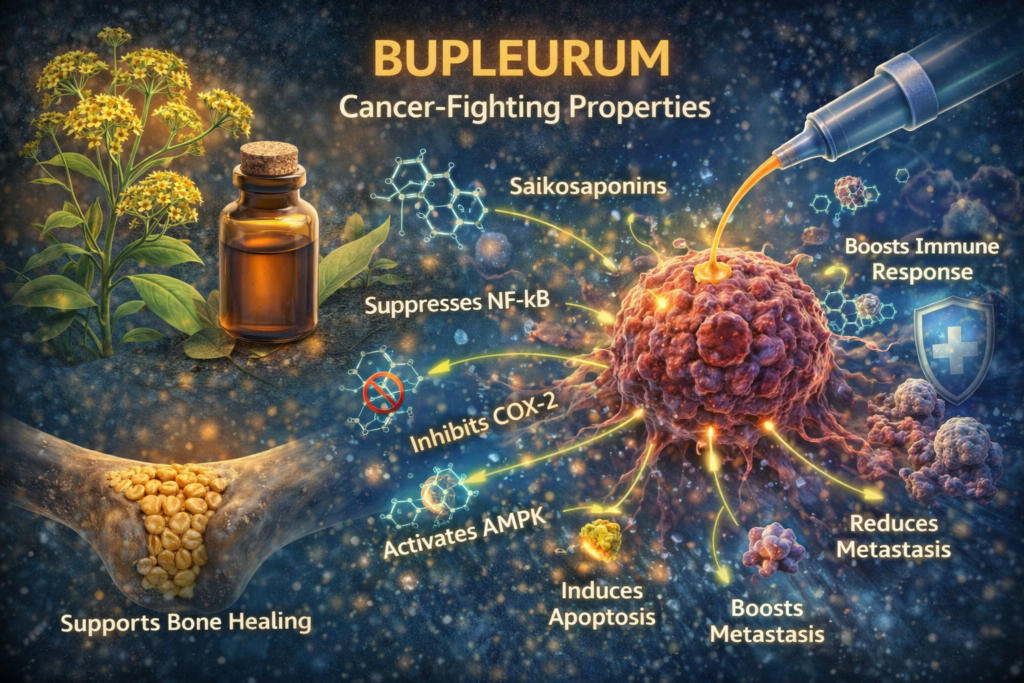
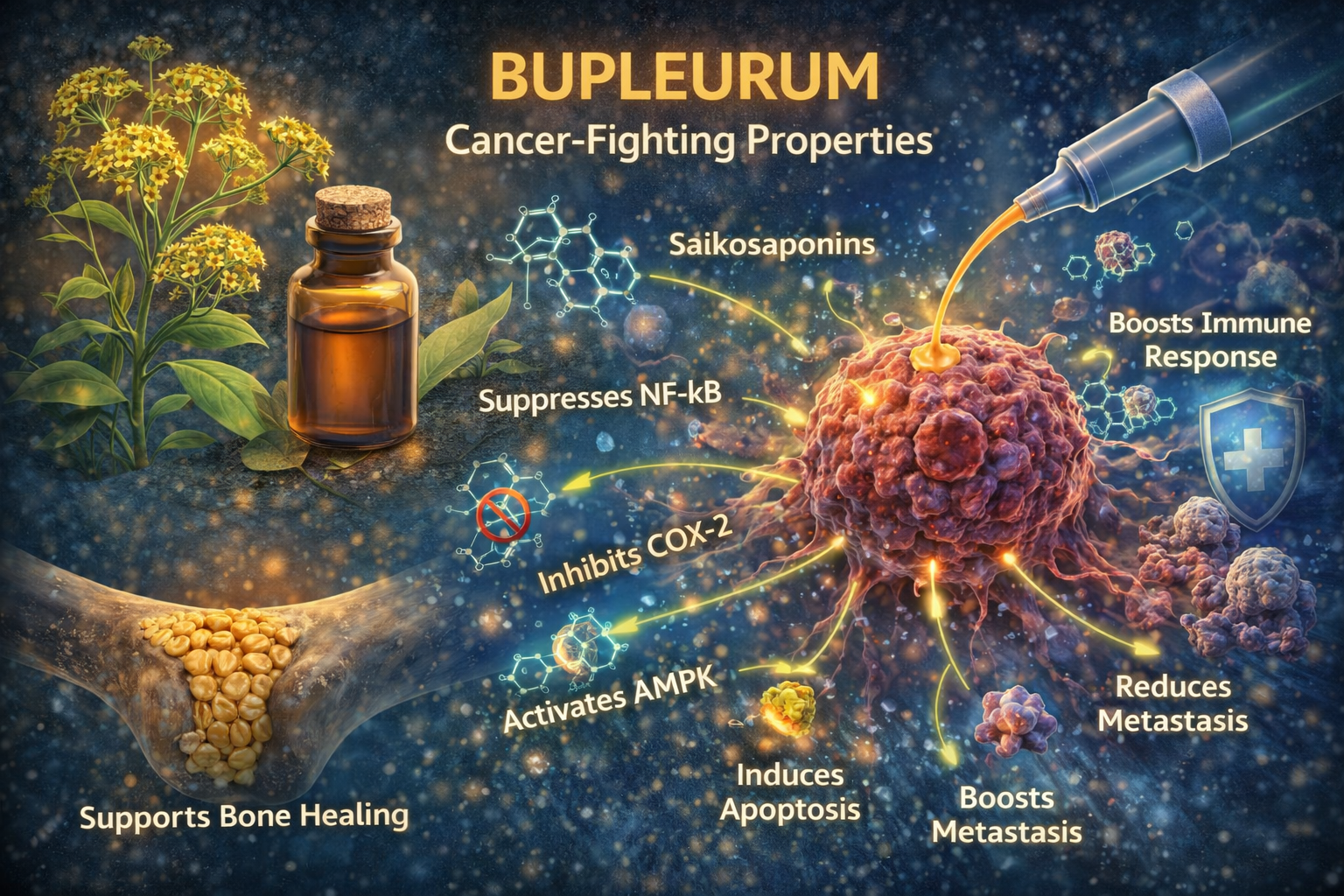
Preclinical research suggests saikosaponins may:
- activate p53-related tumor suppressor signaling
- shift Bcl-2/Bax balance toward apoptosis
- suppress NF-κB, which helps tumors survive chronic inflammation
- reduce STAT3 and COX-2 signaling linked to growth and resistance
- suppress telomerase activity that helps tumor cells maintain immortality
- influence Fas and caspase pathways involved in programmed cell death
These actions matter because cancer cells rarely rely on just one pathway. Inflammation, survival signaling, and resistance mechanisms work together. By influencing NF-κB and STAT3, Bupleurum may help weaken the same kinds of tumor-supportive networks discussed here:
https://helping4cancer.com/nf-kb-cancer/
https://helping4cancer.com/stat3-cancer/
And because these same networks often overlap with growth signaling, Bupleurum also fits naturally into a broader pathway-centered view of cancer biology:
https://helping4cancer.com/pi3k-akt-pathway-cancer/
Metabolism: Liver Function, Oxidative Stress, and Tumor Support
Bupleurum is not primarily known as a classic glycolysis or AMPK herb like berberine, but it still connects to cancer metabolism in important ways.
Its traditional and modern relevance is strongly tied to liver health. Chronic hepatitis, cirrhosis, and fatty liver disease create a pro-inflammatory, high-risk environment for hepatocellular carcinoma. In that sense, Bupleurum’s liver-supportive role may matter upstream of cancer by helping reduce the chronic injury and fibrosis that set the stage for malignant change.
Preclinical literature also suggests saikosaponins may reduce oxidative stress, inflammatory injury, and telomerase-related tumor support. That does not make Bupleurum a direct fasting mimetic, but it does place it within the larger conversation about cancer metabolism, tissue stress, and tumor adaptation:
https://helping4cancer.com/cancer-metabolism/
https://helping4cancer.com/redox-balance-cancer/
Immune System: NK Cells, Cytokines, and Immune Surveillance
Some research suggests Bupleurum and Sho-saiko-to may enhance immune activity, including effects on natural killer cells and cytokine signaling. That is one reason the herb is often described as immune-modulating rather than simply anti-inflammatory.
This is relevant because tumors grow more easily when immune surveillance is weak and inflammation is chronic. By helping shift inflammatory tone and possibly supporting NK-cell function, Bupleurum may fit into a broader immune-support framework rather than acting as a direct immune stimulant alone:
https://helping4cancer.com/immune-system-cancer/
Traditional Use and Cancer Relevance
Bupleurum’s traditional role becomes especially meaningful in liver-related cancer risk. Formulas containing Bupleurum, especially Sho-saiko-to, have long been used in chronic hepatitis and cirrhosis. Since many liver cancers arise on top of chronic liver damage, this history gives Bupleurum a plausible preventive context even before we talk about direct anti-tumor mechanisms.
Some Japanese studies suggested lower hepatocellular carcinoma incidence in cirrhosis patients using Sho-saiko-to. But it is important to be precise here: those studies involved the formula, not isolated Bupleurum alone, and the evidence is not the same as proving direct treatment of active cancer.
Clinical Studies: What We Know So Far
Human data are limited, but not absent. The best-known clinical interest is around Sho-saiko-to in chronic liver disease. Reviews of the literature cite a prospective study suggesting chemopreventive benefit against hepatocellular carcinoma and later analyses discussing possible therapeutic effects in cirrhosis and liver cancer risk reduction.
At the same time, Memorial Sloan Kettering notes that laboratory data exist, but human studies are still needed for cancer-related uses. That is a good summary of where things stand: intriguing, but not confirmed.
Cancer Types Most Often Studied
Most of the clinical-context interest is in liver cancer risk, but preclinical studies have also examined Bupleurum or saikosaponins in:
- liver cancer
- colon cancer
- ovarian cancer
- breast cancer
- lung cancer
In these models, reported effects include slower proliferation, more apoptosis, reduced adhesion and spread, and improved sensitivity to drugs such as cisplatin or doxorubicin. These results are promising, but they are still largely preclinical.
Role in Cancer Strategy
Bupleurum fits best as a support-phase and terrain-modifying herb, especially where liver stress, chronic inflammation, or immune imbalance are part of the picture.
Where It Fits Best
Bupleurum may fit best in:
- liver-supportive recovery strategies
- inflammation-control phases
- long-term support for people with chronic liver disease
- complementary protocols focused on immune balance and tissue protection
How It Connects to Broader Strategy
Its main strategic value is not as a classic attack-phase oxidative compound. Instead, it may help by:
- lowering cancer-promoting inflammation
- supporting liver resilience
- influencing apoptosis-related signaling
- complementing immune surveillance
- potentially making some chemotherapy settings more effective in preclinical models
That makes Bupleurum more connected to support, prevention, and systems-level resilience than to pure ROS escalation. For bigger strategic context, see:
https://helping4cancer.com/metabolic-therapy-cancer/
https://helping4cancer.com/oxidative-stress-cancer/
Key Benefits Being Studied
- supports apoptosis through p53, Fas, caspases, and Bcl-2/Bax balance
- reduces inflammatory signaling through NF-κB and COX-2
- may weaken STAT3-related survival signaling
- may suppress telomerase-related tumor persistence
- may support immune surveillance, including NK-cell-related activity
- may lower liver-cancer risk indirectly by helping manage chronic liver disease
- may improve chemotherapy sensitivity in preclinical models
- may help reduce tumor adhesion and spread in lab settings
Safety and Side Effects
Bupleurum is not automatically harmless. While it is commonly used in traditional formulas, safety concerns have been reported.
Memorial Sloan Kettering notes case reports of liver damage with excess doses, and laboratory data suggest possible interactions with CYP2C9 and CYP3A4-metabolized drugs.
LiverTox reports that Sho-saiko-to and related formulas have been implicated in rare cases of clinically apparent liver injury, and MSK also notes reports of serious lung or liver problems with Sho-saiko-to.
A Taiwanese study also found an association between Chinese herbal products containing Radix bupleuri and hospitalization for liver injury among HBV-infected patients, reinforcing the need for caution in vulnerable populations.
So practical safety points include:
- avoid high doses
- use caution with liver disease and liver-active medications
- monitor liver enzymes if using regularly
- use extra caution with warfarin, chemotherapy drugs, and antidepressants metabolized through CYP pathways
- avoid self-prescribing during active treatment without clinical oversight
Practical Considerations
If Bupleurum is considered, it makes more sense in a supervised integrative setting than as a self-directed stand-alone anti-cancer herb.
The most evidence-informed way to think about it is:
- not a replacement for standard treatment
- better understood in traditional formulas than in isolation
- potentially more relevant in liver-risk settings than in generalized cancer claims
- worth supervising carefully when chemotherapy or complex drug regimens are involved
Summary: Should You Use Bupleurum for Cancer?
Bupleurum is not a cure, but it is more than folklore. Its traditional role in liver support and its modern preclinical activity in apoptosis, inflammation, immune modulation, and tumor signaling make it a legitimate herb of interest in integrative oncology.
Its strongest practical relevance today appears to be in people with chronic liver disease or high inflammatory burden, where support of the underlying terrain may matter. But the gap between promising lab findings and proven human cancer treatment remains large.
Conclusion
Bupleurum offers real potential as a complementary herb in cancer support, especially through its effects on liver health, inflammation, apoptosis, and immune-related signaling. Its strongest evidence is still indirect or preclinical, and its most meaningful clinical context so far is within Sho-saiko-to for chronic liver disease and possible hepatocellular carcinoma risk reduction.
That means the most accurate position is this: Bupleurum may be a useful supportive tool in the right context, but it is not established as a stand-alone cancer treatment. Used carefully and with guidance, it may help strengthen a larger system-based plan rather than replace proven therapy.
Related Topics
Immune system and cancer defense
https://helping4cancer.com/immune-system-cancer/
Foundation of cancer biology
https://helping4cancer.com/the-foundation-of-cancer/
NF-κB and inflammatory cancer signaling
https://helping4cancer.com/nf-kb-cancer/
STAT3 and immune escape
https://helping4cancer.com/stat3-cancer/
PI3K/Akt pathway and tumor survival
https://helping4cancer.com/pi3k-akt-pathway-cancer/
Cancer metabolism and tumor adaptation
https://helping4cancer.com/cancer-metabolism/
Table of Contents