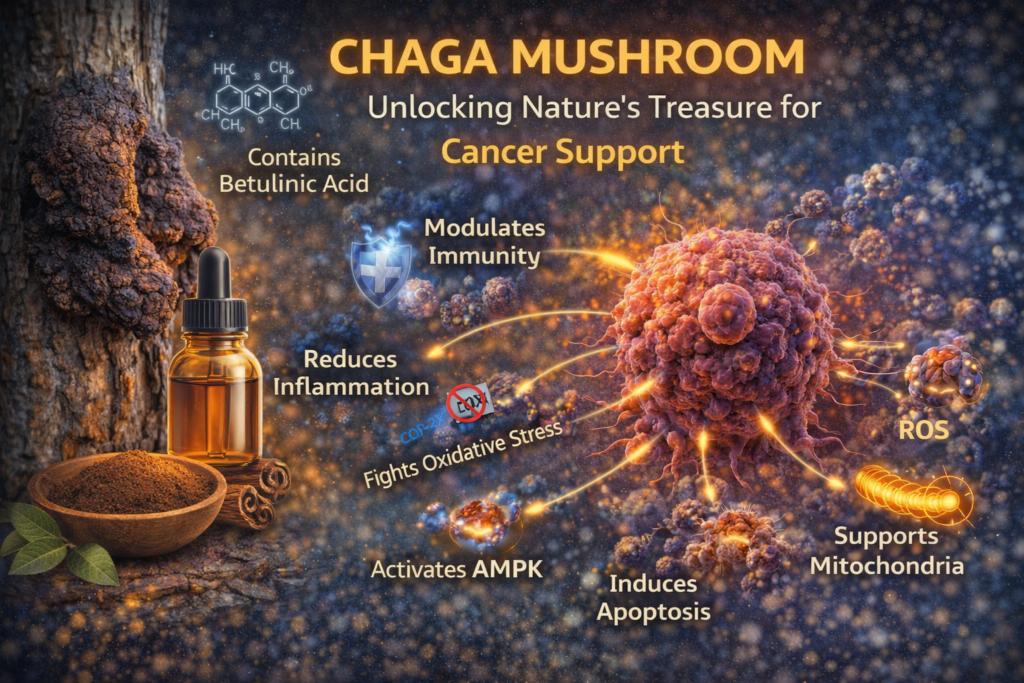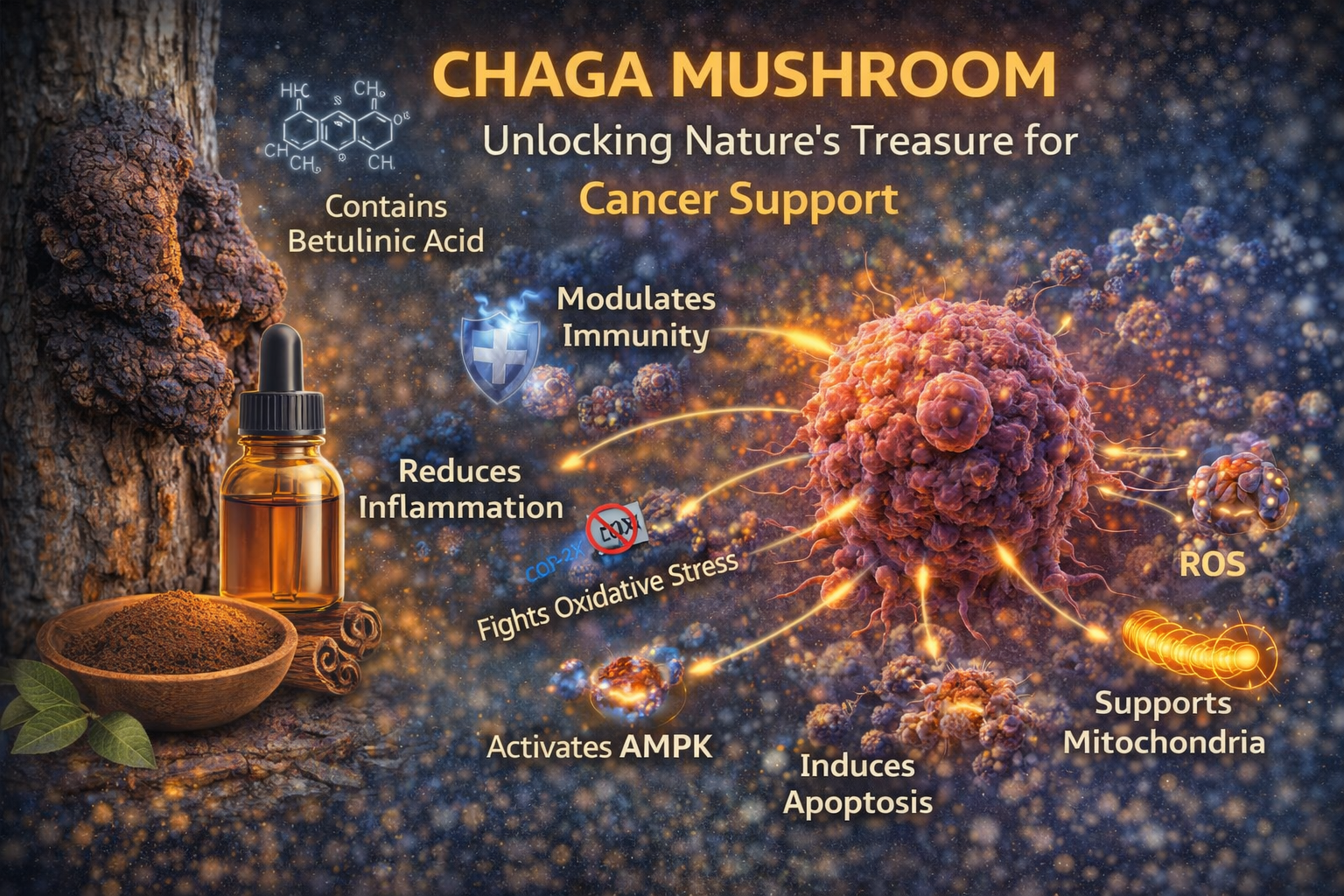
Introduction: What Chaga Is and Why It Matters in Cancer Support
Chaga mushroom, also known as Inonotus obliquus, is a medicinal fungus that grows mainly on birch trees in cold regions such as Siberia, Northern Europe, Canada, and Russia. It has a long history of use in traditional medicine, where it was valued for immune support, vitality, and recovery from illness.
In cancer support, Chaga matters because it combines several features in one natural compound profile. It contains beta-glucans for immune activation, triterpenes like betulinic acid and inotodiol for direct anti-cancer research interest, and antioxidant compounds that may help protect healthy tissue. This makes Chaga especially interesting as a support-phase and immune-focused supplement rather than a stand-alone treatment.
To understand how Chaga fits into the broader cancer system, start here:
https://helping4cancer.com/the-foundation-of-cancer/
What Makes Chaga Unique
Chaga is not a typical culinary mushroom. It is valued because it contains a broad mix of compounds that may work together across immunity, inflammation, oxidative stress, and tumor signaling.
Its most discussed bioactive compounds include:
- Beta-glucans for immune support
- Betulin and betulinic acid for apoptosis research
- Inotodiol, lanosterol, and trametenolic acid B for anti-cancer and anti-inflammatory effects
- Melanin complexes for antioxidant protection
- Phenolic acids and flavonoids for redox balance
This combination is what gives Chaga its reputation as both an immune-support and recovery-support mushroom.
How Chaga Works in Cancer
Pathways: Slowing Growth and Weakening Survival Signals
Preclinical research suggests Chaga may affect several important cancer pathways.
These include:
- PI3K/Akt/mTOR, which helps cancer cells grow and survive
- MAPK/ERK, which supports tumor proliferation and stress adaptation
- NF-κB, which drives inflammation and treatment resistance
- p53-related signaling, which helps damaged cells self-destruct
- Cell-cycle control, especially G0/G1 arrest
This matters because cancer depends on more than one survival switch. Chaga appears to affect several of these systems at once, which makes it more relevant in a pathway-based cancer strategy.
For more on these related systems, see:
https://helping4cancer.com/pi3k-akt-pathway-cancer/
https://helping4cancer.com/nf-kb-cancer/
Metabolism: Oxidative Stress, Mitochondria, and Cellular Pressure
Chaga also connects to cancer metabolism through oxidative balance and mitochondrial signaling.
Potential metabolic roles include:
- Increasing stress inside vulnerable cancer cells
- Supporting apoptosis through mitochondrial pathways
- Helping protect healthy cells from excessive oxidative injury
- Supporting redox balance during recovery
This gives Chaga a dual profile. It may help create pressure against cancer cells while also supporting normal-cell recovery. That makes it more suitable for support and recovery strategy than for direct oxidative attack windows.
For larger context, see:
https://helping4cancer.com/cancer-metabolism/
https://helping4cancer.com/redox-balance-cancer/
Immune System: NK Cells, T Cells, and Surveillance
One of Chaga’s strongest roles is immune support. Its beta-glucans are especially important here.
Research interest centers on Chaga’s ability to help:
- Activate natural killer (NK) cells
- Support macrophage activity
- Strengthen T-cell response
- Improve immune surveillance against abnormal cells
- Regulate cytokines such as TNF-α, IL-6, and IL-10
This makes Chaga especially relevant in cancer recovery, where immune rebuilding is often just as important as direct tumor pressure.
For more, see:
https://helping4cancer.com/immune-system-cancer/
Key Bioactive Compounds in Chaga
Betulin and Betulinic Acid
These compounds come largely from birch bark and are concentrated in Chaga. They are of major interest because they may selectively stress cancer cells and support apoptosis without harming healthy cells to the same extent.
Inotodiol, Lanosterol, and Trametenolic Acid B
These triterpenes are studied for:
- Slowing tumor growth
- Reducing inflammation
- Supporting apoptosis
- Interfering with cancer cell spread
Beta-Glucans
Beta-glucans are central to Chaga’s immune-supportive effects. They help activate frontline immune cells that recognize and attack abnormal cells.
Melanin, Phenolics, and Flavonoids
These compounds contribute to antioxidant protection and may help reduce cellular damage during recovery from treatment stress.
What Lab Studies Suggest
Breast Cancer
Chaga extracts have shown the ability to slow breast cancer cell growth in preclinical research. Some studies suggest stronger effects when combined with drugs such as doxorubicin or cisplatin.
Growth Signaling and Cell-Cycle Arrest
Research suggests Chaga may:
- Lower PI3K/Akt/mTOR activity
- Modify MAPK/ERK signaling
- Reduce NF-κB activity
- Stabilize p53
- Pause cancer cells in G0/G1 so they stop dividing
These effects are important because they connect Chaga to both pathway suppression and apoptosis support.
Chaga and Immune Recovery
Chaga’s immune value may be one of its most practical benefits in cancer support.
Potential benefits include:
- Better NK-cell activity
- Stronger T-cell coordination
- Improved immune recovery after treatment
- More balanced cytokine signaling
- Reduced immune fatigue during recovery
This makes Chaga especially attractive in the periods after chemotherapy or radiation, when the immune system often needs rebuilding.
Chaga’s Potential Synergy with Chemotherapy
Chaga is often discussed as a supportive companion to chemotherapy rather than a replacement.
Possible supportive roles include:
- Helping increase tumor sensitivity in some models
- Protecting healthy cells through antioxidant and immune-support effects
- Helping patients recover immune strength after treatment
- Potentially easing fatigue, inflammation, and tissue stress
However, timing and supervision matter. Because Chaga may interact with drug-processing enzymes, it should be used carefully during active treatment and under medical guidance.
Traditional Use and Why It Still Matters
Chaga has a long traditional history that helps explain why it remains relevant today.
It has been used:
- In Siberian folk medicine for strength and illness recovery
- In Russian herbal traditions for chronic disease support
- In traditional Asian systems for vitality and organ support
That does not prove anti-cancer action, but it does show why researchers continue to explore it as more than just a general wellness mushroom.
Challenges and Research Gaps
Chaga is promising, but several problems remain:
- Most studies are still preclinical
- Human cancer trials are limited
- Product quality varies widely
- Different extraction methods produce different compound profiles
- Standardization is still needed
This means Chaga should be described honestly as promising and supportive, not proven as a direct cancer treatment.
Safety and Practical Considerations
Chaga is often well tolerated in moderate amounts, but it is not risk-free.
Important considerations include:
- High doses may stress the kidneys in sensitive people
- It may interact with blood thinners
- It may affect blood sugar control
- It may interact with chemotherapy metabolism in some cases
Anyone using Chaga during cancer treatment should do so with medical supervision.
Role in Cancer Strategy
Chaga fits best as a support and recovery-phase compound rather than as a primary attack-phase herb.
Best Fit
- Immune rebuilding phases
- Recovery after chemotherapy
- Support windows after radiation
- Long-term maintenance and resilience support
- Anti-inflammatory and antioxidant recovery phases
Strategic Value
Its main value comes from how it helps connect:
- Immune surveillance
- Apoptosis support
- Inflammation control
- Oxidative balance
- Recovery from treatment stress
That makes it a good fit in a larger system focused on strengthening the body while maintaining pressure on cancer-supportive conditions.
Key Benefits of Chaga in Cancer Support
- Supports NK cells and T-cell function
- Promotes apoptosis in preclinical cancer models
- Helps reduce inflammatory signaling such as NF-κB
- May modulate PI3K/Akt/mTOR and MAPK/ERK pathways
- Supports antioxidant protection in healthy tissue
- May improve recovery after chemotherapy
- Helps regulate cytokine balance
- Supports overall immune resilience during treatment recovery
Final Thoughts
Chaga mushroom is one of the most interesting medicinal fungi in cancer support because it brings together immune activation, antioxidant protection, and direct anti-cancer research signals in one profile.
Its strongest practical role appears to be in recovery and immune support. It may help rebuild the body after treatment, support immune surveillance, and contribute to a less favorable environment for tumor survival. While more human studies are still needed, Chaga already fits well into a connected cancer-support strategy focused on immunity, inflammation, and resilience.
Related Topics
Immune system and cancer defense
https://helping4cancer.com/immune-system-cancer/
Foundation of cancer biology
https://helping4cancer.com/the-foundation-of-cancer/
PI3K/Akt pathway and tumor survival
https://helping4cancer.com/pi3k-akt-pathway-cancer/
NF-κB and inflammatory cancer signaling
https://helping4cancer.com/nf-kb-cancer/
Cancer metabolism and tumor adaptation
https://helping4cancer.com/cancer-metabolism/
Redox balance and oxidative stress
https://helping4cancer.com/redox-balance-cancer/
Table of Contents
Continuous intake of the Chaga mushroom (Inonotus obliquus) aqueous extract suppresses cancer progression and maintains body temperature in mice
Link

Chaga mushroom extract induces autophagy via the AMPK-mTOR signaling pathway in breast cancer cells
Link

Chaga mushroom extract suppresses oral cancer cell growth via inhibition of energy metabolism
Link

Chaga mushroom triterpenoids as adjuncts to minimally invasive cancer therapies: A review
Link

Anti-cancer activity of Chaga mushroom (Inonotus obliquus) against dog bladder cancer organoids
Link