Introduction: What Honokiol Is and Why It Matters in Cancer
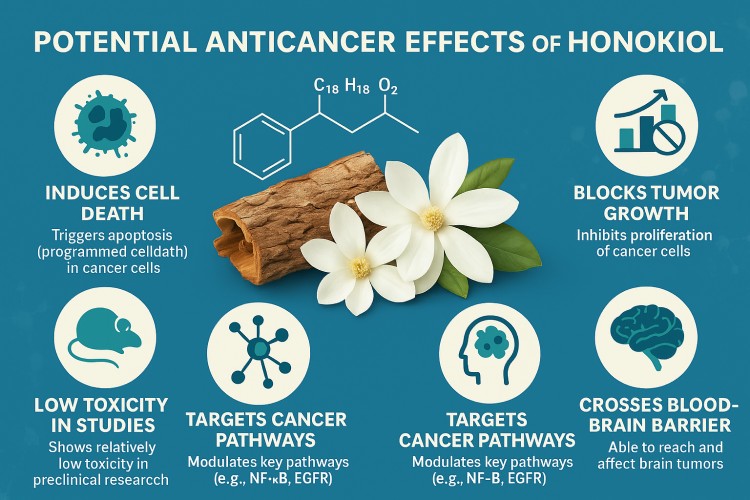
Honokiol is a natural biphenolic compound extracted from Magnolia officinalis bark and seed cones. It has been used for centuries in traditional Chinese and Japanese medicine, but modern cancer research is interested in it for a different reason: honokiol appears to affect multiple tumor survival systems at once. Preclinical studies suggest it can promote apoptosis, slow tumor growth, reduce angiogenesis, limit metastasis, and make some cancers more sensitive to chemotherapy and radiation.
One of honokiol’s most important features is that it is lipid-soluble and can cross the blood-brain barrier. That makes it especially interesting in brain cancer research, where many compounds fail because they cannot reach the tumor. Honokiol has shown activity in preclinical glioblastoma models, and liposomal honokiol has also appeared in early human case-based work.
To see how this fits into the larger cancer system, start here:
https://helping4cancer.com/the-foundation-of-cancer/
What Is Honokiol?
Honokiol is a polyphenolic lignan with the formula C18H18O2. It comes mainly from Magnolia officinalis and related Magnolia species. Unlike many natural compounds that stay mostly in the gut, honokiol’s fat-soluble nature allows it to penetrate membranes more easily, including the blood-brain barrier. That has made it a standout compound in preclinical brain tumor work, especially in glioblastoma and medulloblastoma research.
In cancer discussions, honokiol is best understood as a multi-target support compound rather than a single-pathway drug. That is one reason it keeps showing up in integrative oncology research.
How Honokiol Works in Cancer
Pathways: Growth, Survival, Immune Evasion, and Angiogenesis
Honokiol has been reported to influence several major cancer pathways, including NF-κB, STAT3, EGFR, mTOR-related signaling, and stem-cell pathways such as Notch, Wnt/β-catenin, and Hedgehog. This matters because tumors rarely depend on just one driver. They survive by using overlapping growth, inflammation, and resistance networks. Honokiol appears to weaken several of those networks at once.
It also has anti-angiogenic relevance. Preclinical work describes reductions in VEGF and related vessel-growth signaling, which may help limit tumor blood supply. In some models, honokiol also lowers EMT and invasion-related markers, which can reduce spread potential.
For related pathway background, see:
https://helping4cancer.com/nf-kb-cancer/
https://helping4cancer.com/stat3-cancer/
https://helping4cancer.com/pi3k-akt-pathway-cancer/
https://helping4cancer.com/angiogenesis-inhibitors-cancer/
Metabolism: ROS, Mitochondria, and mTOR Pressure
Honokiol is also relevant to cancer metabolism. In preclinical models, it can increase reactive oxygen species in tumor cells, disrupt mitochondrial function, and reduce survival signaling linked to mTOR and growth adaptation. In brain tumor work, liposomal honokiol has been shown to induce ROS-mediated apoptosis and alter ERK/p38-MAPK signaling.
This places honokiol inside the larger conversation about oxidative stress, tumor metabolism, and mitochondrial vulnerability. It is not mainly known as a glycolysis-first compound like berberine, but it still creates metabolic stress that can make tumors less able to survive.
For more context:
https://helping4cancer.com/cancer-metabolism/
https://helping4cancer.com/oxidative-stress-cancer/
https://helping4cancer.com/redox-balance-cancer/
Immune System: T Cells, PD-L1, and Tumor Evasion
Honokiol also connects to immune strategy. Preclinical literature describes suppression of STAT3 and PD-L1-related signaling, which may help reduce tumor immune evasion and make cancer cells more visible to immune attack. In glioblastoma models, liposomal honokiol has also been linked to macrophage polarization changes, shifting the tumor environment away from an immune-suppressive state.
This makes honokiol more than just a cell-killing compound. It may also help reshape the tumor microenvironment in ways that support immune surveillance.
For broader immune context:
https://helping4cancer.com/immune-system-cancer/
Core Anti-Cancer Mechanisms
Apoptosis
One of honokiol’s strongest research themes is apoptosis. It has been shown to increase pro-apoptotic signals such as BAX, reduce anti-apoptotic proteins like Bcl-2, release cytochrome c from mitochondria, and activate caspases. That gives it a direct role in pushing damaged tumor cells toward programmed death.
Cell Cycle Arrest
Honokiol can also interfere with the cell cycle by reducing cyclins and CDK-related signaling. This can stop tumor cells at key checkpoints like G0/G1 or G2/M, making it harder for them to keep dividing.
Anti-Angiogenesis
Tumors need blood supply to grow. Honokiol has shown anti-angiogenic effects in preclinical studies through VEGF and VEGFR-related suppression. That may help keep tumors smaller and less able to expand.
Anti-Metastatic Effects
Honokiol may reduce metastasis by suppressing EMT-related factors such as Snail and by reducing MMP activity. This can make it harder for cancer cells to invade tissue barriers and spread to distant organs.
Cancer Stem Cell Suppression
One of the most important long-term roles being studied is honokiol’s effect on cancer stem cells. It appears to influence Notch, Wnt/β-catenin, and Hedgehog pathways, all of which help stem-like tumor cells survive, recur, and resist therapy.
Honokiol’s Effects by Cancer Type
Preclinical studies have shown activity in a wide range of cancers, including glioblastoma, breast, lung, ovarian, colorectal, prostate, leukemia, melanoma, liver, kidney, and thyroid cancer. In glioblastoma, honokiol is especially notable because it crosses the blood-brain barrier and has shown tumor-suppressive effects in animal models. Liposomal honokiol has also appeared in a 2023 recurrent glioblastoma case report, and more recent 2025 work explored liposomal honokiol with bevacizumab in glioblastoma models.
In breast, lung, ovarian, and colorectal cancer models, honokiol has been linked to reduced proliferation, less metastasis, more apoptosis, and better response to standard therapy. These are still preclinical findings, but they are consistent across multiple tumor types.
Pharmacokinetics and Drug Delivery
Honokiol’s biggest strength and weakness are related. It is lipid-soluble, which helps with membrane and brain penetration, but it has low water solubility and can be limited by rapid metabolism. That is why delivery systems have become a major research area. Liposomal honokiol, polymeric nanoparticles, dendrimers, and nanoemulsions are all being explored to improve circulation time, stability, and tumor targeting.
This matters because better delivery may be the key to moving honokiol from promising preclinical compound to practical clinical tool.
Role in Cancer Strategy
Honokiol fits best as a support and pressure compound that bridges several goals at once.
Where It Fits Best
Honokiol makes the most sense in:
- multi-pathway support strategies
- recurrence-prevention discussions
- brain tumor support research because of BBB penetration
- combination approaches with chemo or radiation
- longer-term inflammation and metastasis control
Strategic Value
Its main value is that it combines:
- apoptosis support
- anti-angiogenesis
- anti-metastatic effects
- cancer stem cell pressure
- immune evasion blockade
- BBB penetration for brain-related cancers
That makes it one of the more system-wide natural compounds in cancer research.
Safety and Limits
Preclinical safety appears encouraging, with animal studies generally reporting low toxicity at therapeutic ranges. Early human discussion suggests possible mild drowsiness or GI discomfort, but large human safety datasets are still missing. Honokiol can also have sedative-like effects, so caution is reasonable with sedatives or benzodiazepines.
The biggest limitation is still the lack of strong human clinical data. A recurrent glioblastoma case report was published in 2023, but beyond that, there has not been a major wave of human cancer-trial results. More recent work remains largely preclinical, especially in delivery research.
So the most accurate framing is:
honokiol is a promising multi-target natural compound, but it is not yet a proven cancer therapy in humans.
Key Benefits Being Studied
- promotes apoptosis in tumor cells
- slows tumor cell division through cell cycle arrest
- reduces VEGF-driven angiogenesis
- lowers invasion and metastasis signaling
- pressures cancer stem cell pathways
- may reduce PD-L1 and immune evasion
- crosses the blood-brain barrier
- may improve response to chemotherapy and radiation in preclinical models
Final Thoughts
Honokiol is one of the more exciting natural compounds in cancer research because it acts on several major cancer systems at once. It targets tumor growth, metastasis, stem-cell survival, angiogenesis, immune evasion, and in brain tumor research it adds the rare advantage of blood-brain barrier penetration.
That combination makes it a strong candidate for future integrative oncology work. But for now, it is still best understood as a promising research-stage compound rather than an established therapy. The science is real, the mechanisms are compelling, and the delivery technology is improving, but larger human data are still needed before it can move closer to mainstream oncology use.
Related Topics
Cancer metabolism and oxidative stress
https://helping4cancer.com/cancer-metabolism/
https://helping4cancer.com/oxidative-stress-cancer/
The foundation of cancer
https://helping4cancer.com/the-foundation-of-cancer/
NF-κB and inflammatory cancer signaling
https://helping4cancer.com/nf-kb-cancer/
STAT3 and immune escape
https://helping4cancer.com/stat3-cancer/
PI3K/Akt pathway and tumor survival
https://helping4cancer.com/pi3k-akt-pathway-cancer/
Angiogenesis and tumor blood supply
https://helping4cancer.com/angiogenesis-inhibitors-cancer/
In Protocol 2, 500 mg of Honokiol is taken during the OMAD phase to:
- Suppress multiple tumor survival pathways
- Support mitochondrial apoptosis
- Inhibit angiogenesis and metastasis
- Calm the nervous system and reduce stress-related immune suppression
🔍 Honokiol – OMAD Phase Summary
✅ Best Timing:
- 2:30–4:30 PM with the OMAD + Second Wave supplements and meal
- Take with healthy fats (e.g., Black Seed Oil, MCT Oil) to maximize absorption
- Do not take during oxidative therapy hours (early morning); it has antioxidant properties
💊 Recommended Dose:
- 500 mg once daily of high-purity Honokiol (standardized extract or liposomal preferred)
- May increase to 1000 mg/day for advanced cancer or during immune rebuilding (e.g., Weeks 9–12)
- Safe for long-term use
⏳ Active Duration in Body:
- Absorbed within 1–2 hours; peak effects around 2–4 hours post-ingestion
- Active mitochondrial and anti-inflammatory effects last 8–10 hours
- Cumulative benefits build with continuous daily use
🔁 Redundancy With:
- Some overlap with Resveratrol, Curcumin, and EGCG in anti-inflammatory function
- Unique in its mitochondrial penetration, GABAergic calm, and anti-metastatic properties
- Excellent for synergy with Dandelion Root, Luteolin, and Diosmetin in the recovery stack
📉 Pathways Inhibited or Affected:
- NF-κB inhibition – lowers inflammation and immune suppression
- PI3K/Akt/mTOR inhibition – reduces tumor growth and metabolic resilience
- STAT3 inhibition – blocks immune evasion
- Angiogenesis suppression (VEGF) – cuts off tumor blood supply
- Mitochondrial apoptosis promotion – helps initiate cancer cell death
- GABA receptor activation – reduces anxiety and cortisol, supporting immune recovery
🔒 Final Summary
Honokiol is a mitochondrial assassin and immune ally. In Protocol 2, it is taken at 500 mg during the OMAD phase to extend anti-cancer pressure into the afternoon, calm the system, and protect against hidden inflammation and metastasis.
Its rare combination of tumor inhibition, neuroprotection, and mitochondrial penetration makes it a keystone in long-term cancer control and relapse prevention.
Citations
- Honokiol: A Review of Its Anticancer Potential and Mechanisms (MDPI, 2019, https://www.mdpi.com/2072-6694/12/1/48)
- Honokiol: A Novel Natural Agent for Cancer Prevention and Therapy (PMC, 2013, https://pmc.ncbi.nlm.nih.gov/articles/PMC3663139/)
- Honokiol Induces Apoptosis and Suppresses Migration and Invasion of Ovarian Carcinoma Cells (International Journal of Molecular Medicine, 2019, https://www.spandidos-publications.com/10.3892/ijmm.2019.4122)
- Frontiers | Honokiol in Glioblastoma Recurrence: A Case Report (Frontiers in Neurology, 2023, https://www.frontiersin.org/journals/neurology/articles/10.3389/fneur.2023.1172860/full)
- Honokiol and Its Analogues as Anticancer Compounds: Current Mechanistic Insights and Structure-Activity Relationship (ScienceDirect, 2023, https://www.sciencedirect.com/science/article/abs/pii/S0009279723004143)
- A Comprehensive Review of Anti-Cancer Mechanisms of Polyphenol Honokiol and Nano Carrier-Based Approaches (Springer, 2025, https://link.springer.com/article/10.1007/s11101-025-10090-0)
- Liposomal Honokiol Inhibits Non-Small Cell Lung Cancer Progression and Enhances PD-1 Blockade (PubMed, 2024, https://pubmed.ncbi.nlm.nih.gov/39531934/)
Table of Contents