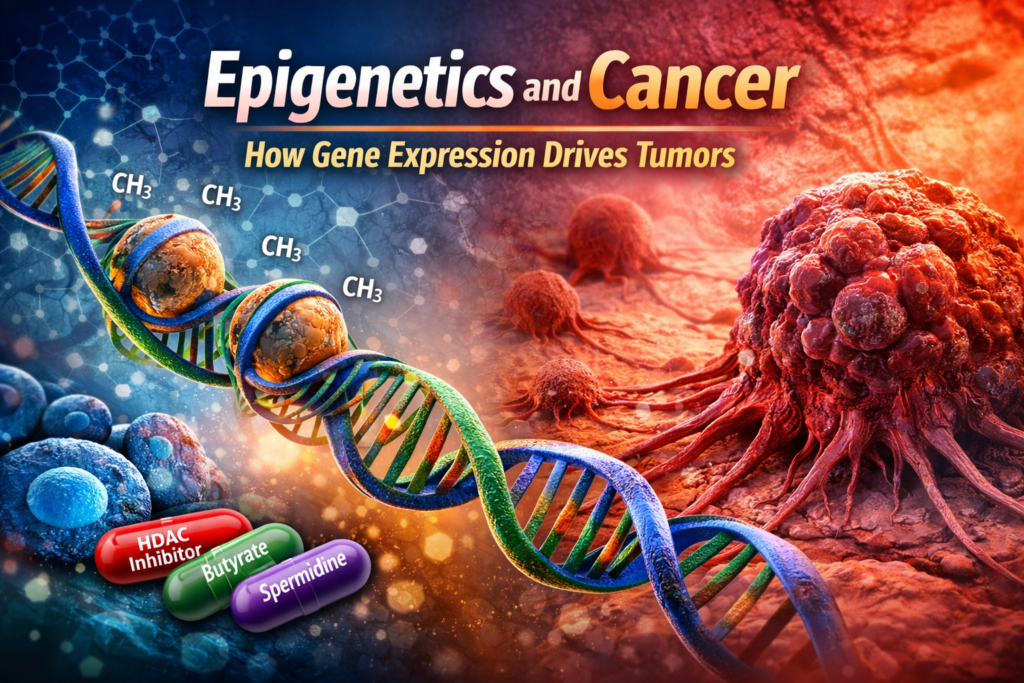
Epigenetics and Cancer Introduction
Cancer is often described as a disease of genetic mutations, but mutations are only part of the story. Modern research has revealed that many cancers are also driven by epigenetic changes—chemical modifications that control how genes are turned on or off without altering the underlying DNA sequence.
These epigenetic alterations can silence protective genes, activate growth pathways, and allow tumors to survive and spread.
Understanding epigenetics and cancer is transforming oncology. Scientists now recognize that changes in DNA methylation, histone modification, and chromatin structure can be just as important as genetic mutations in driving tumor behavior.
Unlike permanent DNA mutations, epigenetic changes are potentially reversible, which makes them an exciting target for therapies and metabolic strategies.
This guide explains:
- What epigenetics is
- How epigenetic changes drive cancer growth
- The role of DNA methylation and histone modification
- How HDAC inhibitors influence gene expression
- Natural compounds like butyrate and spermidine that affect epigenetic pathways
What Is Epigenetics?
Epigenetics refers to biological mechanisms that regulate gene activity without changing the DNA code itself.
Your DNA contains thousands of genes, but not all of them are active at the same time. Epigenetic mechanisms act like switches and dimmers, determining which genes are turned on, turned off, or partially activated.
These mechanisms are essential for normal development and cellular function.
For example, epigenetics determines:
- Which genes allow a stem cell to become a liver cell
- How immune cells recognize pathogens
- How cells respond to stress and environmental signals
However, when epigenetic regulation becomes abnormal, it can contribute to cancer formation and progression.
Learn more about cancer biology in our guide:
https://helping4cancer.com/hallmarks-of-cancer/
How Epigenetic Changes Contribute to Cancer
Cancer cells often hijack epigenetic mechanisms to gain survival advantages.
These changes can:
• Silence tumor-suppressor genes
• Activate growth-promoting genes
• Help tumors evade the immune system
• Increase resistance to therapy
• Promote metastasis
Unlike DNA mutations, epigenetic alterations do not change the genetic code, but they change how that code is interpreted.
Think of it like a piano:
The DNA sequence is the piano itself, while epigenetic modifications determine which keys are played.
When the wrong genes are activated or silenced, normal cells can gradually transform into cancer cells.
DNA Methylation and Cancer
One of the most important epigenetic mechanisms is DNA methylation.
DNA methylation occurs when small chemical groups called methyl groups (CH₃) attach to DNA molecules.
This usually happens at specific DNA regions called CpG islands, which are often located near gene promoters.
What DNA Methylation Does
DNA methylation generally acts as a gene silencing mechanism.
When methyl groups attach to DNA:
• Gene expression is reduced or shut down
• Proteins needed for cell regulation may stop being produced
This process is essential for normal biology, but in cancer it becomes dysregulated.
DNA Methylation in Tumors
Cancer cells frequently show abnormal methylation patterns.
Two major changes occur:
1. Hypermethylation
Tumor suppressor genes become excessively methylated and silenced.
Examples include genes involved in:
- DNA repair
- apoptosis
- cell cycle control
2. Hypomethylation
Other regions of the genome become less methylated, which can activate oncogenes and genomic instability.
This combination creates a cellular environment that promotes tumor growth.
More details about cancer genetics can be found here:
National Cancer Institute
https://www.cancer.gov/about-cancer/causes-prevention/genetics
Histone Modification and Cancer
DNA in human cells is wrapped around proteins called histones.
These histones act like spools that organize DNA into structures called chromatin.
Chemical modifications to histones influence how tightly DNA is wrapped.
If DNA is tightly packed, genes cannot be accessed and are turned off.
If DNA is loosely packed, genes become active.
This regulation occurs through histone modifications, including:
• acetylation
• methylation
• phosphorylation
• ubiquitination
These modifications act as signals that control gene accessibility.
Histone Acetylation and Gene Expression
One of the most studied histone modifications is histone acetylation.
When histones are acetylated:
- DNA becomes less tightly wrapped
- gene expression increases
This process is controlled by two enzyme groups:
Histone Acetyltransferases (HATs)
Add acetyl groups to histones.
Histone Deacetylases (HDACs)
Remove acetyl groups.
Balance between these enzymes determines gene activity.
In many cancers, HDAC activity becomes excessive, causing tumor suppressor genes to become silenced.
HDAC Inhibitors and Cancer Treatment
Because HDAC enzymes silence important protective genes, scientists developed drugs called HDAC inhibitors.
These compounds block HDAC activity, allowing genes that suppress tumors to become active again.
Several HDAC inhibitors are now used in cancer therapy.
Examples include:
- Vorinostat
- Romidepsin
- Belinostat
- Panobinostat
These drugs are particularly useful in certain lymphomas and leukemias.
HDAC inhibitors work by:
• reactivating tumor suppressor genes
• inducing cancer cell death
• enhancing immune recognition of tumors
Research on epigenetic drugs continues to expand rapidly.
Learn more from:
National Institutes of Health
https://www.ncbi.nlm.nih.gov/books/NBK26817/
Butyrate: A Natural HDAC Inhibitor
Interestingly, some natural compounds can influence epigenetic pathways.
One of the most studied is butyrate, a short-chain fatty acid produced by gut bacteria during fiber fermentation.
Butyrate acts as a natural HDAC inhibitor, meaning it can influence histone acetylation and gene expression.
Research suggests butyrate may:
• promote cancer cell apoptosis
• reduce inflammation
• support colon health
• regulate immune responses
Butyrate is primarily produced when gut microbes ferment dietary fiber.
Foods that support butyrate production include:
- resistant starch
- whole grains
- legumes
- vegetables
Because of its role in colon health, butyrate has become an important topic in colorectal cancer research.
Learn more about diet and cancer prevention:
World Cancer Research Fund
https://www.wcrf.org/dietandcancer/
Spermidine and Epigenetic Regulation
Another compound linked to epigenetic regulation is spermidine, a naturally occurring polyamine found in many foods.
Spermidine influences cellular health through several mechanisms, including:
• promoting autophagy
• stabilizing DNA structure
• affecting histone acetylation
Autophagy is a cellular recycling process that helps remove damaged components and maintain cell health.
You can learn more here:
Some studies suggest spermidine may support healthy aging and metabolic regulation by influencing epigenetic pathways.
Foods rich in spermidine include:
- wheat germ
- mushrooms
- soy products
- aged cheese
- legumes
Researchers are continuing to investigate its role in cancer biology.
Epigenetics and Tumor Microenvironment
Epigenetic changes do not occur in isolation. They interact with the tumor microenvironment, which includes immune cells, blood vessels, and surrounding tissue.
Epigenetic regulation can influence:
• immune cell recognition of tumors
• inflammatory signaling
• angiogenesis (blood vessel formation)
• metabolic adaptation
For example, epigenetic modifications may allow cancer cells to suppress immune detection.
This helps tumors escape immune surveillance, one of the key hallmarks of cancer.
Read more here:
Epigenetics and Cancer Therapy Resistance
One reason cancer treatments sometimes stop working is epigenetic adaptation.
Tumor cells can alter gene expression in response to therapy, allowing them to survive.
This process can contribute to resistance against:
- chemotherapy
- radiation therapy
- targeted therapy
Because epigenetic changes are reversible, researchers are exploring combination treatments that include epigenetic drugs alongside conventional therapies.
These strategies may help restore treatment sensitivity.
The Future of Epigenetic Cancer Research
Epigenetics is one of the most rapidly advancing fields in oncology.
Scientists are now exploring:
• epigenetic biomarkers for early cancer detection
• personalized epigenetic therapies
• diet and microbiome influences on gene regulation
• combinations of epigenetic drugs with immunotherapy
Because epigenetic modifications are reversible, they represent a promising pathway for precision medicine.
Future cancer treatments may include therapies designed to reprogram tumor cells back toward normal gene expression patterns.
Key Takeaways
Epigenetics plays a central role in cancer development and progression.
Important concepts include:
- Epigenetic changes control gene expression without altering DNA
- DNA methylation can silence tumor suppressor genes
- Histone modification influences chromatin structure and gene activity
- HDAC inhibitors can reactivate protective genes
- Natural compounds like butyrate and spermidine may influence epigenetic pathways
Understanding these mechanisms helps scientists develop new treatments that target the regulatory systems controlling cancer cell behavior.
Conclusion
Cancer is not only a genetic disease—it is also an epigenetic disease.
Changes in DNA methylation, histone modification, and chromatin structure allow tumors to manipulate gene expression and gain survival advantages.
The encouraging aspect of epigenetics is that these changes are potentially reversible.
By understanding the epigenetic drivers of cancer, researchers are discovering new therapeutic strategies, diagnostic tools, and lifestyle approaches that may help regulate gene expression and improve treatment outcomes.
As research continues, epigenetics will likely remain a major focus in the future of cancer biology and personalized medicine.
External References
National Cancer Institute
https://www.cancer.gov/about-cancer/causes-prevention/genetics/epigenetics
Nature – Epigenetics and Cancer
https://www.nature.com/subjects/cancer-epigenetics
National Institutes of Health
https://www.ncbi.nlm.nih.gov/books/NBK26817/
World Cancer Research Fund
https://www.wcrf.org/dietandcancer/
Table of Contents