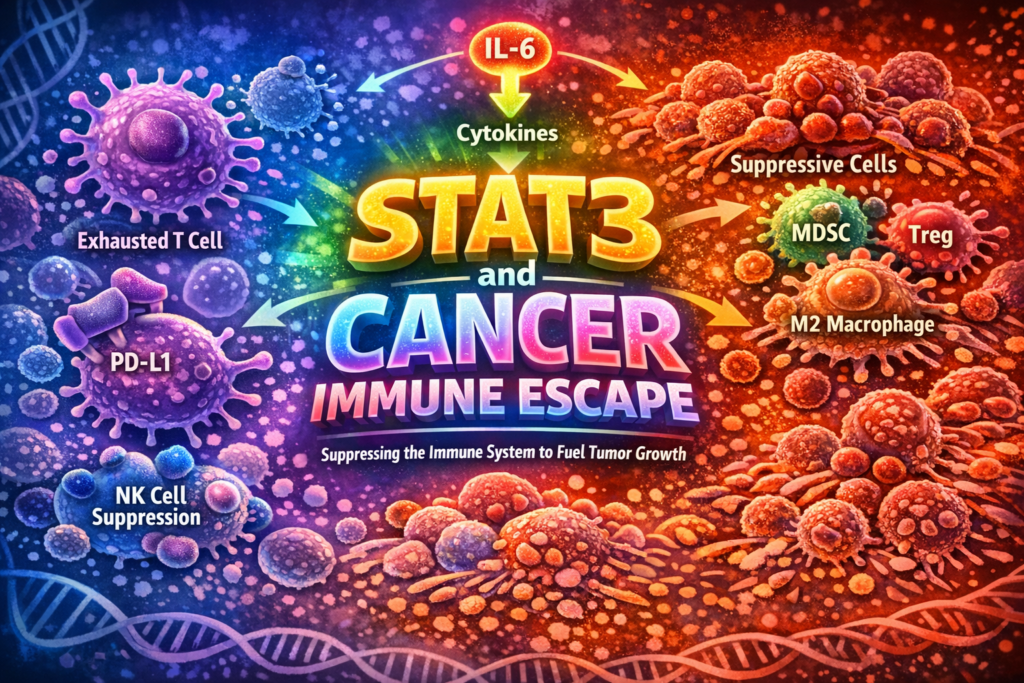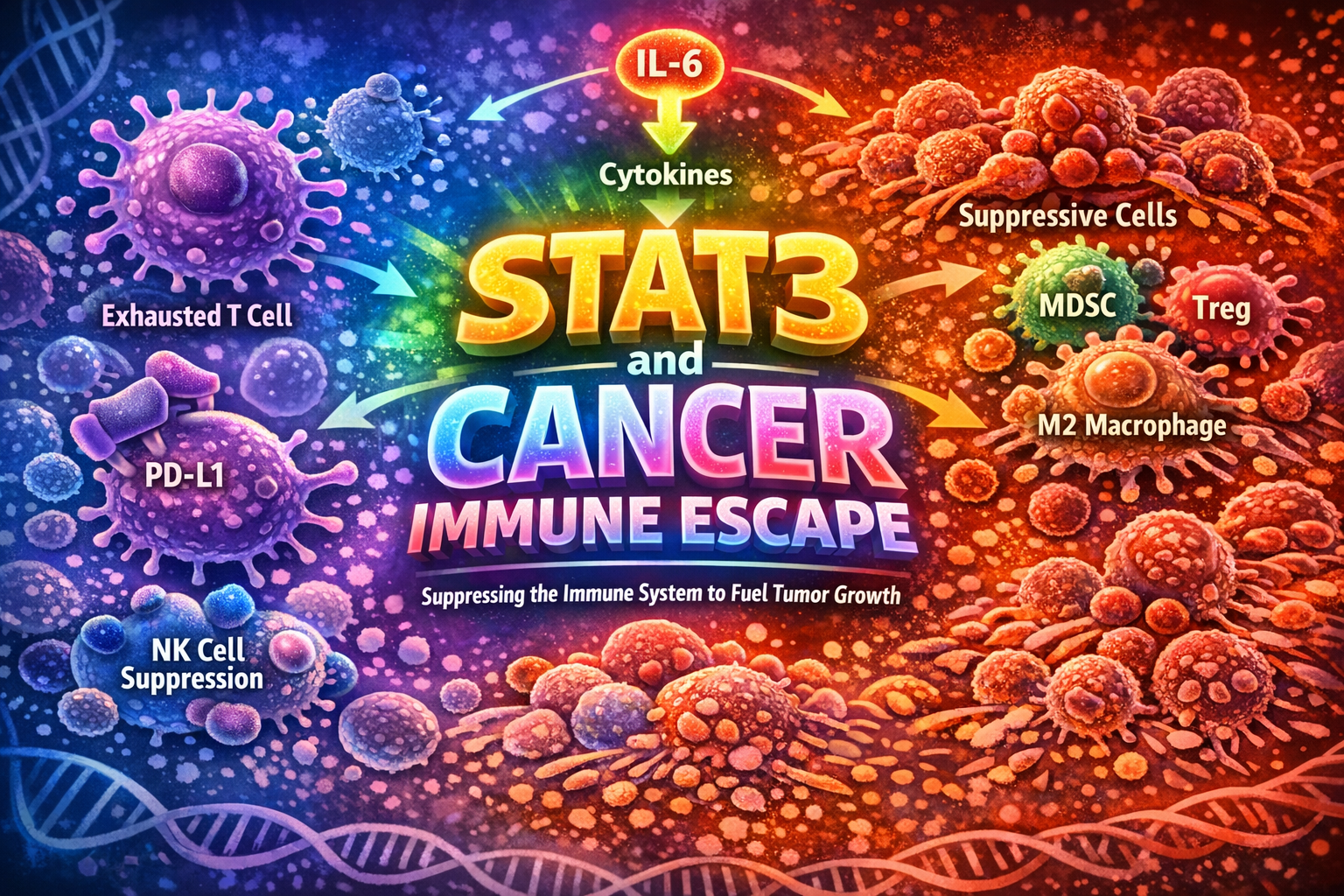
Introduction: STAT3 as a Master Immune Escape Switch
The STAT3 signaling pathway is one of the most critical drivers of immune suppression in cancer.
Modern research shows that STAT3 does not just help tumors grow—it allows them to hide from the immune system, survive therapy, and spread. The IL-6/JAK/STAT3 axis is now recognized as a central regulator of tumor progression, immune evasion, and resistance across many cancers .
STAT3 Biology: Structure and Activation
STAT3 is activated by cytokines and growth signals:
- IL-6, IL-10 (immune signaling)
- EGFR, HER2 (growth signaling)
- JAK kinases (activation step)
Activation Sequence
- Cytokine binds receptor
- JAK phosphorylates STAT3
- STAT3 dimerizes
- STAT3 enters nucleus
- Gene transcription begins
STAT3 regulates over 1,000 genes involved in survival, inflammation, and immune suppression.
STAT3 in Cancer: Persistent Activation
In tumors, STAT3 becomes chronically active due to:
- IL-6 autocrine loops
- Tumor microenvironment signaling
- Loss of negative regulators (SOCS, PIAS)
This leads to:
- Increased tumor growth
- Immune suppression
- Therapy resistance
The IL-6/STAT3 pathway specifically reprograms the tumor microenvironment to support tumor growth and suppress immunity .
STAT3 Drives Immune Escape (Core Mechanisms)
STAT3 enables tumors to shut down immune attack through multiple coordinated mechanisms.
🔥 1. PD-L1 and Immune Checkpoint Activation
STAT3 directly increases PD-L1 expression, a key immune checkpoint that blocks T-cell function.
- STAT3 activation correlates with PD-1/PD-L1 expression in tumors
- Blocking STAT3 reduces PD-L1 levels and restores immune response
👉 This is one of the most important ways tumors evade immunotherapy.
🛡️ 2. CD8⁺ T-Cell Suppression
STAT3 weakens cytotoxic T cells by:
- Reducing IFN-γ production
- Limiting tumor infiltration
- Promoting exhaustion
Tumors can create “T-cell desert” environments where immune cells cannot function effectively .
🧲 3. Expansion of Immunosuppressive Cells
STAT3 drives expansion of:
- MDSCs (myeloid-derived suppressor cells)
- Tregs (regulatory T cells)
- M2 macrophages (TAMs)
These cells suppress immune responses and protect tumors.
STAT3 signaling promotes recruitment of these suppressive cells into the tumor microenvironment .
🧬 4. Cytokine Feedback Loops (IL-6 Axis)
STAT3 forms a powerful feedback loop:
IL-6 → JAK → STAT3 → more IL-6
This loop:
- Sustains inflammation
- Suppresses immunity
- Enhances tumor survival
IL-6 is also linked to therapy resistance and tumor adaptability .
STAT3 and the Tumor Microenvironment
STAT3 transforms the tumor microenvironment (TME) into an immunosuppressive ecosystem.
Key Effects
- Increased IL-10, TGF-β
- Reduced dendritic cell function
- Impaired antigen presentation
- Recruitment of suppressive immune cells
STAT3-driven signaling actively reshapes the TME to favor tumor growth and immune escape .
🔗 Internal Links
Tumor Microenvironment:
https://helping4cancer.com/tumor-microenvironment-and-cancer/
Tumor Immune Escape:
https://helping4cancer.com/tumor-immune-escape-mechanisms/
STAT3–NF-κB Inflammatory Loop
STAT3 works closely with the NF-κB signaling pathway.
Self-Amplifying Cycle
NF-κB → IL-6 → STAT3 → more IL-6
This creates:
- Chronic inflammation
- Persistent immune suppression
- Tumor survival reinforcement
🔗 Internal Link
NF-κB Pathway:
https://helping4cancer.com/nf-kb-cancer/
STAT3 and Therapy Resistance
STAT3 contributes to resistance across:
- Chemotherapy
- Radiation
- Immunotherapy
Mechanisms
- Anti-apoptotic signaling
- Immune suppression
- DNA repair activation
For example, IL-6/STAT3 signaling can block effective immune responses even after chemotherapy .
STAT3 and Metabolism
STAT3 supports tumor metabolism by:
- Increasing glycolysis
- Supporting mitochondrial function
- Promoting oxidative stress adaptation
This helps tumors survive in hostile conditions like hypoxia and nutrient deprivation .
🔗 Internal Links
Cancer Metabolism:
https://helping4cancer.com/cancer-metabolism-explained/
Tumor Hypoxia:
https://helping4cancer.com/tumor-hypoxia-cancer/
STAT3 and Metastasis
STAT3 promotes metastasis by:
- Activating EMT (invasion program)
- Increasing MMP activity
- Preparing metastatic niches
STAT3 signaling contributes to tumor spread and aggressive disease progression .
Therapeutic Targeting of STAT3
STAT3 is a major target in modern oncology.
Direct Targeting
- STAT3 inhibitors
- PROTAC degraders
- STAT3 decoys
Recent research shows STAT3 degraders can restore immune function and improve therapy response .
Indirect Targeting
- JAK inhibitors
- IL-6 blockers
- Cytokine targeting
Combination Therapy (Most Promising)
Combining STAT3 inhibition with immunotherapy:
- Enhances checkpoint inhibitor response
- Restores T-cell activity
- Reduces tumor immune suppression
Targeting IL-6/STAT3 alongside immunotherapy is considered a high-potential strategy in cancer treatment .
External Authority Research Links
Nature – Immune evasion in cancer:
https://www.nature.com/articles/s41392-025-02280-1
PubMed – IL-6/STAT3 tumor microenvironment review:
https://pubmed.ncbi.nlm.nih.gov/39893129/
Frontiers – STAT3 immune suppression:
https://www.frontiersin.org
ScienceDirect – STAT3 pathway and therapy resistance:
https://www.sciencedirect.com/science/article/abs/pii/S1359610125000036
Nature Communications – IL-6 suppresses anti-cancer immunity:
https://www.nature.com/articles/s41467-021-26407-4
Key Takeaways
- STAT3 is a central driver of immune escape in cancer
- It suppresses T cells, NK cells, and dendritic cells
- It expands MDSCs, Tregs, and TAMs
- It connects inflammation, metabolism, and survival
- It contributes to therapy resistance and metastasis
Final Summary
STAT3 is one of the most powerful pathways tumors use to survive.
It allows cancer to:
- Hide from the immune system
- Resist treatment
- Adapt and spread
Understanding STAT3 is essential for understanding why cancer persists—and how to disrupt it.
Table of Contents