What This Page Explains
This page explains:
- How fasting affects cancer and metabolism
- Why eating frequency matters
- What OMAD (one meal a day) does
- How to start safely and gradually
- How hunger works and adapts over time
What Is Fasting (Simple Explanation)
Fasting means spending time without eating.
Most people are already fasting without realizing it.
If you:
- Eat during a 16-hour window
- Sleep for 8 hours
You are already going 8 hours without food.
That is a basic fasting state.
Why Eating Less Often Matters
Every time you eat:
- Blood sugar rises
- Insulin rises
- The body shifts into digestion mode
Digestion requires energy and signals the body to:
- Store nutrients
- Build tissue
- Stay in growth mode
Simple Insight
Eating more often means:
- More fuel available
- More growth signaling
Eating less often means:
- Less fuel available
- More metabolic pressure
How This Affects Cancer
Cancer cells:
- Use fuel quickly
- Depend heavily on glucose
- Are less efficient than normal cells
Because of this:
- Frequent eating gives cancer constant fuel
- Less frequent eating reduces available fuel
OMAD (One Meal a Day)
OMAD means eating all daily food in one meal.
This creates:
- A short feeding window
- A long fasting window (about 23 hours)
Why OMAD Can Be Effective
During OMAD:
- The body gets fuel once
- Then spends most of the day without incoming energy
Healthy cells can adapt by:
- Using stored fat
- Using ketones
Cancer cells often struggle because:
- They rely more on constant fuel
- They are less flexible metabolically
Simple Way to Understand It
- Eat once → fuel enters briefly
- Fast long → fuel stays low
This keeps cancer under more stress than normal cells.
Important Reality
Fasting alone is not enough.
Cancer can adapt if pathways are not controlled.
This is why combining fasting with a pathway-focused strategy is important.
Learn more:
https://helping4cancer.com/autophagy-stack-protocol-dosing-timing/
Hunger Is Controlled by a Hormone
Hunger is not just about needing food.
It is largely controlled by a hormone called ghrelin.
Ghrelin acts like an internal alarm clock.
It tells your body:
“It is time to eat.”
What Happens When You Ignore Hunger
If you delay eating:
- Hunger rises briefly
- Then it falls
Over time:
- Ghrelin signals weaken
- Hunger becomes less intense
- The body adapts
Key Insight
Hunger is often a signal, not an emergency.
With consistency, it becomes easier to manage.
How to Start (Step-by-Step)
Start small and build over time.
Step 1: Delay Breakfast
If you normally eat early:
- Push your first meal later
- Example: eat at 10 AM instead of early morning
Step 2: Stop Eating Earlier at Night
- Try not eating after 6 PM
Step 3: Extend the Fasting Window
Gradually increase time between meals.
Step 4: Move Toward Fewer Meals
Over time:
- 3 meals → 2 meals → 1 meal (OMAD)
Tools That Help
Coffee
- Reduces appetite
- Helps extend fasting window
Green Tea
- Supports metabolism
- Helps control hunger
Monk Fruit Sweetener
- Does not raise blood sugar
- Can help with cravings
MCT Oil
- Provides energy without glucose
- Supports ketone production
Important:
- Limit to about 3 tablespoons per day
- Too much can slow progress
Why Electrolytes Still Matter
Even during fasting:
- Sodium, potassium, and magnesium are important
Low electrolytes can cause:
- Fatigue
- Weakness
- Headaches
Use sugar-free electrolytes if needed.
What Happens During Long Fasting Windows
When you go long periods without eating:
- Blood sugar stays lower
- Insulin stays lower
- The body shifts to stored energy
This increases:
- Fat use
- Cellular cleanup processes
- Metabolic efficiency
Why Cancer Is More Affected
Cancer cells:
- Burn through fuel quickly
- Have less metabolic flexibility
So during long fasting periods:
- They experience more stress
- They have fewer fuel options
Combining OMAD with Strategy
OMAD works best when combined with:
- Low-carb nutrition
- Controlled protein intake
- Pathway inhibition
This creates:
- Lower fuel availability
- Reduced growth signaling
- Increased stress on cancer cells
Important Safety Notes
Do not:
- Jump straight into extreme fasting
- Ignore rapid weight loss
- Continue if weakness becomes severe
If experiencing:
- Rapid weight loss
- Muscle loss
- Severe fatigue
See:
https://helping4cancer.com/cancer-cachexia-muscle-loss-recovery-meals/
Simple Daily Mindset
Instead of asking:
“When should I eat next?”
Ask:
“Do I actually need to eat right now?”
Simple Takeaway
- Eating less often reduces available fuel
- Fasting increases metabolic pressure
- Hunger adapts over time
- OMAD creates long low-fuel periods
- Strategy matters more than willpower
One-Line Summary
Controlling when you eat can reduce the fuel cancer depends on and create longer periods where cancer cells are under metabolic stress.
From Understanding Fasting to Applying It
Now that you understand how fasting reduces fuel availability and affects metabolism, the next step is applying it in a structured way.
Fasting works best when it is consistent and gradually increased over time.
Below are simple fasting schedules you can follow, starting from beginner and progressing toward OMAD.
Fasting Schedule Charts (Beginner to Advanced)
What This Page Explains
This page shows:
- How to start fasting safely
- How to progress step by step
- Simple schedules you can follow
- How to move toward OMAD over time
Core Principle
The goal is simple:
Reduce how often you eat.
This lowers:
- Glucose levels
- Insulin spikes
- Total daily fuel availability
Important Reminder
Do not rush this.
The body adapts over time.
Consistency matters more than intensity.
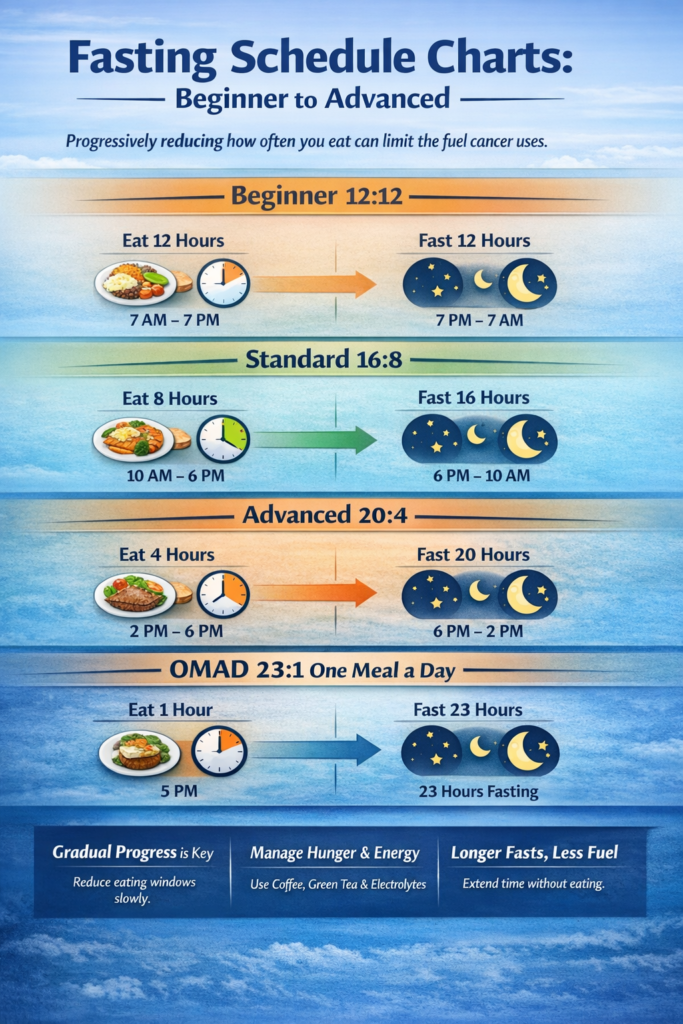
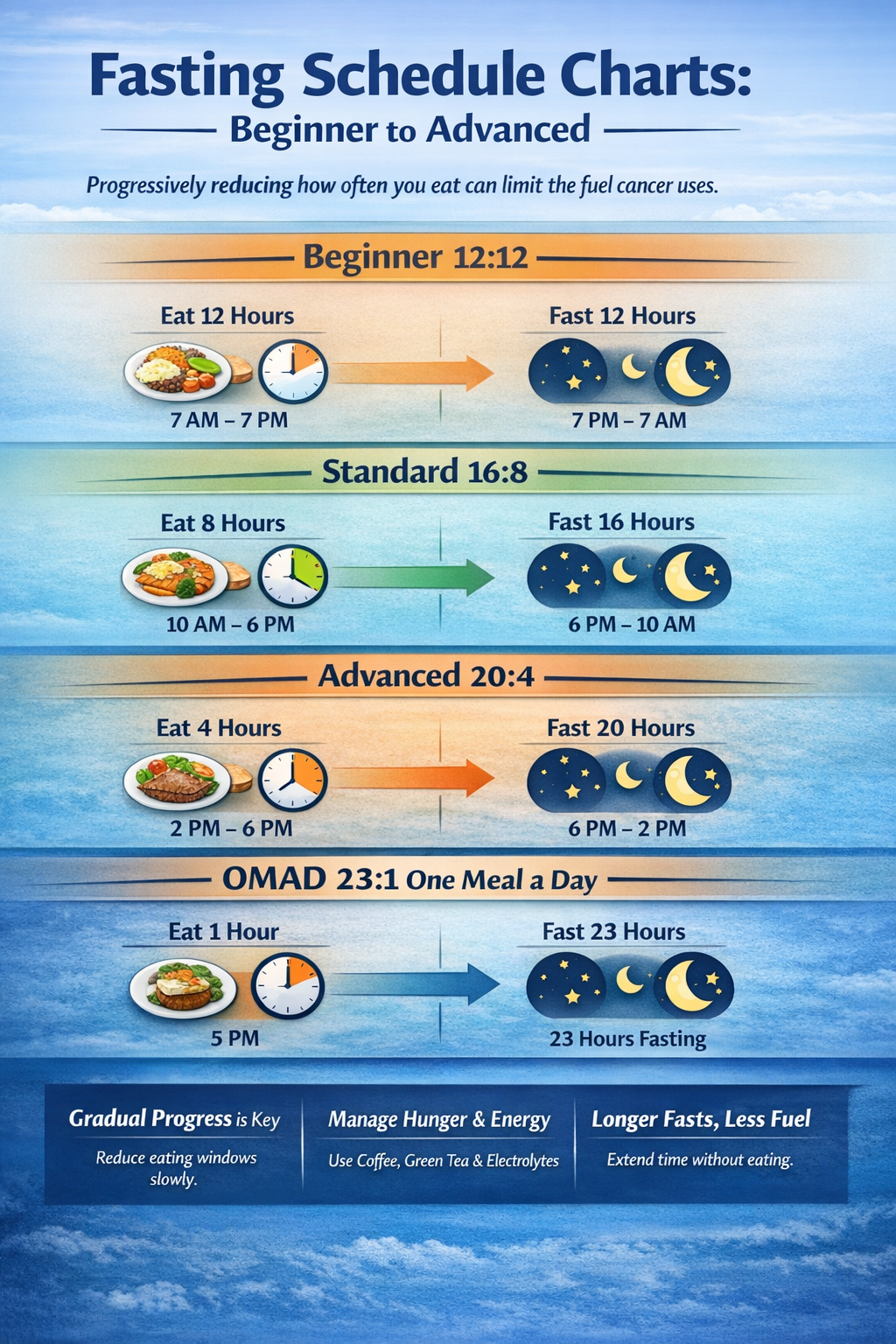
Beginner Fasting Schedule (12:12)
Eating Window: 12 hours
Fasting Window: 12 hours
Example
- Eat: 7 AM – 7 PM
- Fast: 7 PM – 7 AM
Why This Works
- Easy starting point
- Builds routine
- Introduces fasting without stress
Early Progression (14:10)
Eating Window: 10 hours
Fasting Window: 14 hours
Example
- Eat: 8 AM – 6 PM
- Fast: 6 PM – 8 AM
What Changes
- Less late-night eating
- Slightly longer fat-burning window
- Reduced insulin exposure
Standard Intermittent Fasting (16:8)
Eating Window: 8 hours
Fasting Window: 16 hours
Example
- Eat: 10 AM – 6 PM
- Fast: 6 PM – 10 AM
Why This Is Popular
- Sustainable
- Noticeable metabolic benefits
- Helps reduce snacking
Advanced Fasting (18:6)
Eating Window: 6 hours
Fasting Window: 18 hours
Example
- Eat: 12 PM – 6 PM
- Fast: 6 PM – 12 PM
What Happens Here
- Longer low-fuel periods
- More metabolic pressure
- Hunger becomes more controlled
Two-Meal Structure (20:4)
Eating Window: 4 hours
Fasting Window: 20 hours
Example
- Eat: 2 PM – 6 PM
- Fast: 6 PM – 2 PM
Key Benefit
- Very limited feeding window
- Strong reduction in daily fuel exposure
OMAD (One Meal a Day)
Eating Window: 1–2 hours
Fasting Window: ~22–23 hours
Example
- Eat: 5 PM
- Fast: Remaining 23 hours
Why OMAD Is Powerful
- Only one fuel intake per day
- Long period with no incoming energy
- Forces reliance on stored energy
Simple Insight
Eat once → fuel spike
Fast long → fuel stays low
What is the best fasting schedule for cancer support?
The best fasting schedule is one that gradually reduces eating frequency over time, starting with 12 hours and progressing toward longer fasting windows like 16:8 or OMAD, while maintaining energy and stability.
Visual Progression Summary
Fasting Progression Ladder
| Level | Schedule | Fasting Hours |
|---|---|---|
| Beginner | 12:12 | 12 hours |
| Early | 14:10 | 14 hours |
| Standard | 16:8 | 16 hours |
| Advanced | 18:6 | 18 hours |
| High Control | 20:4 | 20 hours |
| OMAD | 23:1 | 22–23 hours |
How to Progress Safely
Step-by-Step Approach
- Start with 12:12
- Move to 14:10 after a few days
- Progress to 16:8
- Hold for 1–2 weeks
- Slowly extend further if tolerated
Key Rule
Only increase fasting time when:
- Energy is stable
- Hunger is manageable
- Weight loss is controlled
Understanding Hunger (Ghrelin)
Hunger is controlled by a hormone called ghrelin.
It works like a schedule.
What Happens Over Time
- Hunger spikes at usual eating times
- If ignored, it fades
- Over weeks, it becomes weaker
Simple Truth
Hunger adapts.
It is not permanent.
Tools That Make Fasting Easier
Coffee
- Helps reduce appetite
- Makes fasting easier
Green Tea
- Supports metabolism
- Mild appetite control
Sugar-Free Electrolytes
- Prevent fatigue
- Support hydration
MCT Oil (Use Carefully)
- Provides energy without glucose
- Can help extend fasting
Limit to about 3 tablespoons per day.
Common Mistakes
- Trying to go too fast
- Ignoring hydration
- Overeating during eating window
- Not controlling carbs
How This Connects to Your Strategy
Fasting works best with:
- Low-carb nutrition
- Controlled protein intake
- Pathway inhibition
Learn more:
https://helping4cancer.com/how-food-feeds-cancer-autophagy-pathways/
Important Safety Note
Do not push fasting if experiencing:
- Rapid weight loss
- Muscle loss
- Weakness
See:
https://helping4cancer.com/cancer-cachexia-muscle-loss-recovery-meals/
Simple Takeaway
- Start simple
- Progress slowly
- Let the body adapt
- Reduce how often you eat
One-Line Summary
Fasting works by reducing how often fuel enters the body, creating longer periods where cancer has fewer resources to use.