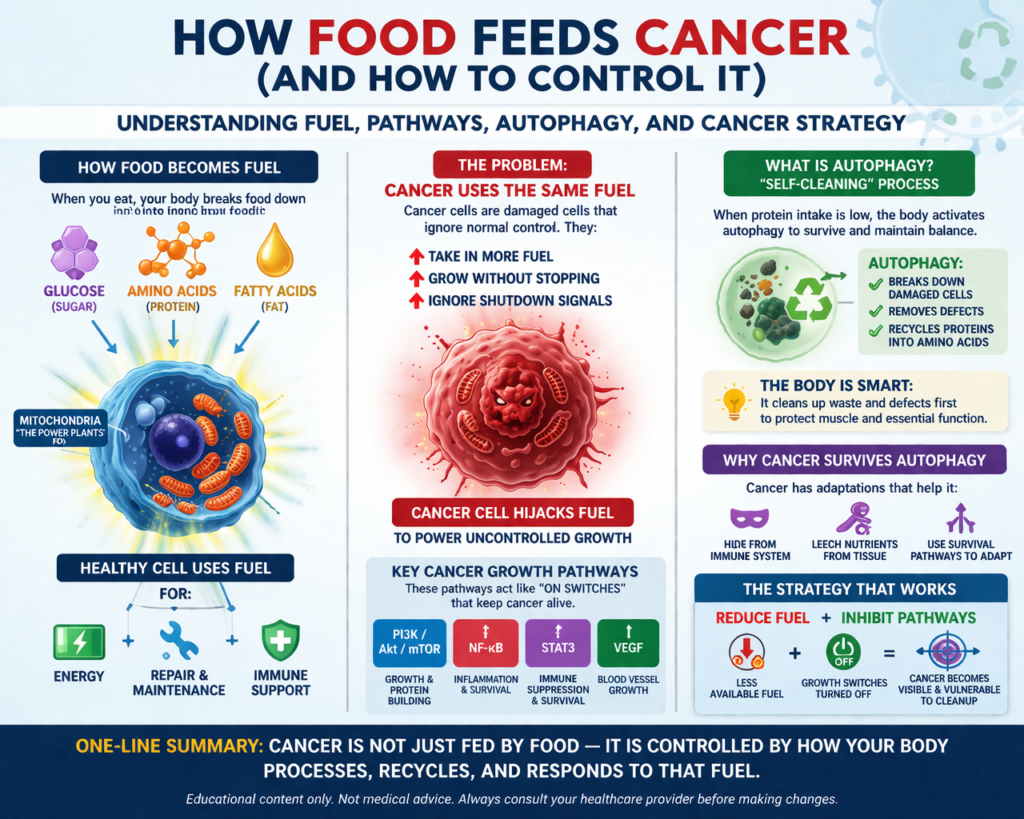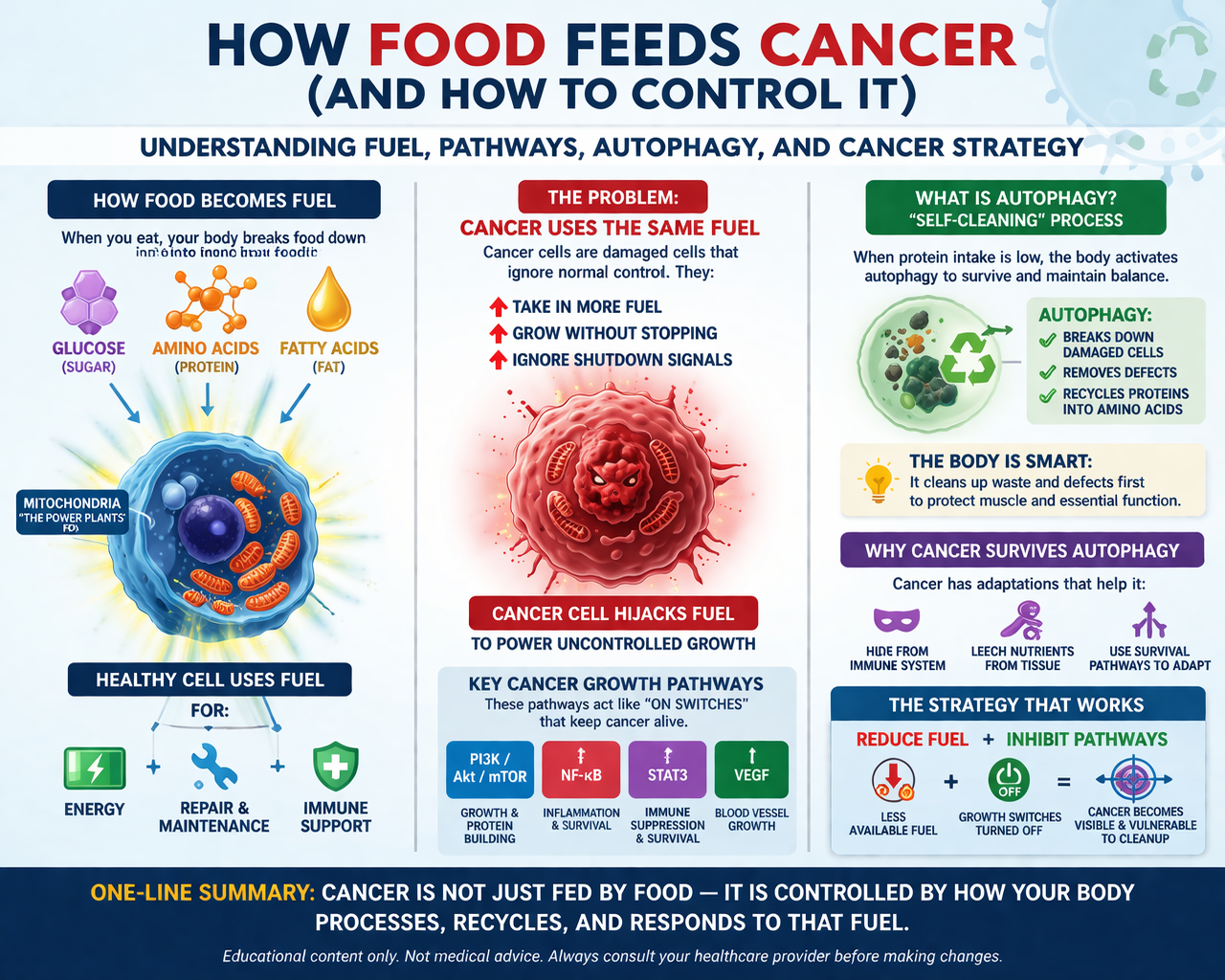
Understanding Fuel, Pathways, Autophagy, and Cancer Strategy
What This Page Explains
Every time you eat, your body turns food into fuel.
That fuel is used inside your cells by tiny structures called mitochondria — the “power plants” that create energy.
But here is the problem:
Cancer cells use the same fuel — but in a broken, uncontrolled way.
This page explains:
- How food fuels cells
- How cancer hijacks that fuel
- What happens during low protein intake
- What autophagy really is
- Why cancer can survive it
- Why strategy (not just diet) matters
How Food Becomes Fuel
When you eat, your body breaks food into:
- Glucose (sugar)
- Amino acids (protein)
- Fatty acids (fat)
These are used to:
- Create energy
- Build and repair tissue
- Support immune function
This system is what keeps you alive.
The Problem: Cancer Uses the Same System
Cancer is not separate from your body.
It is made from your own cells — but with damaged control systems.
Cancer cells:
- Take in more fuel than normal cells
- Grow without stopping
- Ignore shutdown signals
- Use survival pathways to stay alive
So when you eat, you are feeding both healthy cells and cancer cells.
The Real Control System: Pathways
Cancer growth is controlled by signaling pathways.
These are like switches that tell cells:
- Grow
- Survive
- Repair
- Shut down
Key pathways include:
- PI3K / Akt / mTOR (growth and protein building)
- NF-κB (inflammation and survival)
- STAT3 (immune suppression and survival)
- VEGF (blood vessel growth)
If these pathways stay active:
Cancer can keep growing even under stress
Simple Way to Understand It
- Food = fuel
- Pathways = control switches
- Cancer = broken system that won’t turn off
👉 If switches are ON → cancer uses the fuel
👉 If switches are OFF → cancer struggles to survive
Protein: The Most Important and Most Misunderstood Fuel
Protein becomes amino acids.
Your body uses amino acids to:
- Repair tissue
- Build muscle
- Support immune cells
But cancer also uses amino acids to grow.
What Happens When Protein Intake Drops
When protein intake drops below basic needs
(around 0.36 grams per pound / 0.8 g per kg):
The body enters a survival mode.
Instead of immediately breaking down muscle, the body begins:
Autophagy
What Is Autophagy (Simple Explanation)
Autophagy means:
“self-cleaning”
It is a natural process where the body:
- Breaks down damaged cells
- Removes defective components
- Recycles proteins into amino acids
This process exists because:
Humans would not survive if muscle was always the first thing destroyed during food scarcity
Instead, the body is designed to:
👉 Clean up waste and defects first
👉 Preserve essential function as long as possible
Autophagy is a natural survival system that helps maintain balance inside the body
Important Reality: The Body Is Smart — But Not Perfect
Autophagy is powerful.
But cancer has evolved ways to survive it.
Cancer can:
- Hide from immune detection
- Use autophagy to recycle its own nutrients
- Pull nutrients from surrounding tissue
- Adapt to low nutrient environments
In fact, research shows autophagy can sometimes help cancer survive under stress conditions
The Critical Problem
Protein Deficit Alone Is Not Enough
If you reduce protein without controlling pathways:
- The body releases amino acids
- Cancer can use those amino acids
- Cancer adapts and survives
👉 This is where many people get it wrong
Cancer Cachexia: The Dangerous Version of This Process
Cancer cachexia is a serious condition.
It involves:
- Muscle loss
- Weight loss
- Metabolic dysfunction
And most importantly:
👉 The body breaks down muscle even when food is present
This is not normal fasting or autophagy.
It is a disease-driven state.
Research shows cachexia involves:
- Increased protein breakdown
- Activation of autophagy in muscle
- Systemic inflammation signals from tumors
Tumors can even send signals (like IL-6) that:
👉 Increase autophagy and accelerate muscle loss
🔗 Learn More About Cachexia
Key Difference: Controlled vs Uncontrolled Breakdown
| Situation | What Happens |
|---|---|
| Controlled protein deficit | Cleanup (autophagy) |
| Cancer cachexia | Muscle wasting |
| No pathway control | Cancer adapts and survives |
| Pathway inhibition | Cancer becomes vulnerable |
Why Cancer Escapes Natural Cleanup
Cancer survives because it can:
- Hide from immune detection
- Activate survival pathways
- Use surrounding tissue as fuel
- Adapt to stress conditions
So even during autophagy:
👉 Cancer may not be removed
👉 It may actually survive better
The Missing Piece: Pathway Inhibition
To make a protein deficit effective:
You must also reduce cancer’s ability to use fuel.
This means:
- Turning down growth pathways
- Increasing stress on cancer cells
- Making cancer visible to the immune system
What Happens When You Combine Both
Protein Deficit + Pathway Control
This creates a very different environment:
- Less available fuel
- Reduced growth signaling
- Increased cellular stress
- Improved immune recognition
👉 Now damaged and abnormal cells become easier to break down
Simple Analogy
Think of cancer like a system that is out of control:
- Fuel = food
- Pathways = control switches
If you only reduce fuel:
The system slows, but still runs
If you reduce fuel AND shut off switches:
The system breaks down
Why Strategy Matters More Than Diet Alone
Eating less protein is not the strategy.
Eating “healthy” is not the strategy.
The real strategy is:
- Controlling pathways
- Managing fuel availability
- Supporting immune function
- Preventing cancer from adapting
What This Means Moving Forward
This page is the foundation.
From here, everything else makes sense:
- Why protein is calculated by body weight
- Why iron matters differently
- Why meals are structured carefully
- Why timing and combinations matter
Simple Takeaway
- Food fuels all cells
- Cancer uses that fuel differently
- Protein restriction activates cleanup (autophagy)
- Cancer can survive that cleanup
- Cachexia is dangerous uncontrolled breakdown
- Strategy requires BOTH:
- Controlled nutrition
- Pathway inhibition
One-Line Summary
Cancer is not just fed by food — it is controlled by how your body processes and responds to that fuel.
Educational Note
This content is for educational purposes only and not medical advice. Always consult your healthcare provider before making dietary or treatment changes.