People Also Ask About Resistant Starch and Colon Health
As gut microbiome and colon cancer research grows, many people are asking:
- What is resistant starch?
- How does resistant starch help colon health?
- Does resistant starch reduce colon cancer risk?
- What foods are high in resistant starch?
- Why are cooked and cooled potatoes healthier?
- Does resistant starch feed beneficial gut bacteria?
- What is butyrate?
- How does resistant starch affect the microbiome?
- Can resistant starch improve insulin sensitivity?
- Is resistant starch good for blood sugar control?
- What is the difference between resistant starch and regular starch?
- Does resistant starch help inflammation?
- Can resistant starch support the gut barrier?
- Are green bananas healthy for the microbiome?
- Is cooled rice healthier than freshly cooked rice?
Researchers are increasingly studying how resistant starch may support short-chain fatty acid production, gut barrier integrity, microbiome diversity, inflammation control, and long-term colon health.
Resistant Starch and Colon Health
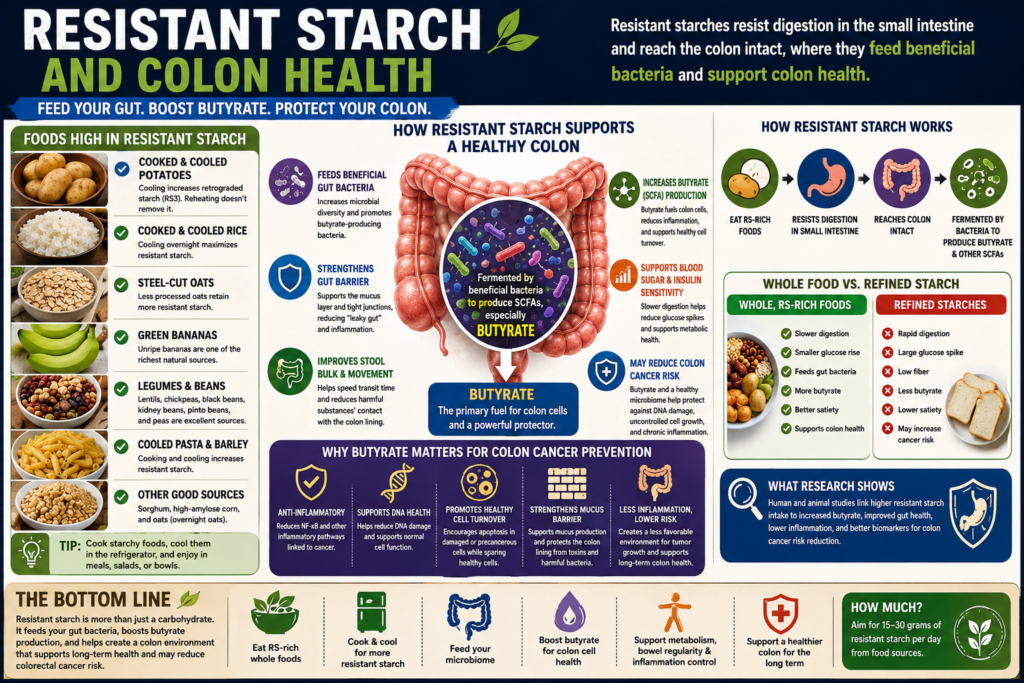
Resistant starch is a special type of carbohydrate that resists digestion in the small intestine and reaches the colon mostly intact.
Instead of being rapidly broken down into glucose, resistant starch becomes food for beneficial gut bacteria.
That makes resistant starch very different from many refined carbohydrates.
Researchers are increasingly studying resistant starch because it may help:
- Feed beneficial gut bacteria
- Increase butyrate production
- Support the gut barrier
- Reduce inflammation
- Improve stool bulk
- Support insulin sensitivity
- Improve blood sugar regulation
- Support the mucus lining of the colon
These effects are important because colon cancer is strongly connected to inflammation, microbiome disruption, metabolic dysfunction, insulin resistance, and gut barrier health.
Resistant starch is not a cancer cure.
But it may help create a healthier environment inside the colon.
What Is Resistant Starch?
Most starches are quickly broken down into glucose during digestion.
Resistant starch behaves differently.
It “resists” digestion in the small intestine and passes into the colon where gut bacteria ferment it.
This fermentation process produces beneficial compounds called short-chain fatty acids.
The most important short-chain fatty acid for colon health is butyrate.
This is one reason resistant starch is receiving so much attention in colon health research.
Why Resistant Starch Is Different From Refined Carbohydrates
Refined carbohydrates are often rapidly absorbed.
This can lead to:
- Fast glucose spikes
- Large insulin responses
- Energy crashes
- Hunger soon after eating
- Greater metabolic stress over time
Resistant starch behaves differently because much of it bypasses rapid digestion.
Instead of becoming a fast glucose load, resistant starch becomes fuel for the microbiome.
That changes how the body and colon experience the carbohydrate.
In simple terms:
Refined carbohydrates mostly feed rapid glucose absorption.
Resistant starch mostly feeds beneficial bacteria.
Resistant Starch Feeds Beneficial Gut Bacteria
One of resistant starch’s biggest benefits is its effect on the gut microbiome.
Beneficial bacteria ferment resistant starch and produce short-chain fatty acids.
This may help support:
- More microbial diversity
- More butyrate-producing bacteria
- Better gut barrier integrity
- Lower inflammation
- Healthier colon cells
- A more stable colon environment
A low-fiber, low-resistant-starch diet may reduce these beneficial microbial activities over time.
Resistant Starch and Butyrate
Butyrate is one of the most important compounds in colon health research.
Butyrate is produced when beneficial bacteria ferment resistant starch and certain fibers.
Healthy colon cells use butyrate as a major fuel source.
Researchers are studying butyrate because it may help:
- Support colon cell energy
- Reduce inflammatory signaling
- Strengthen the gut barrier
- Support the mucus lining
- Support normal cell turnover
- Influence immune regulation
- Help regulate abnormal cell growth pathways
Butyrate may be one of the biggest reasons resistant starch is connected to colon health research.
Resistant Starch and Colon Cancer Research
Researchers are studying resistant starch because many of its effects overlap with pathways involved in colorectal cancer risk.
Some studies suggest resistant starch may help support:
- Lower inflammation
- Better gut barrier function
- Higher butyrate production
- Better stool movement
- Healthier microbiome diversity
- Lower DNA damage markers
- Improved metabolic health
Animal studies often show strong protective effects.
Human studies are promising but more complex.
Some human research shows resistant starch may improve biomarkers connected to colon health and reduce harmful metabolites in the colon.
Other studies show benefits may depend on:
- The type of resistant starch
- Existing microbiome health
- Fiber intake
- Overall diet quality
- Genetics
- Obesity status
- Gut bacteria composition
Researchers still need larger long-term human trials.
But mechanistically, resistant starch strongly supports many pathways associated with colon protection.
Resistant Starch and the Gut Barrier
The gut barrier helps separate the contents of the intestine from the bloodstream.
A stronger barrier may help reduce:
- Inflammation
- Bacterial toxin leakage
- Immune overactivation
- Gut irritation
Resistant starch may support the gut barrier indirectly through butyrate production.
Butyrate helps strengthen tight junction proteins and support the mucus lining of the colon.
This is important because gut barrier dysfunction and chronic inflammation are increasingly linked with colorectal cancer development.
Resistant Starch and Blood Sugar
Resistant starch may also help improve blood sugar regulation.
Because it resists digestion, resistant starch often causes a slower glucose response compared to rapidly absorbed refined starches.
Some studies suggest resistant starch may help:
- Improve insulin sensitivity
- Lower post-meal glucose spikes
- Improve metabolic flexibility
- Support fullness
- Reduce metabolic overload
This matters because obesity, insulin resistance, type 2 diabetes, and metabolic syndrome are linked with higher colorectal cancer risk.
Resistant Starch and Inflammation
Chronic inflammation is one of the biggest themes in colon cancer research.
Resistant starch may help reduce inflammation through several pathways:
- Increased butyrate production
- Better microbiome balance
- Stronger gut barrier integrity
- Improved stool movement
- Improved metabolic health
- Lower insulin resistance
Researchers are especially interested in how butyrate may influence inflammatory pathways such as NF-κB and immune regulation inside the colon.
Resistant Starch and Stool Movement
Resistant starch may also improve stool bulk and bowel movement regularity.
This matters because healthy stool movement may help:
- Reduce constipation
- Improve transit time
- Reduce colon irritation
- Reduce prolonged exposure to waste products
- Support a healthier bowel environment
A healthier stool environment may support long-term colon health.
Foods High in Resistant Starch
Some of the best resistant starch foods include:
- Cooked and cooled potatoes
- Cooked and cooled rice
- Steel-cut oats
- Overnight oats
- Green bananas
- Green plantains
- Lentils
- Chickpeas
- Black beans
- Pinto beans
- Kidney beans
- White beans
- Peas
- Cooked and cooled pasta
- Barley
- Sorghum
Cooking and cooling starchy foods increases a form called retrograded starch, which behaves as resistant starch.
Interestingly, reheating after cooling usually does not completely remove the resistant starch.
Why Cooked and Cooled Foods Matter
When foods like potatoes or rice are cooked and then cooled, some of the starch changes structure.
This process is called retrogradation.
Retrograded starch becomes harder for the body to digest quickly.
That means more of it reaches the colon where gut bacteria can ferment it.
This is why cooled potatoes and cooled rice often behave differently metabolically than freshly cooked versions.
Resistant Starch and the Modern Diet
Many modern diets are low in resistant starch.
Ultra-processed foods often contain refined starches that digest rapidly but provide little support for the microbiome.
Historically, humans likely consumed far more naturally resistant starch through:
- Legumes
- Whole plant foods
- Less processed starches
- Naturally cooled foods
- Less refined grains
Researchers believe the decline in resistant starch and fermentable fiber intake may contribute to:
- Lower butyrate production
- Less microbial diversity
- More inflammation
- Worse insulin sensitivity
- Weaker gut barrier integrity
This may be one reason resistant starch is now receiving major attention in microbiome and colon cancer research.
Practical Ways to Add Resistant Starch
Simple ways to add resistant starch include:
- Make overnight oats
- Cool potatoes after cooking
- Use cooled rice in bowls or salads
- Add beans or lentils to meals
- Eat green bananas or green plantains
- Add chickpeas to salads
- Include legumes several times per week
Start slowly if your diet has been low in fiber.
Increasing resistant starch too quickly may cause gas or bloating while the microbiome adapts.
The Bigger Picture
Resistant starch may support colon health through several overlapping mechanisms.
It may:
- Feed beneficial bacteria
- Increase butyrate production
- Improve stool movement
- Support the mucus lining
- Strengthen gut barrier integrity
- Reduce inflammation
- Improve insulin sensitivity
- Support blood sugar regulation
- Support a healthier metabolic environment
This is why resistant starch is more than “just another carbohydrate.”
It behaves differently inside the body and colon.
Final Thoughts
Resistant starch is one of the most interesting areas in microbiome and colon cancer research because it helps connect food, gut bacteria, metabolism, inflammation, and colon health together.
Instead of acting like a rapidly absorbed refined carbohydrate, resistant starch becomes fuel for beneficial bacteria and supports butyrate production inside the colon.
Foods such as cooked and cooled potatoes, cooled rice, steel-cut oats, green bananas, legumes, beans, and cooled pasta may help support a healthier gut environment when included as part of an overall fiber-rich diet.
Colon cancer prevention is never about one food alone.
But resistant starch appears to support many of the same pathways linked to long-term colon protection, including microbiome diversity, gut barrier integrity, stool movement, inflammation control, and metabolic health.
Internal Links
- Colon Cancer Reduction: Metabolic Health, Gut Health, and Lifestyle Factors
- The Gut Microbiome and Colon Health
- Fiber and Colon Cancer Prevention
- Ultra-Processed Foods and Colon Cancer
- Akkermansia muciniphila and Colon Cancer
- Butyrate and Colon Health
- Gut Barrier Integrity and Colon Health
- Insulin Resistance and Colon Cancer
- Obesity and Colon Cancer
- Hypoxia and HIF-1α in Cancer
External Authority Sources
- NIH / PubMed Central: Resistant Starch and Colorectal Cancer — Review discussing resistant starch, butyrate production, inflammation control, microbiome changes, and colorectal cancer protection mechanisms.
- NIH / PubMed Central: Butyrate and Colon Health — Scientific review explaining how butyrate supports colon cells, gut barrier integrity, inflammation regulation, and colorectal cancer biology.
- Cambridge University Press: Resistant Starch and WNT Signaling — Research exploring how resistant starch and butyrate may influence WNT/β-catenin signaling pathways linked to colorectal cancer growth.
- NIH / PubMed Central: Resistant Starch and the Gut Microbiome — Review covering resistant starch fermentation, microbiome diversity, short-chain fatty acid production, and metabolic health.
- American Cancer Society: Diet and Colorectal Cancer Prevention — Evidence-based guidance on diet, body weight, physical activity, and lifestyle factors connected to colorectal cancer prevention.
Medical Disclaimer
This article is for educational and informational purposes only and is not medical advice. It does not diagnose, treat, cure, or prevent any disease. Always speak with a qualified healthcare professional about colon cancer risk, digestive symptoms, diet changes, resistant starch intake, supplements, screening, or medical treatment decisions.